
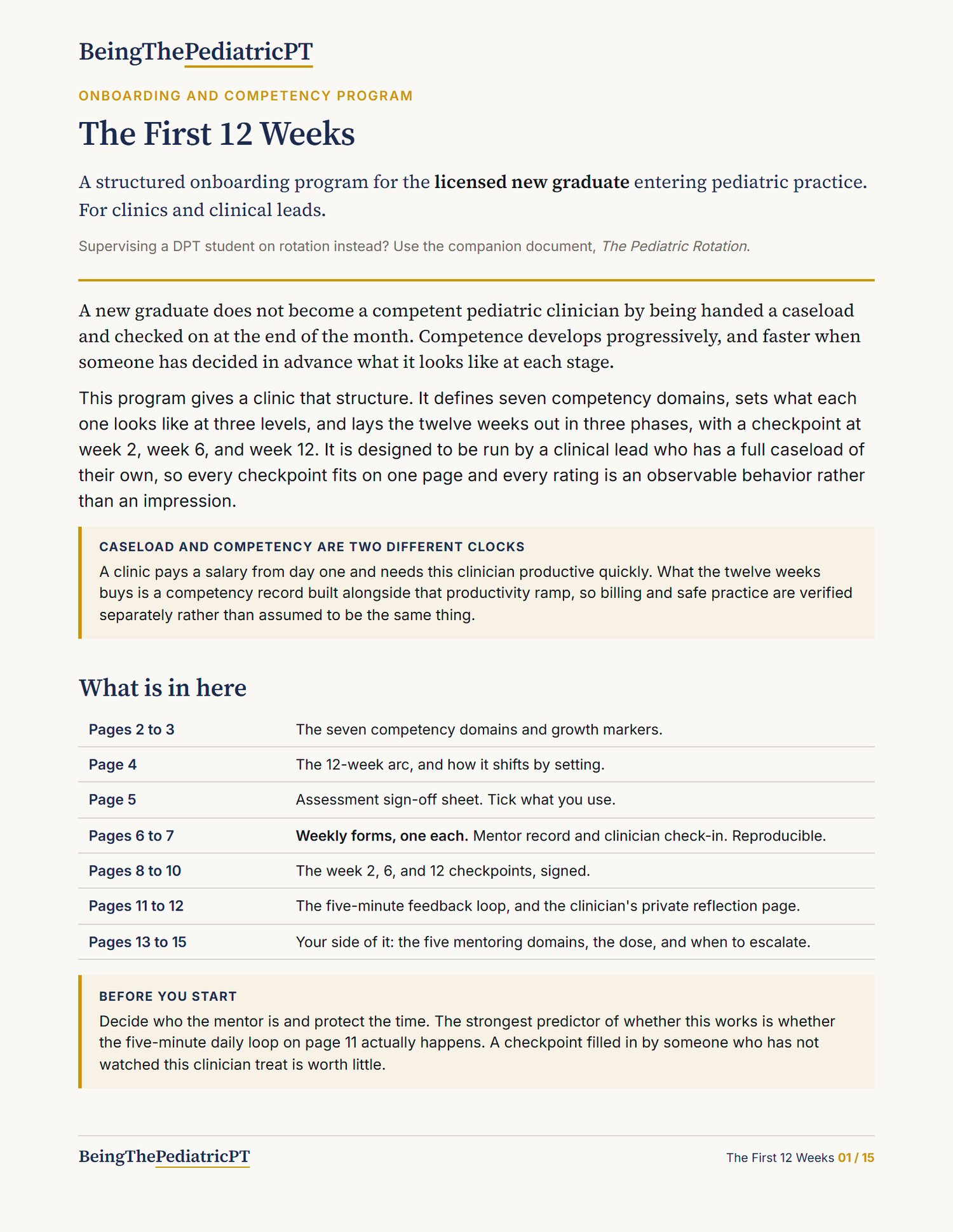
The First 12 Weeks: Pediatric Onboarding and Competency Program
WHO THIS IS FOR
You run a pediatric clinic or lead its clinicians, and you have just hired a new graduate. You need them safe and productive, and you need a record that those two things were verified separately rather than assumed.
WHY IT WORKS
A new graduate does not become competent by being handed a caseload and checked on at the end of the month. This program separates two clocks that usually get confused: the productivity ramp the clinic needs, and the competency record that says this person is safe to practice with appropriate consultation.
It is built to be run by a clinical lead who already carries a full caseload. Every checkpoint fits on one page. Every rating points at an observable behavior rather than an impression, which is what makes a record fair in remediation and defensible if anyone ever reviews it.
It is also honest about what it is not. An accredited residency provides at least 150 hours of one-to-one mentoring across roughly a year. This delivers about 30 to 40 hours across twelve weeks. It is structured onboarding, not a residency. The comparison that matters is not a residency, which most new graduates never get. It is the nothing-in-particular that most of them do get.
WHAT IS INSIDE
Seven competency domains, a three-level behavioral rating scale, and the four growth markers that predict trajectory better than any single session can.
The twelve-week arc in three phases, and how it shifts by setting: school-based starts on day one because the caseload is already tied to IEPs, hospital-based outpatient runs 8 to 12 weeks, home health and early intervention take two to three months.
A 72-tool assessment sign-off sheet you tick down to your own battery, so solo evaluations wait on the tools this clinic actually uses being signed off.
A weekly progress record for the mentor and a weekly check-in for the clinician, covering the same week and compared at each gate. Where the two disagree is the conversation worth having.
Checkpoints at the end of weeks 2, 6 and 12, signed, each with two legitimate outcomes rather than a pass and a fail.
The five-minute daily feedback loop, with a worked example. The clinician's private reflection page. And your own side of it, mapped to the five domains of mentoring competence in APTA's 2025 guide, with how much mentoring time each phase actually takes.
WHO IT IS FOR
Pediatric clinic owners and managers, clinical leads, and mentors responsible for a new graduate's first twelve weeks in pediatrics.
15 pages, PDF. A fillable edition is included, so the weekly forms and checkpoints can be typed into and saved rather than printed.
SUPERVISING A DPT STUDENT INSTEAD?
The Pediatric Rotation is the companion guide. Same seven competency domains, built for a placement rather than a job.
YOUR LICENSE
This program is licensed to you as an individual mentor or clinical lead. You may print or reproduce any page, in any quantity, for the clinicians you personally mentor. The forms are meant to be copied rather than rationed.
Clinic-wide use is a separate license. Reproducing it for mentors you do not supervise, hosting it on an intranet or learning management system, or running it as your organization's standard onboarding program is not covered here. For that, contact drky@beingthept.com.
TERMS OF USE
Professional education for licensed clinicians and clinicians in training. Not clinical advice for any individual patient. Your program, employer, state practice act and payer rules govern your practice. This product carries no CEU, no certification, and no accreditation.