
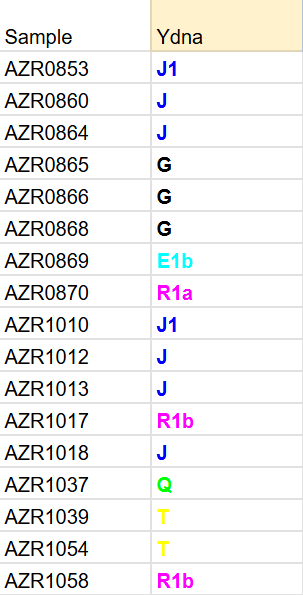
Azeri.HO 17 samples 23andme format
The deep roots of the Azeris reach back to the Bronze Age Kura-Araxes culture. These early communities practiced mixed farming and pastoralism, built distinctive mudbrick architecture, and produced dark burnished pottery that became a hallmark of the region.
During the Late Bronze and Iron Ages, the region came increasingly into contact with Indo-European–speaking groups. Influences flowed first from Anatolia, through interactions with Hittite and later Anatolian cultures, and then more decisively from the Iranian plateau. By the early first millennium BC, Iranian-speaking peoples such as the Medes were active in the South Caucasus. Under empires like the Achaemenid Empire, the area was integrated into wider imperial networks. Over time, much of the local population adopted Iranian languages and cultural forms, contributing to the Iranian linguistic layer that preceded Turkicization. The very name “Azerbaijan” derives from Old Iranian Āturpātakān, meaning “Land of Atropates”. This evolved into Middle Persian Ādurbādagān and eventually Azerbaijan.
A dramatic transformation occurred beginning in the 11th century with the arrival of Oghuz Turkic tribes under the Seljuk Empire. These migrations introduced a Turkic language that gradually replaced the earlier Iranian dialects in much of the population. Importantly, this was more a process of linguistic and elite dominance than wholesale population replacement. The Azerbaijani language today is Turkic in structure and vocabulary core, yet it preserves heavy Persian and Arabic influence in literature, administration, and culture—reflecting centuries under Persianate states such as the Safavid Empire, founded by Shah Ismail I, himself of mixed Turkic and Iranian background and closely tied to Azerbaijan.
The majority of the world’s Azeris actually live in northwestern Iran, often called Iranian Azerbaijan, centered on cities like Tabriz. They have played major roles in Iranian political and intellectual life. For example, Mir-Hossein Mousavi, a former Prime Minister of Iran, is of Azerbaijani origin. In the cultural sphere, the celebrated singer Googoosh, one of Iran’s most iconic pop figures, also comes from an Azerbaijani background.
For this video, I’ve gathered the raw genomes of 17 ethnic Azerbaijanis from Reich Lab’s official v62 dataset using plink. I used academic tools, such as admixtools 1 and 2, but also amateur tools, like my trait predictor, to analyze their genetics.