
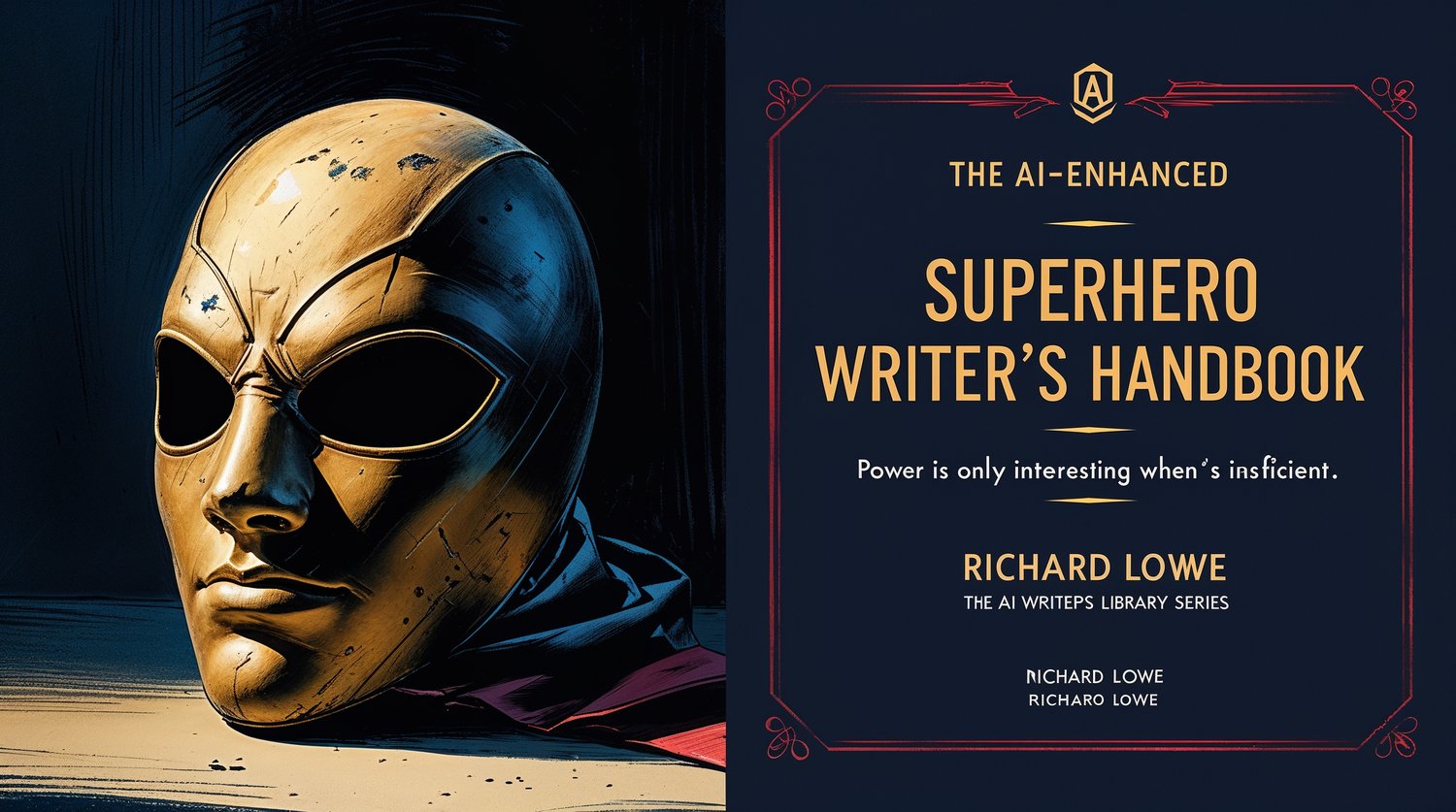
AI-Enhanced Superhero Writer's Handbook
I found Iron Man at Arts Book Store in San Bernardino when I was seven years old. I spent the next several years working through every Marvel title I could find.
Then I watched the MCU prove the same point over fifty years of reading had been building toward.
Phase I was nearly perfect. Films that understood their characters well enough to put them under genuine pressure. Phase II started slipping. Phase III turned into event management. Phase IV abandoned the question that makes the genre work almost entirely. What's being produced now isn't superhero fiction. It's brand maintenance with superhero aesthetics.
The collapse is instructive. The MCU didn't run out of budget or talent. It ran out of writers willing to ask: what does this cost the person who has to do it? When that question disappears, you get spectacle audiences watch and don't think about again. When it's present, you get stories that make people cry about a man in a bat suit.
This handbook is about the difference between those two outcomes and how to produce the first one deliberately.
What You're Getting
19 chapters and 10 case studies from a 113-book author who has been reading superhero comics since 1965 and watched the genre produce its best and worst work across six decades.
✅ The Villain as Argument — The villain right about the problem and wrong about who has the right to solve it. How to build an antagonist the story can't dismiss.
✅ The Nemesis — Not the dark mirror, not the arch-enemy. The opponent whose existence is an argument about the hero specifically — and what the hero loses when it's over.
✅ Powers and Their Cost — A power without cost is a fantasy. A power with cost is a character. The quiet unanticipated cost, not the dramatic one.
✅ Collateral Damage and Public Trust — What power owes to the specific person who was the number on the wrong side of the calculation.
✅ The Secret Identity — The cost of maintaining two lives in the same body, the person who almost knows, and what happens when the structure collapses.
✅ Moral Compromise and the Greater Good — The line that sounds clear in the abstract, and what it looks like when the cost of holding it is specific and immediate.
✅ The Dark Mirror — The hero with a different answer to the same question — and why the answer is comprehensible, which is what makes it terrible.
✅ Government, Institutions, and Registration — Both cases simultaneously true and the hero has to decide anyway.
✅ 228+ AI Prompts — Real-world research grounding: trauma psychology in first responders, how law enforcement coordinates major incidents, how public trust is built and lost. The texture that makes the fantasy feel true.
✅ Plus 11 more chapters covering The Origin Story, The Team, The Mentor and Legacy, The Civilian Life, The Reluctant Hero, The Retired Hero, Love and the Superhero, Redemption and the Reformed Villain, Death and Resurrection, The World Without Heroes, and Antagonists: The Institution That Makes Heroes Necessary.
10 Case Studies
- Watchmen — The villain whose argument the story cannot dismiss
- The Dark Knight — Batman is the protagonist but Harvey Dent is the subject
- The Boys — The genre contract intact with the subject changed — and what escalation costs
- Spider-Man: Into the Spider-Verse — The best superhero origin story since Watchmen
- Daredevil — The neighborhood as character
- Ms. Marvel — Power cost through identity, humor as craft decision
- Invincible — Physical power described as what it actually feels like
- Superman: Red Son — Alternate history as moral examination
- Misfits — Origin as diagnosis rather than empowerment
- Hannibal — The most rigorous available treatment of the nemesis dynamic on screen
Who This Is For
Superhero • Action • Science Fiction • Fantasy • Thriller
✓ Writers who grew up on comics and want to write fiction that earns what the best of the genre can do
✓ Writers frustrated that their superhero story feels like plot mechanics without weight
✓ Writers who can build the spectacle but can't find the emotional core underneath it
✓ Writers watching the MCU decline and understanding exactly what went wrong
✓ Writers using AI who keep getting generic cape-and-cowl surface instead of grounded character pressure
✓ Anyone who wants to write a villain readers can't stop thinking about
What You Get
📄 Full handbook — instant PDF download
📄 19 chapters covering the complete range of superhero craft
📄 10 deep-dive case studies
📄 228+ AI prompts ready to copy and paste
📄 Lifetime access
30-Day Money-Back Guarantee
If this handbook doesn't change how you approach superhero fiction, request a full refund. No questions. No hassle.
Power is only interesting when it's insufficient. This handbook teaches you to keep it that way.
👉 Click "Buy Now" to get the handbook instantly.