Enterprise-Wide Strategic Alignment
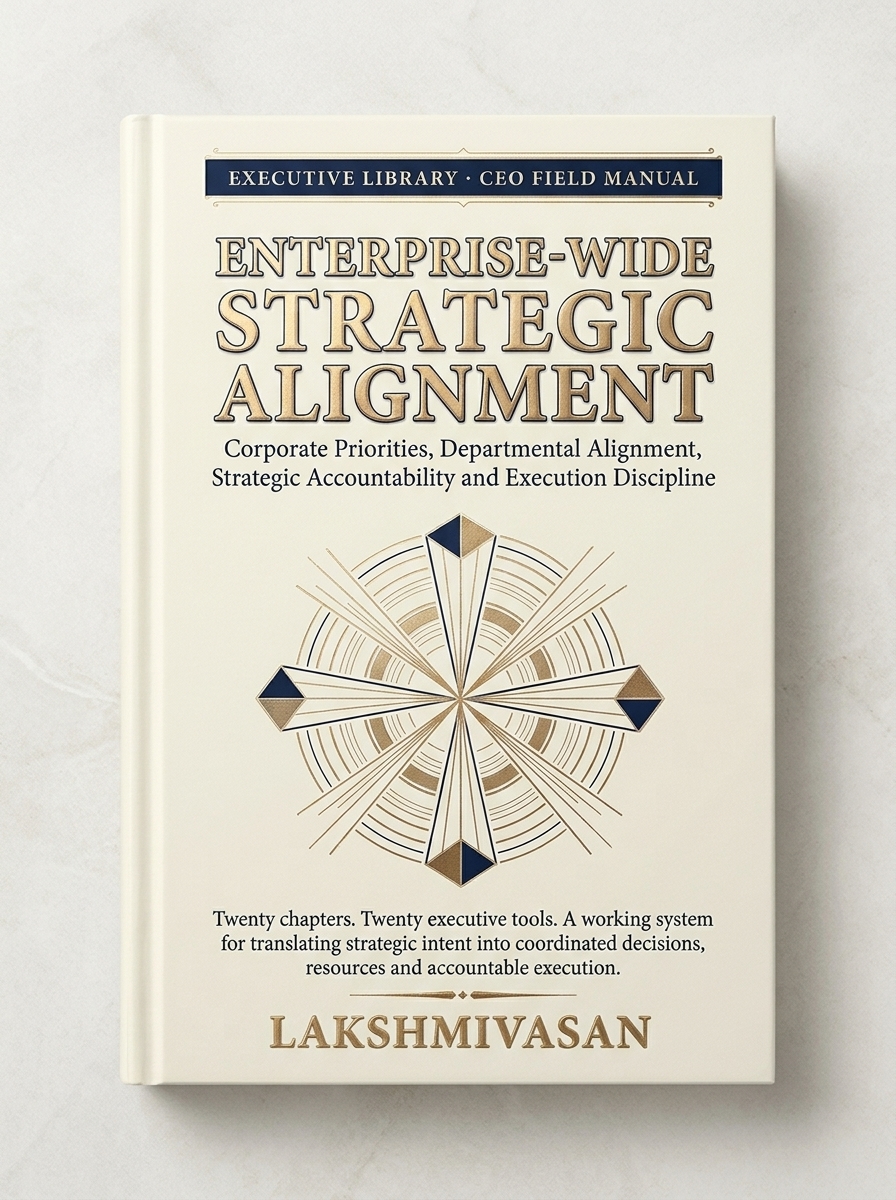
ENTERPRISE-WIDE STRATEGIC ALIGNMENT
CORPORATE PRIORITIES, DEPARTMENTAL ALIGNMENT, STRATEGIC ACCOUNTABILITY AND EXECUTION DISCIPLINE
EXECUTIVE LIBRARY | BY LAKSHMIVASAN
STRATEGY IS ONLY REAL WHEN THE ENTERPRISE CAN ACT ON IT TOGETHER.
A PRACTICAL EXECUTIVE HANDBOOK FOR TURNING CORPORATE PRIORITIES INTO DEPARTMENTAL COMMITMENTS, CLEAR ACCOUNTABILITY AND EXECUTION DISCIPLINE — WITH 20 EDITABLE TOOLS FOR THE MEETINGS WHERE ALIGNMENT IS WON OR LOST.
Organizations develop strategies to establish direction, define priorities and achieve long-term objectives.
However, having a corporate strategy does not automatically mean that the organization is aligned around it.
The CEO may establish a clear strategic direction, but departments may interpret priorities differently. Business units may pursue competing objectives. Functional leaders may allocate resources according to local requirements rather than enterprise priorities. Employees may receive performance targets without understanding how their responsibilities contribute to the organization's strategic objectives.
The result is a gap between strategic intention and organizational execution.
A strategy may be clearly documented at corporate level while remaining fragmented across departments, subsidiaries, leadership teams and operational activities.
Enterprise-Wide Strategic Alignment addresses this management challenge.
It provides a structured executive framework for connecting corporate purpose, strategic priorities, departmental contributions, business unit commitments, executive accountability, resource allocation and performance reviews.
Across 20 chapters and six structured parts, the handbook examines how organizations can translate strategic direction into coordinated action across the enterprise.
It explores the responsibilities of CEOs, executive leadership teams, strategy functions, business unit leaders and departmental heads in ensuring that organizational activities support common corporate priorities.
The handbook addresses important executive questions:
- How should an organization establish a clear enterprise-wide strategic direction?
- How can corporate priorities be translated into measurable departmental commitments?
- How should business units and subsidiaries align their plans with corporate strategy?
- How can executive leadership teams establish common strategic understanding?
- Who should be accountable for each strategic outcome?
- How should responsibilities be distributed across departments?
- How can competing priorities and conflicting objectives be identified?
- How should resources be allocated against enterprise priorities?
- How can strategic communication connect leadership decisions with operational action?
- How should cross-functional dependencies be managed?
- Which KPIs demonstrate strategic progress?
- How can organizations distinguish genuine strategic performance from activity reporting?
- How should strategic risks and execution barriers be addressed?
- What should CEOs review monthly, quarterly and annually?
- How can organizations sustain alignment as priorities, markets and operating conditions change?
The central principle is straightforward:
Enterprise strategy creates value only when organizational priorities, leadership decisions, departmental commitments and available resources work towards common outcomes.
This handbook provides a practical management approach for establishing that connection.
A COMPLETE FRAMEWORK FOR ENTERPRISE-WIDE STRATEGIC ALIGNMENT
FROM CORPORATE DIRECTION TO ORGANIZATIONAL COMMITMENT
Strategic alignment is often treated as a communication exercise.
Corporate objectives are announced, departmental plans are prepared and performance indicators are distributed.
Yet communication alone does not establish alignment.
Departments must understand their contribution. Executives must agree on priorities. Business units must coordinate their objectives. Resources must support the intended direction. Responsibilities must be clear. Progress must be reviewed through a consistent management process.
An effective strategic alignment system connects all these elements.
This handbook organizes enterprise-wide alignment into six interconnected management dimensions.
PART I — DIRECTION AND STRATEGIC CHOICES
Establish the foundations of enterprise-wide alignment.
Understand corporate purpose, vision, mission, strategic direction and corporate priorities.
Examine how organizations define strategic choices, establish priorities and communicate the direction that should guide enterprise decisions.
PART II — ORGANIZATION AND ACCOUNTABILITY
Translate corporate priorities into organizational responsibilities.
Examine departmental alignment, business unit and subsidiary alignment, executive leadership alignment and strategic accountability.
Clarify how different parts of the enterprise contribute to shared strategic outcomes.
PART III — EXECUTION AND MANAGEMENT SYSTEMS
Connect strategic commitments with organizational execution.
Explore strategic implementation, KPIs, resource allocation, strategic communication, performance management and cross-functional collaboration.
Establish management arrangements that convert strategic intent into measurable action.
PART IV — CULTURE, GOVERNANCE AND RISK
Understand the organizational conditions that support or undermine alignment.
Examine strategic culture, decision-making, governance, organizational behaviour, execution risks and leadership accountability.
PART V — DIGITAL SYSTEMS AND STRATEGIC ALIGNMENT
Evaluate how enterprise systems, digital platforms, analytics and artificial intelligence can support strategic decisions and organizational coordination.
Connect technology investments to the actual business decisions and outcomes they are intended to serve.
PART VI — REVIEW AND SUSTAINED ALIGNMENT
Establish a disciplined approach to strategic review and continuous improvement.
Examine CEO leadership, quarterly and annual reviews, organizational learning and the development of long-term enterprise alignment maturity.
Together, these six dimensions provide an integrated executive framework for managing the relationship between corporate strategy and enterprise execution.
WHAT MAKES THIS HANDBOOK DIFFERENT?
IT CONNECTS THE COMPLETE STRATEGIC MANAGEMENT CHAIN.
Many organizations have corporate strategies, departmental plans, business unit objectives and performance dashboards.
The challenge is ensuring that these management elements are connected.
A corporate priority may not have a clearly identified executive owner. A departmental objective may not contribute directly to a corporate outcome. A business unit may pursue a target that conflicts with another unit's priorities. Resources may be committed without considering the enterprise-wide consequences.
This handbook focuses on the connections that make strategic alignment work.
1. PURPOSE, PRIORITY AND CONTRIBUTION ON ONE LINE
Every organizational priority should have a clear connection to the enterprise's strategic direction.
The handbook examines how organizations can connect:
- Corporate purpose and strategic direction.
- Enterprise-wide strategic priorities.
- Business unit contributions.
- Departmental commitments.
- Executive accountability.
- Required resources and capabilities.
- Strategic performance indicators.
- Review evidence and management decisions.
This creates a clearer relationship between what the organization intends to achieve and what its different organizational units are expected to deliver.
2. STRATEGIC TRADE-OFFS MADE VISIBLE
Organizations cannot pursue every opportunity with equal intensity.
Time, management attention, financial resources, workforce capacity and organizational capabilities are limited.
Strategic alignment therefore requires choices.
The handbook examines how executive teams can evaluate competing priorities, identify conflicting commitments, clarify what should receive attention and record which activities may need to be reduced, deferred or discontinued.
Each major priority should establish:
- The strategic outcome being pursued.
- The executive accountable for delivery.
- The organizational units contributing to the outcome.
- The resources required.
- The expected performance evidence.
- The activities or priorities being displaced.
- The conditions that could justify revisiting the decision.
The objective is to make strategic choices explicit rather than allowing competing priorities to remain hidden within departmental plans.
3. DEPARTMENTAL ALIGNMENT WITHOUT DEPARTMENTAL ISOLATION
A corporate objective rarely belongs to only one department.
Growth may require coordination between sales, marketing, operations, finance, technology and human resources.
Customer experience may depend on multiple functions. Digital transformation may require simultaneous changes in processes, systems, capabilities and governance.
The handbook examines how organizations can establish departmental contributions while maintaining enterprise-wide accountability.
It addresses shared outcomes, cross-functional dependencies, business unit alignment, subsidiary alignment and coordination between organizational functions.
4. ACCOUNTABILITY THAT CAN BE REVIEWED
Strategic accountability should not be based on general expectations.
It requires clearly assigned responsibilities, agreed outcomes, measurable indicators and a defined review process.
The handbook examines how organizations can establish strategic ownership at executive, business unit and departmental levels.
It explores responsibility matrices, RACI arrangements, performance commitments, escalation processes and executive review responsibilities.
The objective is to reduce ambiguity about who owns an outcome, who contributes and who must resolve obstacles.
5. RESOURCES CONNECTED TO STRATEGIC PRIORITIES
Strategic priorities require organizational support.
A priority without sufficient funding, people, capabilities or management attention may remain an aspiration.
The handbook examines the relationship between strategic objectives and resource allocation.
It considers how executive teams can evaluate investment requirements, identify resource constraints, manage competing requests and ensure that organizational capacity supports the agreed strategic direction.
6. A REVIEW CADENCE THAT SUPPORTS DECISIONS
Strategic reviews should produce management decisions, not simply presentations.
Monthly reviews, quarterly reviews and annual reviews serve different purposes.
- Monthly reviews examine execution progress, operational barriers and corrective actions.
- Quarterly reviews examine strategic performance, resource requirements, emerging risks and changes in priorities.
- Annual reviews evaluate strategic relevance, organizational performance and the direction for the next planning cycle.
The handbook emphasizes recording decisions, accountable owners, deadlines and follow-up evidence.
7. DIGITAL SYSTEMS CONNECTED TO BUSINESS DECISIONS
Digital tools and AI can support strategic planning, performance monitoring, reporting and organizational coordination.
However, technology should serve a defined management requirement.
The handbook examines how organizations can evaluate digital systems and AI against the business decisions they support, the information they provide, the quality of their data and the governance requirements involved.
The focus is on strategic usefulness rather than technology adoption for its own sake.
WHAT'S INSIDE
20 CHAPTERS ACROSS SIX PARTS OF ENTERPRISE STRATEGIC MANAGEMENT
The handbook progresses from strategic direction to departmental alignment, executive accountability, execution systems, governance and sustained organizational alignment.
PART I — DIRECTION AND STRATEGIC CHOICES
01. Foundations of Enterprise-Wide Strategic Alignment
Understand the meaning, principles and organizational importance of enterprise-wide alignment. Examine the relationship between corporate strategy, organizational objectives, departmental plans, leadership commitments and enterprise performance.
02. Vision, Mission and Strategic Direction
Examine how organizational purpose, vision and mission establish the foundation for strategic choices. Understand how leadership translates long-term ambition into a clear strategic direction that guides organizational priorities and decisions.
03. Corporate Strategic Priorities
Understand how organizations identify, evaluate and establish enterprise-wide strategic priorities. Explore strategic choices, competing demands, prioritization criteria, resource constraints and the importance of defining what the organization will and will not pursue.
04. Strategic Planning and Direction
Examine how strategic direction is translated into organizational plans and management commitments. Explore strategic objectives, planning horizons, strategic initiatives, performance expectations and the relationship between strategy formulation and implementation.
PART II — ORGANIZATION AND ACCOUNTABILITY
05. Departmental Strategic Alignment
Understand how departments translate corporate priorities into functional objectives, plans and measurable commitments. Examine departmental contributions, cross-functional dependencies, conflicting targets and the relationship between local performance and enterprise outcomes.
06. Business Unit and Subsidiary Alignment
Examine how organizations align business units, subsidiaries and operating divisions with corporate strategic direction. Explore common enterprise priorities, business unit autonomy, local operating requirements, performance commitments and governance arrangements.
07. Executive Leadership Alignment
Understand the importance of a unified executive leadership team in supporting enterprise-wide strategic priorities. Examine leadership commitment, shared understanding, decision consistency, competing executive interests and collective accountability for organizational outcomes.
08. Strategic Accountability Framework
Explore how organizations establish strategic ownership and responsibility. Examine executive accountability, departmental commitments, decision rights, performance ownership, escalation arrangements and the management structures needed to maintain accountability.
PART III — EXECUTION AND MANAGEMENT SYSTEMS
09. Strategic Execution and Implementation
Understand how corporate priorities are translated into initiatives, projects, departmental actions and measurable outcomes. Examine implementation planning, sequencing, milestones, dependencies, execution barriers and management oversight.
10. Performance Management and KPIs
Examine how organizations develop indicators that measure progress against strategic objectives. Explore leading and lagging indicators, outcome measures, departmental performance, enterprise dashboards, target setting and performance review.
11. Strategic Resource Allocation
Understand how organizations connect financial, human, technological and organizational resources with strategic priorities. Examine investment choices, competing requirements, capacity constraints, resource trade-offs and strategic portfolio decisions.
12. Communication and Strategic Cascading
Explore how strategic direction is communicated throughout the enterprise. Examine executive communication, departmental cascading, management dialogue, employee understanding, feedback mechanisms and the connection between corporate objectives and team responsibilities.
13. Cross-Functional Collaboration and Integration
Understand how different departments and business units coordinate their contributions to shared enterprise outcomes. Examine functional dependencies, shared objectives, coordination mechanisms, handoff problems, collaboration barriers and integrated execution.
PART IV — CULTURE, GOVERNANCE AND RISK
14. Organizational Culture and Alignment
Examine how organizational values, behaviours, leadership practices and management norms influence strategic alignment. Understand the relationship between organizational culture, employee commitment, departmental behaviour and enterprise priorities.
15. Strategic Decision-Making and Governance
Understand how executive governance supports strategic choices and organizational accountability. Examine decision rights, governance forums, strategic approvals, escalation procedures, management oversight and the consistency of enterprise decisions.
16. Strategic Risk and Execution Management
Examine the risks that can prevent strategic objectives from being achieved. Explore strategic assumptions, execution dependencies, organizational constraints, emerging threats, risk ownership, mitigation plans and executive monitoring.
PART V — DIGITAL SYSTEMS AND STRATEGIC ALIGNMENT
17. Digital Systems and AI for Strategic Alignment
Understand how enterprise information systems, analytics, dashboards, digital platforms and artificial intelligence can support strategic alignment.
Examine how to evaluate systems against the business decisions they serve, the information required, data reliability, integration needs, security considerations and governance requirements.
PART VI — REVIEW AND SUSTAINED ALIGNMENT
18. Strategic Review and Continuous Improvement
Examine how organizations evaluate strategic progress and adjust execution arrangements. Explore monthly, quarterly and annual reviews, performance evidence, corrective decisions, lessons learned and continuous improvement.
19. CEO Leadership for Execution
Understand the CEO's responsibility for translating corporate direction into coordinated enterprise action. Examine executive focus, strategic communication, resource decisions, leadership accountability, organizational barriers and the management discipline required to sustain execution.
20. Enterprise-Wide Alignment Excellence
Bring the major elements of strategic alignment together into an integrated management approach. Examine organizational maturity, alignment effectiveness, strategic coherence, execution discipline, leadership consistency and the development of sustained enterprise-wide alignment.
TWENTY EDITABLE BONUS WORKSHEETS INCLUDED
20 PRACTICAL EXECUTIVE TOOLS FOR STRATEGIC ALIGNMENT AND ACCOUNTABILITY
Understanding strategic alignment is important.
Putting it into practice requires structured management tools.
The handbook includes twenty separate editable HTML worksheets designed to support corporate priority setting, departmental alignment, executive accountability, strategic execution, performance measurement, resource allocation, governance and strategic review.
They provide practical formats for recording organizational priorities, evaluating alignment, assigning responsibilities, monitoring commitments and documenting management decisions.
You can enter your own corporate objectives, departmental plans, performance indicators, resource requirements, accountability arrangements and review findings.
SET DIRECTION — FOUR WORKSHEETS
BONUS 01 — ENTERPRISE-WIDE ALIGNMENT FRAMEWORK
A structured framework for evaluating and establishing the connection between corporate strategy and organizational activities.
What it helps you do:
- Define enterprise-wide strategic direction.
- Identify major corporate priorities.
- Connect strategic objectives with organizational units.
- Evaluate departmental contributions.
- Identify alignment gaps and conflicting commitments.
- Establish strategic accountability and review arrangements.
BONUS 02 — CEO CORPORATE PRIORITY SETTING
An executive working tool for establishing and prioritizing the organization's most important strategic commitments.
What it helps you do:
- Identify proposed corporate priorities.
- Evaluate strategic significance.
- Compare competing priorities.
- Assess organizational capacity and resource requirements.
- Identify activities that may need to be deferred or discontinued.
- Record CEO decisions and executive ownership.
BONUS 03 — CORPORATE STRATEGY CASCADING
A structured instrument for translating corporate priorities into business unit, departmental and team-level commitments.
What it helps you do:
- Record corporate strategic objectives.
- Identify contributing business units.
- Translate priorities into departmental objectives.
- Establish measurable contributions.
- Identify dependencies between functions.
- Monitor the connection between corporate and departmental plans.
BONUS 04 — DEPARTMENTAL STRATEGIC ALIGNMENT MATRIX
A practical matrix for evaluating how individual departments support enterprise strategic priorities.
What it helps you do:
- Record enterprise-wide priorities.
- Identify departmental objectives.
- Map departmental contributions.
- Evaluate alignment and relevance.
- Identify conflicting or duplicated activities.
- Establish departmental improvement actions.
ALIGN LEADERS AND UNITS — FOUR WORKSHEETS
BONUS 05 — BUSINESS UNIT ALIGNMENT SCORECARD
A scorecard for evaluating the consistency between business unit plans and corporate strategy.
What it helps you do:
- Assess business unit strategic priorities.
- Compare unit objectives with corporate direction.
- Evaluate performance commitments.
- Identify conflicting strategic choices.
- Examine resource and capability requirements.
- Record alignment gaps and corrective actions.
BONUS 06 — EXECUTIVE LEADERSHIP ALIGNMENT ASSESSMENT
An assessment tool for examining the degree of shared strategic understanding and commitment across the executive leadership team.
What it helps you do:
- Evaluate executive understanding of corporate priorities.
- Assess leadership agreement on strategic choices.
- Identify competing executive priorities.
- Examine consistency of management decisions.
- Assess collective accountability.
- Record leadership alignment improvement actions.
BONUS 07 — STRATEGIC ACCOUNTABILITY MATRIX
A working framework for assigning ownership and accountability for corporate strategic outcomes.
What it helps you do:
- Identify strategic objectives.
- Assign accountable executives.
- Identify contributing departments.
- Define expected outcomes.
- Establish performance measures.
- Record review and escalation responsibilities.
BONUS 08 — RACI RESPONSIBILITY ASSIGNMENT
A responsibility assignment tool using Responsible, Accountable, Consulted and Informed categories.
What it helps you do:
- Identify strategic activities and decisions.
- Assign responsible individuals or functions.
- Establish accountability.
- Clarify consultation requirements.
- Identify communication responsibilities.
- Reduce role ambiguity and duplicated responsibility.
EXECUTE AND MEASURE — FIVE WORKSHEETS
BONUS 09 — ENTERPRISE STRATEGIC EXECUTION ROADMAP
A structured roadmap for translating corporate priorities into implementation activities and measurable milestones.
What it helps you do:
- Define strategic initiatives.
- Establish implementation phases.
- Identify accountable owners.
- Record dependencies and milestones.
- Assess required resources.
- Track progress and execution barriers.
BONUS 10 — CORPORATE KPI DEVELOPMENT
A working tool for developing performance indicators connected to enterprise strategic objectives.
What it helps you do:
- Define strategic outcomes.
- Develop relevant KPIs.
- Distinguish outcome and activity measures.
- Establish baselines and targets.
- Identify data sources and reporting frequency.
- Assign KPI ownership.
BONUS 11 — ENTERPRISE PERFORMANCE DASHBOARD
A structured dashboard for monitoring strategic performance across the organization.
What it helps you do:
- Consolidate enterprise strategic indicators.
- Monitor progress against targets.
- Identify performance gaps.
- Review departmental contributions.
- Highlight strategic risks and execution issues.
- Record management decisions and corrective actions.
BONUS 12 — STRATEGIC RESOURCE ALLOCATION MATRIX
An executive instrument for connecting organizational resources with corporate strategic priorities.
What it helps you do:
- Identify resource requirements.
- Evaluate strategic importance.
- Compare competing resource requests.
- Assess funding, people and capability requirements.
- Identify resource constraints and trade-offs.
- Record allocation decisions and ownership.
BONUS 13 — EXECUTIVE COMMUNICATION PLAN
A structured planning tool for communicating strategic direction and priorities throughout the enterprise.
What it helps you do:
- Identify key strategic messages.
- Define executive communication responsibilities.
- Identify target audiences.
- Plan communication channels and timing.
- Connect corporate messages with departmental commitments.
- Establish feedback and communication review mechanisms.
CULTURE, DECISIONS AND RISK — FOUR WORKSHEETS
BONUS 14 — CROSS-FUNCTIONAL COLLABORATION ASSESSMENT
An assessment tool for evaluating how effectively organizational functions work together to achieve shared strategic outcomes.
What it helps you do:
- Identify cross-functional dependencies.
- Evaluate coordination arrangements.
- Assess shared accountability.
- Identify departmental barriers.
- Examine information and decision handoffs.
- Establish collaboration improvement actions.
BONUS 15 — ORGANIZATIONAL STRATEGIC CULTURE ASSESSMENT
A structured assessment of the organizational behaviours and management practices that support or undermine strategic alignment.
What it helps you do:
- Evaluate understanding of strategic priorities.
- Assess leadership behaviour and consistency.
- Examine collaboration and accountability practices.
- Identify local optimization and departmental silos.
- Evaluate employee awareness and engagement.
- Identify cultural alignment improvement priorities.
BONUS 16 — CEO STRATEGIC DECISION-MAKING CHECKLIST
An executive checklist for evaluating important strategic choices and their enterprise-wide implications.
What it helps you do:
- Evaluate decisions against corporate priorities.
- Examine strategic assumptions.
- Assess organizational consequences.
- Identify resource implications.
- Review risks and dependencies.
- Record decisions, accountability and follow-up requirements.
BONUS 17 — ENTERPRISE STRATEGIC RISK REGISTER
A structured register for identifying and monitoring risks that may affect strategic objectives and execution.
What it helps you do:
- Identify strategic and execution risks.
- Record potential causes and consequences.
- Assess likelihood and impact.
- Assign risk ownership.
- Document mitigation actions.
- Monitor risk exposure and review requirements.
DIGITAL, REVIEW AND MATURITY — THREE WORKSHEETS
BONUS 18 — DIGITAL STRATEGIC ALIGNMENT ASSESSMENT
An assessment tool for evaluating how effectively digital systems and AI support enterprise strategic priorities and management decisions.
What it helps you do:
- Identify strategic business decisions requiring digital support.
- Evaluate existing systems and capabilities.
- Assess information and data requirements.
- Examine technology integration and reporting.
- Evaluate AI opportunities and governance requirements.
- Prioritize digital alignment improvements.
BONUS 19 — QUARTERLY STRATEGIC REVIEW
A structured executive review instrument for evaluating progress against enterprise strategic priorities.
What it helps you do:
- Review strategic objectives and KPIs.
- Examine departmental commitments.
- Assess execution progress.
- Identify performance gaps and emerging risks.
- Evaluate resource requirements and changing priorities.
- Record executive decisions, owners and deadlines.
BONUS 20 — ENTERPRISE-WIDE ALIGNMENT MATURITY SCORECARD
An assessment framework for evaluating the maturity of strategic alignment across the organization.
What it helps you do:
- Evaluate clarity of corporate priorities.
- Assess departmental and business unit alignment.
- Review executive accountability.
- Examine strategic performance management.
- Evaluate resource alignment and cross-functional collaboration.
- Identify maturity gaps and development priorities.
WHY THESE TWENTY WORKSHEETS MATTER
Strategic alignment requires more than distributing corporate objectives.
Organizations must translate strategic direction into clear commitments, establish who is accountable, determine which resources are required and evaluate whether departments are contributing to shared outcomes.
The twenty worksheets provide structured formats for these management activities.
Worksheet groupManagement applicationSet direction — 4Corporate priorities, strategic direction and departmental cascadingAlign leaders and units — 4Business unit alignment, executive agreement and accountabilityExecute and measure — 5Strategic implementation, KPIs, resources and communicationCulture, decisions and risk — 4Collaboration, culture, governance and strategic riskDigital, review and maturity — 3Digital alignment, quarterly reviews and organizational maturity
DESIGNED FOR ACTUAL EXECUTIVE AND MANAGEMENT USE
These are not simply reading materials or static examples.
Each worksheet is a separate editable HTML tool intended for direct use in executive planning sessions, departmental reviews, strategy workshops, performance discussions and management meetings.
You can:
- Fill in information directly on screen.
- Enter your organization's corporate priorities and departmental objectives.
- Record executive ownership and responsibilities.
- Tick interactive checkboxes.
- Allow worksheet entries to autosave in your browser.
- Download a completed copy.
- Print completed worksheets or save them as PDF.
- Reuse the original blank worksheets for future planning and review cycles.
The worksheets are designed for browser-based use without requiring a separate application or online subscription.
WHO SHOULD USE THIS HANDBOOK?
Enterprise-Wide Strategic Alignment is designed for executives and professionals responsible for corporate strategy, organizational alignment, business unit performance, enterprise execution and strategic accountability.
CEOs AND MANAGING DIRECTORS
You establish corporate direction and are accountable for ensuring that the organization can act on its strategic priorities.
Use the handbook to clarify enterprise priorities, align executive leadership, resolve competing commitments and establish a consistent approach to strategic review.
CHIEF STRATEGY OFFICERS AND STRATEGY LEADERS
You translate corporate strategy into organizational plans, priorities and performance expectations.
Use the frameworks and worksheets to coordinate strategy cascading, evaluate departmental alignment, identify execution gaps and monitor strategic outcomes.
COOs AND BUSINESS UNIT LEADERS
You are responsible for ensuring that organizational activities support agreed corporate objectives.
Use the handbook to align operational plans, business unit commitments, resources and cross-functional execution requirements.
FUNCTIONAL HEADS AND DEPARTMENTAL LEADERS
Your department must contribute to enterprise priorities while managing its own operational responsibilities.
Use the alignment matrix, KPI tools and accountability frameworks to connect departmental objectives with wider corporate outcomes.
TRANSFORMATION AND PMO TEAMS
You coordinate strategic initiatives and monitor the delivery of enterprise-wide programmes.
Use the roadmap, resource allocation, accountability and performance tools to strengthen execution coordination and management reporting.
EXECUTIVE LEADERSHIP TEAMS
You are collectively responsible for translating corporate strategy into organizational action.
Use the handbook to establish shared understanding, evaluate competing priorities, clarify executive commitments and review strategic performance.
WHAT YOU RECEIVE
THE COMPLETE ENTERPRISE-WIDE STRATEGIC ALIGNMENT HANDBOOK
Enterprise-Wide Strategic Alignment
- 20 comprehensive chapters.
- Six structured parts.
- Foundations of enterprise-wide strategic alignment.
- Vision, mission and strategic direction.
- Corporate strategic priorities.
- Strategic planning and direction.
- Departmental strategic alignment.
- Business unit and subsidiary alignment.
- Executive leadership alignment.
- Strategic accountability frameworks.
- Strategic execution and implementation.
- Performance management and KPIs.
- Strategic resource allocation.
- Strategic communication and cascading.
- Cross-functional collaboration.
- Organizational culture and alignment.
- Strategic decision-making and governance.
- Strategic risk and execution management.
- Digital systems and AI for strategic alignment.
- Strategic review and continuous improvement.
- CEO leadership for execution.
- Enterprise-wide alignment excellence.
- Executive management questions throughout the chapters.
- Self-contained HTML format.
- Designed for browser-based reading and offline access.
TWENTY SEPARATE EDITABLE HTML WORKSHEETS
- Enterprise-Wide Alignment Framework.
- CEO Corporate Priority Setting.
- Corporate Strategy Cascading.
- Departmental Strategic Alignment Matrix.
- Business Unit Alignment Scorecard.
- Executive Leadership Alignment Assessment.
- Strategic Accountability Matrix.
- RACI Responsibility Assignment.
- Enterprise Strategic Execution Roadmap.
- Corporate KPI Development.
- Enterprise Performance Dashboard.
- Strategic Resource Allocation Matrix.
- Executive Communication Plan.
- Cross-Functional Collaboration Assessment.
- Organizational Strategic Culture Assessment.
- CEO Strategic Decision-Making Checklist.
- Enterprise Strategic Risk Register.
- Digital Strategic Alignment Assessment.
- Quarterly Strategic Review.
- Enterprise-Wide Alignment Maturity Scorecard.
All twenty worksheets are editable in a modern browser and support autosaving, downloading completed copies and printing.
INSTANT DIGITAL DOWNLOAD
Receive the complete handbook and all twenty editable worksheets in one digital download.
Open the files in a modern browser and use them on your preferred device.
No additional application, account or internet connection is needed after downloading.
FREQUENTLY ASKED QUESTIONS
1. WHAT DO I RECEIVE AFTER PURCHASE?
You receive one self-contained HTML handbook containing 20 chapters and twenty separate editable HTML worksheet files.
The handbook covers corporate strategy, departmental alignment, executive accountability, strategic execution, resource allocation, governance, risk management and continuous improvement.
2. CAN I USE MY OWN CORPORATE PRIORITIES?
Yes.
All worksheets are designed for your organization's own strategic priorities and management requirements.
You can enter corporate objectives, departmental commitments, business unit plans, executive responsibilities, KPIs, resource requirements, risks and review findings.
3. ARE ALL TWENTY WORKSHEETS EDITABLE?
Yes.
Each worksheet supports direct browser-based editing and interactive checkboxes.
Your entries can autosave in the browser. You can also download completed copies and retain blank originals for future planning and review cycles.
4. DOES IT WORK WITHOUT AN INTERNET CONNECTION?
Yes.
The handbook and worksheets are designed to work offline after downloading.
Open the HTML files in any modern browser. No separate application or online subscription is required.
5. CAN I PRINT THE WORKSHEETS?
Yes.
Print styles are included for A4 and US Letter paper.
You can print completed worksheets directly or save them as PDF using your browser.
6. DOES THE HANDBOOK COVER DEPARTMENTAL ALIGNMENT?
Yes.
It includes dedicated coverage of departmental strategic alignment, corporate strategy cascading, business unit alignment, subsidiary alignment and cross-functional collaboration.
It examines how individual organizational units can translate corporate priorities into measurable commitments.
7. DOES IT COVER EXECUTIVE ACCOUNTABILITY?
Yes.
The handbook examines executive leadership alignment, strategic accountability, responsibility assignment, RACI frameworks, governance arrangements and performance ownership.
It includes practical tools for clarifying who is accountable for strategic outcomes and who contributes to their achievement.
8. DOES IT COVER STRATEGIC KPIs AND PERFORMANCE MANAGEMENT?
Yes.
It examines corporate KPI development, enterprise performance dashboards, strategic performance monitoring, departmental contributions and the relationship between strategic objectives and measurable results.
9. DOES IT COVER STRATEGIC RESOURCE ALLOCATION?
Yes.
It examines how financial, human, technological and organizational resources can be evaluated against corporate priorities.
The Strategic Resource Allocation Matrix provides a practical format for recording resource requirements, competing requests, constraints and allocation decisions.
10. DOES IT INCLUDE STRATEGIC REVIEW TOOLS?
Yes.
The handbook examines monthly, quarterly and annual strategic review activities.
The Quarterly Strategic Review worksheet provides a structured format for evaluating progress, identifying risks, reviewing resources and recording executive decisions and follow-up actions.
11. DOES IT COVER DIGITAL SYSTEMS AND ARTIFICIAL INTELLIGENCE?
Yes.
It examines how enterprise systems, digital platforms, analytics and AI can support strategic management and organizational coordination.
It emphasizes evaluating digital capabilities against the business decisions they serve and the information required to make those decisions.
12. IS IT SUITABLE FOR LARGE ORGANIZATIONS WITH MULTIPLE BUSINESS UNITS?
Yes.
The handbook addresses enterprise-wide alignment across departments, business units, subsidiaries and executive leadership teams.
Its frameworks can be adapted to different organizational structures, operating models and governance arrangements.
13. CAN STRATEGY CONSULTANTS AND PMO TEAMS USE THE WORKSHEETS?
Yes.
The worksheets provide practical formats for strategy workshops, corporate priority setting, departmental cascading, accountability reviews, execution monitoring and strategic performance discussions.
They can be adapted to different organizational contexts and management methodologies.
14. IS THIS PROFESSIONAL ADVICE?
No.
This is a general management reference and educational resource.
It does not replace professional, legal, financial, investment or other specialist advice.
Organizations should adapt and validate strategic decisions, governance arrangements, performance measures and resource allocation choices against their actual circumstances and applicable obligations.
A STRATEGY NOBODY CAN ACT ON IS ONLY A DOCUMENT.
Corporate strategy establishes direction.
Enterprise-wide alignment connects that direction with the decisions and commitments of the people responsible for delivering it.
Without clear priorities, departments may pursue competing objectives.
Without accountability, strategic commitments may remain unowned.
Without resource alignment, important initiatives may lack the capacity required for execution.
Without performance evidence and regular review, leadership may struggle to distinguish progress from activity.
Enterprise-wide strategic alignment requires all these elements to work together.
Enterprise-Wide Strategic Alignment brings them together in one practical executive resource.
20 Chapters.
Six Parts.
20 Executive Tools.
20 Editable Worksheets.
A structured management reference for connecting corporate priorities with departmental contributions, leadership accountability and enterprise execution.
TURN CORPORATE PRIORITIES INTO ENTERPRISE-WIDE COMMITMENTS.
GET THE HANDBOOK + 20 EDITABLE TOOLS
IMPORTANT DISCLAIMER
This handbook and its accompanying worksheets are provided for general educational and management reference purposes.
They do not constitute legal, financial, investment, regulatory, governance or other professional advice.
The strategic frameworks, examples, assessment criteria, performance measures and management tools are general references and should be adapted to the organization's operating environment, ownership structure, jurisdiction, governance requirements and strategic circumstances.
All financial assumptions, performance targets, resource estimates, risk assessments and strategic projections should be independently validated before management decisions are made.
Strategic decisions and implementation arrangements should be reviewed by appropriately authorized executives and qualified advisers where necessary.
The use of these materials does not guarantee strategic success, organizational alignment, improved financial performance or successful execution.
Responsibility for strategic decisions, resource allocation, governance, implementation and organizational outcomes remains with the organization and its authorized decision-makers.
© LAKSHMIVASAN | EXECUTIVE LIBRARY