Interactive ACR CT Phantom ROI Analysis with Python – Desktop & Web Apps
ACR CT Phantom ROI Analysis Toolkit
Standalone Desktop + Web-Based Versions
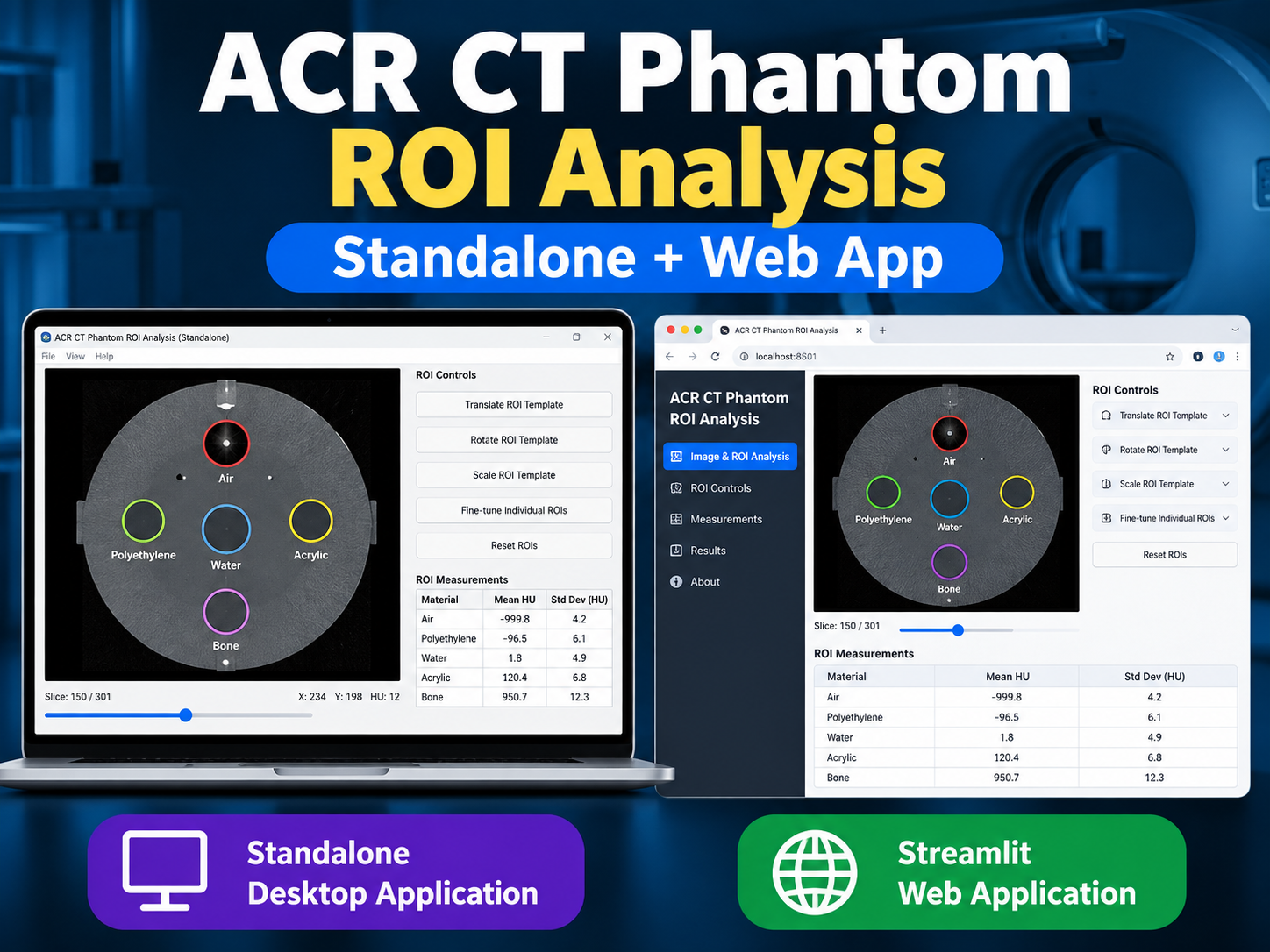
Automate and simplify ROI analysis for the ACR CT Accreditation Phantom with this interactive Python-based toolkit.
This package includes two versions of the application:
1. Standalone Desktop Application
Run the ROI analysis tool locally as a desktop application with an interactive graphical interface.
2. Streamlit Web Application
Run the same analysis through a browser-based interface using Streamlit, making it easy to explore a modern web-based approach to medical physics QA tools.
What the Tool Does
The application is designed to assist with ROI analysis of Module 1 of the ACR CT Phantom, including the CT number accuracy inserts.
The tool allows you to:
- Load a CT DICOM image series
- Navigate through CT slices
- Automatically place a predefined ROI template
- Interactively translate the entire ROI template
- Rotate the ROI configuration
- Scale the ROI configuration
- Fine-tune individual ROI positions
- Calculate the mean CT number (HU) within each ROI
- Calculate the standard deviation (HU) within each ROI
- Review the measurements directly on the CT image
- Generate a convenient analysis report
The ROI template includes the major Module 1 material regions:
- Air
- Polyethylene
- Water
- Acrylic
- Bone-equivalent material
Why Two Versions?
The package is also intended as an educational example of how the same medical physics workflow can be implemented using two different deployment approaches.
The standalone version demonstrates how a Python application can operate as a traditional desktop tool, while the Streamlit version demonstrates how the workflow can be converted into an interactive browser-based application.
This makes the package useful not only for exploring automated CT phantom analysis, but also for medical physicists interested in learning how Python tools can evolve from scripts into practical clinical-style applications.
Who Is This For?
This toolkit may be useful for:
- Medical physicists
- Medical physics residents
- Medical physics students
- Imaging QA professionals
- Researchers
- Anyone learning Python automation for medical imaging and quality assurance
Educational Use
This software is provided as an educational and demonstration tool. Users should independently verify all measurements and results before applying them to clinical quality assurance or accreditation activities.
It is not intended to replace institutional QA procedures, manufacturer recommendations, professional judgment, or official ACR accreditation requirements.