
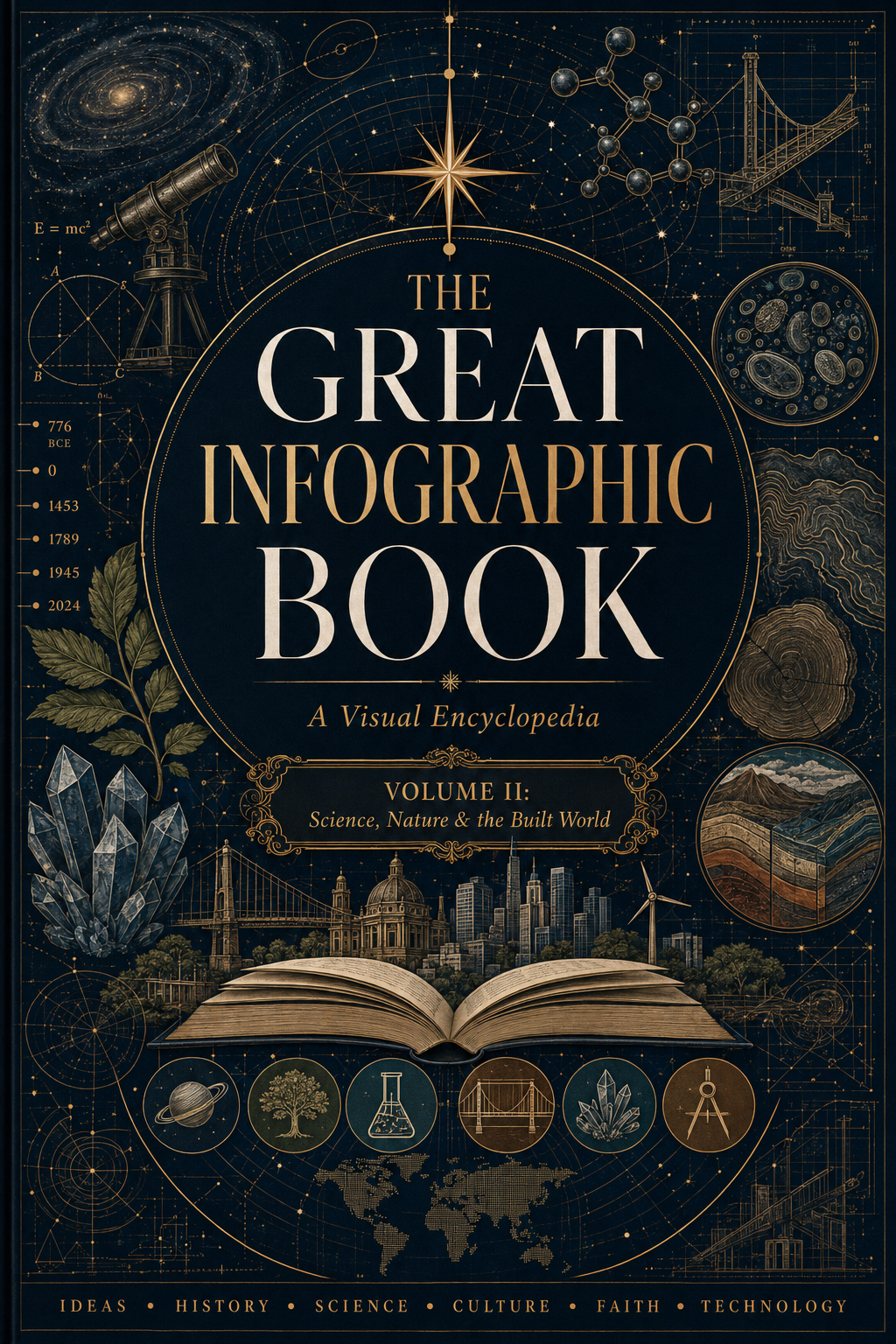
Vol.II - Science, Nature & the Built World - The Great Infographic Book
For sample, check out the website! The Great Infographic Book | A Five-Volume Visual Encyclopedia
Volume II: Science, Nature & the Built World explores the forces, systems, discoveries, and structures that shape both the natural universe and the human-made environment. Designed as a visual journey through eight major fields of knowledge, this volume brings together mathematics, science and technology, space, geology, the environment, the human body, engineering, and architecture and urbanism. Across 171 carefully structured infographics, complex ideas become clear visual explanations showing how different areas of knowledge connect, from biology to the largest structures in the cosmos.
The journey begins with Mathematics, the language through which patterns, quantities, relationships, and change can be understood. Readers are introduced to essential mathematical ideas through visual models that make abstract concepts more intuitive. From there, Science & Technology examines the principles, inventions, discoveries, and technological systems that have transformed human civilization. They reveal how scientific thinking develops, how major technologies function, and how innovation reshapes everyday life.
The section on Space expands the scale dramatically. It explores the structure of the universe, stars, planets, galaxies, cosmic phenomena, space exploration, and the scientific tools used to observe worlds far beyond Earth. It gives readers a visual sense of distance, scale, motion, and the physical laws governing the cosmos. Geology then brings the focus back to Earth, examining the planet's internal structure, plate tectonics, rocks, minerals, volcanoes, earthquakes, geological time, and the processes that reshape the surface beneath our feet.
Environment investigates the interconnected systems that sustain life. Climate, ecosystems, biodiversity, natural resources, pollution, energy, and environmental change are presented as parts of a larger network in which human activity and natural processes interact. The Human Body section moves inward, exploring anatomy, physiology, organs, biological systems, health, development, and the mechanisms that allow the body to function as an integrated whole. The infographics emphasize relationships between structure, function, regulation, and adaptation.
Engineering shows how scientific and mathematical principles become practical solutions. Structures, machines, materials, energy systems, transportation, infrastructure, and design processes are explained through diagrams and visual breakdowns that reveal how engineers solve problems under real-world constraints. Finally, Architecture & Urbanism examines the spaces humans create to live, work, move, and build communities. It explores architectural principles, construction, city planning, transportation networks, public space, density, sustainability, and the evolution of the built environment.
Together, these eight sections show how reality is studied, understood, and shaped. Volume II is for curious readers, students, educators, families, and lifelong learners who want more than isolated facts. Its purpose is to make difficult subjects approachable without stripping away their depth. Each infographic combines concise explanations with diagrams, timelines, comparisons, maps, and visual hierarchies so readers can grasp central ideas quickly while still discovering layers of detail.
Science, Nature & the Built World ultimately tells one continuous story: mathematics gives us the tools to describe patterns; science helps us understand natural laws; technology and engineering apply that knowledge; geology and environmental science explain the planet we inhabit; biology reveals the complexity of our own bodies; astronomy places Earth within the wider universe; and architecture and urbanism show how human beings transform knowledge into the environments in which civilization unfolds. It is a volume about understanding the world as it is, imagining what it can become, and seeing the hidden systems behind things we often take for granted.