
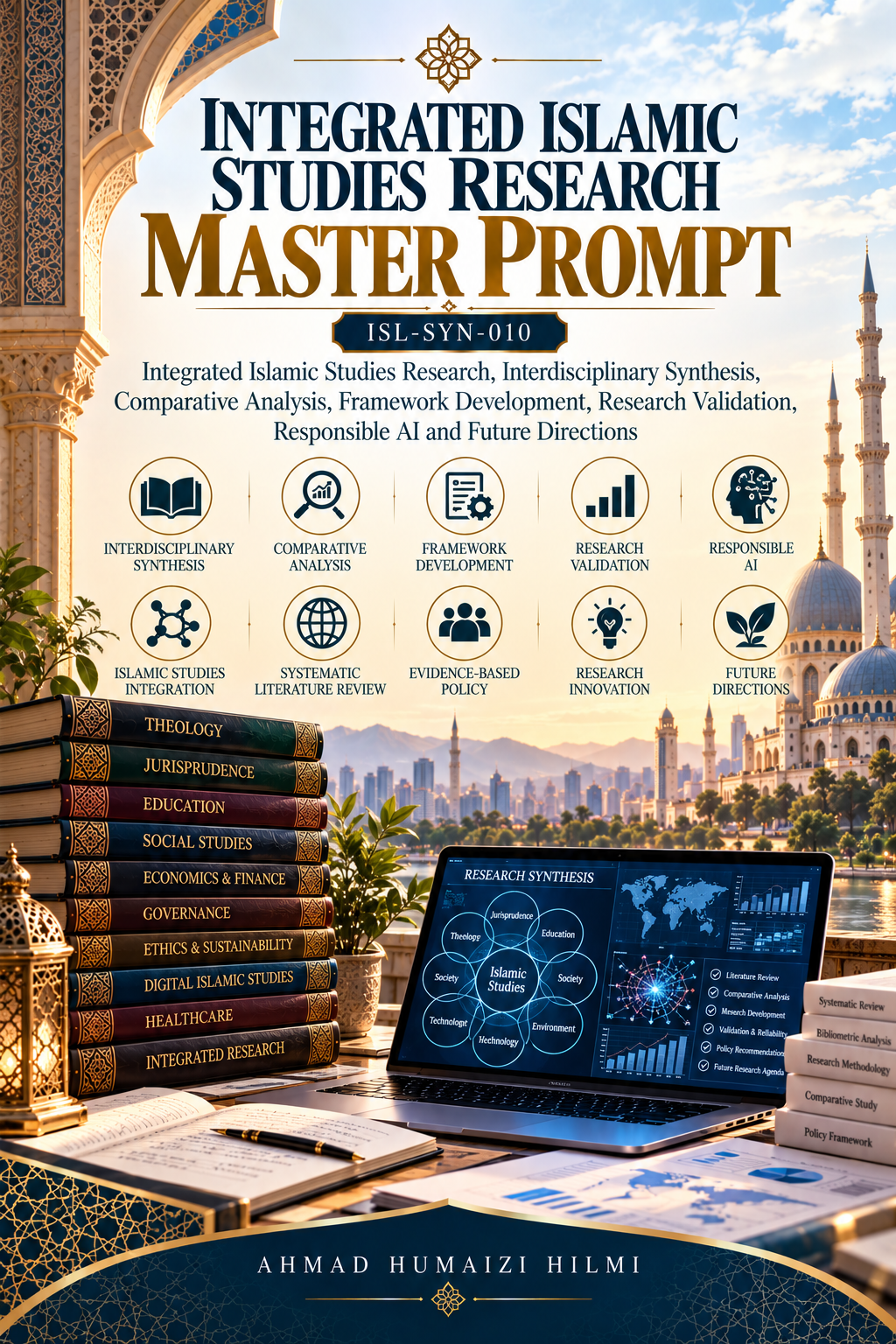
10. ISL-SYN-010 — Integrated Islamic Studies Research, Interdisciplinary Synthesis, Comparative Analysis, Framework Development, Research Validation, Responsible AI and Future Directions
Description
This Master Prompt provides a comprehensive, systematic, interdisciplinary, and academically rigorous framework for conducting advanced integrated research across the principal disciplines of Islamic Studies, including Islamic theology, Qur'anic interpretation, Hadith scholarship, jurisprudence, Islamic education, sociology, economics, finance, institutional governance, environmental sustainability, healthcare ethics, digital transformation, and artificial intelligence. It emphasises the systematic integration of Islamic intellectual traditions with contemporary theoretical perspectives, empirical research methodologies, computational techniques, comparative analysis, and evidence-based policy development. The Master Prompt encompasses systematic literature reviews, scoping reviews, integrative reviews, bibliometric analysis, thematic synthesis, meta-analysis, comparative institutional research, mixed-methods integration, theoretical model development, conceptual framework construction, instrument validation, and interdisciplinary research synthesis. Particular attention is given to the relationships among Islamic worldview, maqāṣid al-Sharīʿah, religious knowledge, social behaviour, Shariah governance, financial inclusion, ethical leadership, sustainable development, healthcare practices, technological innovation, and institutional performance. It examines methodological triangulation, cross-country comparisons, construct operationalisation, measurement invariance, reliability and validity assessment, causal inference, model robustness, research reproducibility, and the development of integrated theoretical and policy frameworks. The theme further addresses responsible artificial intelligence, algorithmic accountability, digital research ethics, scholarly transparency, source authenticity, data governance, interdisciplinary collaboration, and the responsible use of computational tools in Islamic scholarship. Researchers are guided through the complete process of identifying interdisciplinary research gaps, synthesising diverse evidence, developing original conceptual models, designing integrated research methodologies, validating theoretical and empirical frameworks, interpreting multidisciplinary findings, and formulating practical recommendations. Emphasis is placed on intellectual integrity, authentic Islamic source interpretation, recognition of legitimate scholarly differences, methodological coherence, transparent reporting, empirical defensibility, ethical accountability, and the advancement of Islamic Studies through theoretically grounded, scientifically informed, and socially beneficial interdisciplinary research.