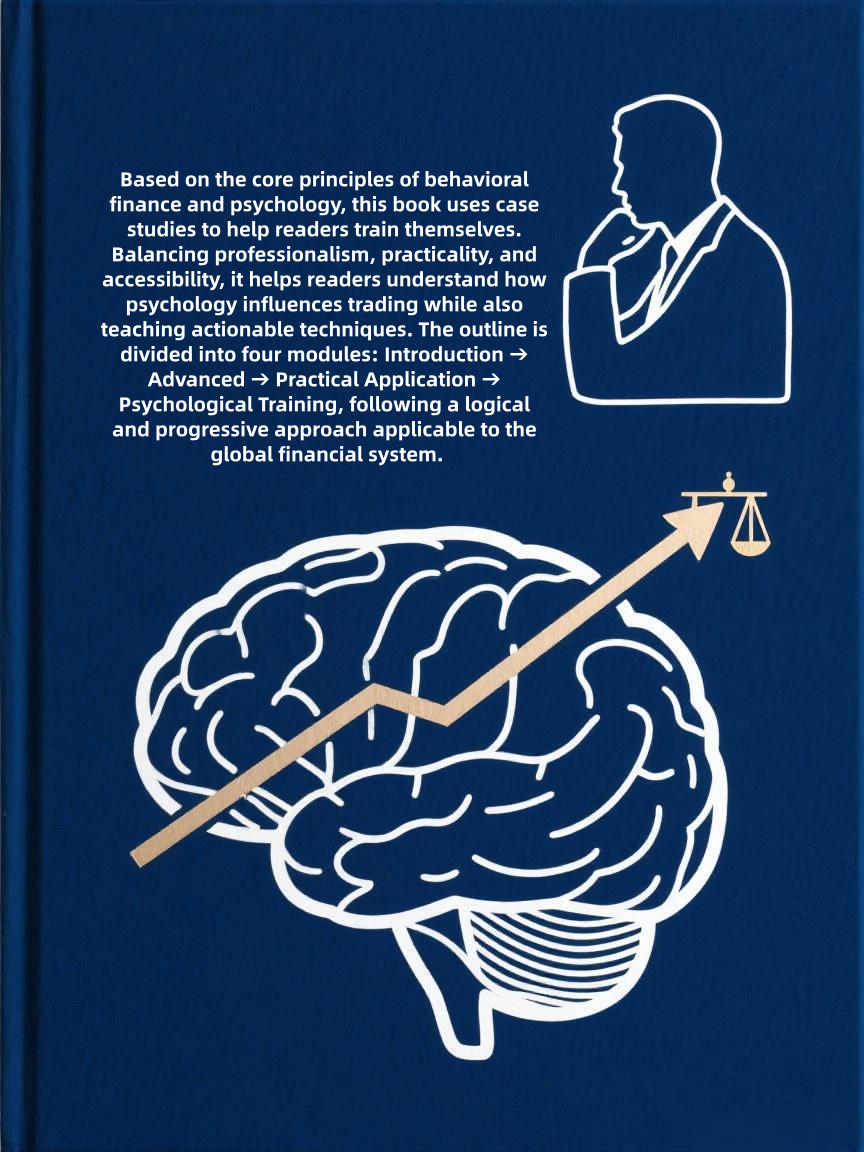

Winner Trading Psychology-English(PDF)-230 pages-66 sections-Applicable to the global financial system

Author of the Winner Trading Book series
Atwood
(introduce)
The author entered the financial market in 2005 and has been focusing on candlestick charts in different markets, researching trading strategies and quantitative strategies, as well as various risk control strategies. He has published 10 books on financial securities trading to help readers learn systematically.
detailed outline
Part 1: Psychological cognition and trading basics
1-Overview of Transactional Psychology
2-The relationship between psychology and financial markets
3-The relationship between psychology and market game
4-The relationship between psychological experiments and transactions
5-Human Nature and Market Deviation
6-Fear and Greed: The Core Drivers of Market Volatility
7-The Use of the VIX Fear Index
8-Why can't technical and fundamental factors solve all problems?
9-Why do 90% of traders lose psychologically rather than technically?
10-10 common cognitive biases
11-Self-cognition and personality assessment
12-What trading style is your personality suited to?
13-How to find your trading weaknesses?
Part 2: Emotional management and risk control
14-The nature of emotions and the psychological mechanism of trading
15--Core emotion management methods in trading
16-Psychological basis of risk control
17-Emotional trading and emotional traps
18-People with emotional discipline are more likely to succeed
19-The cycle of emotion and risk interaction
20-Build a stable trading mentality and long-term psychological resilience
21-Bull and Bear cycles and mood curves
22-Psychological neglect of black swans and gray rhinos
23--Market group psychology and price fluctuation law
24-The balance between position management and psychological endurance
25-Anger, anxiety, and retaliatory trading in transactions
26-Why is it easy to "revenge trade" after a loss?
27-The trader's psychological safety boundary
28--Risk tolerance assessment model
Part 3: Practical Application and Strategy Coordination
29-Trading Plan and Psychological Execution
30-Psychological training for self-control
31-The process of establishing personal trading rules
32-How to avoid blindly chasing the high
33-Discipline is the watershed of successful traders
34-Scenario-based training (how to respond to profits, losses, and volatility)
35-Why can't a plan be implemented?
36-Psychological methods to improve execution
37-Psychological Training for Execution (7-Day Plan)
38-Winner mentality and loss acceptance
39--The mindset of successful traders
40-The psychological habits of successful traders
41-The psychological trap of the failed trader
42-How to recover from a loss quickly
43-Psychological response to different market environments
44-Bull market: Overcoming overconfidence and greed
45-Bear Market: How to Stay Calm and Rational
46-Volatile markets: a test of patience and discipline
Part 4: Mental Training and Long-term Growth
47-Mindfulness, Exercise, Writing, and Trading Mindset
48-Create a "transaction diary" and emotional records
49-The Daily Psychological Habits of Successful Traders
50-How to integrate psychology into daily trading
51-Visual training and simulation
52-Daily psychological monitoring sheet
53-Build a "psychological firewall"
54-The mental model of a professional trader
55-The mental transformation from amateur to professional trader
56-How to Stay Focused and Motivated in Long-Term Trading
57-Create a personal "Trading Psychology Handbook"
58-Five mental pillars for long-term growth
59--Case 1: Professional trader profits against the trend
60-Case 2: The Cool Discipline of a Professional Trader
61-Case 3: The Psychological Training Method of Top Traders
62-Case 4: Daily Mindset Management for Wall Street Fund Managers
Appendix
63-Festinger's Law
64-The Mustang Law
65-Simon's Learning Method
66-Belief First, Action Follows
ending