
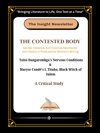
A Critical Study of Tsitsi Dangarembga's Nervous Conditions and Maryse Condé's I, Tituba, Black Witch of Salem
The Contested Body: Gender Violence, Anti-Colonial Resistance & History in Postcolonial Women's Writing is a comprehensive critical study that examines how the female body functions as the central organizing figure in postcolonial women's fiction. Through a rigorous comparative analysis of Tsitsi Dangarembga's Nervous Conditions (1988) and Maryse Condé's I, Tituba, Black Witch of Salem (1986), Dr. Divya Gehlotra develops an integrated framework connecting postcolonial feminism, body politics, intersectionality, and feminist historiography.
The book argues that the female body in postcolonial women's writing is never merely personal—it is a battleground, an archive, a text upon which empires inscribe their power and from which women wrest back the right to speak. Dangarembga's novel, rooted in the mission schools of colonial Rhodesia, and Condé's novel, set against the slave ships and witch trials of the seventeenth-century Atlantic, stand at opposite ends of the postcolonial world. Yet both place the female body at the centre of their critique of power. Tambudzai's hunger for education is inseparable from the bodily discipline imposed upon her as a girl. Nyasha's anorexia is both a wound and a weapon. Tituba's sexuality is both the site of her exploitation and the ground of her resistance. In both novels, the body is where history is felt, where violence is inflicted, and where memory is preserved.
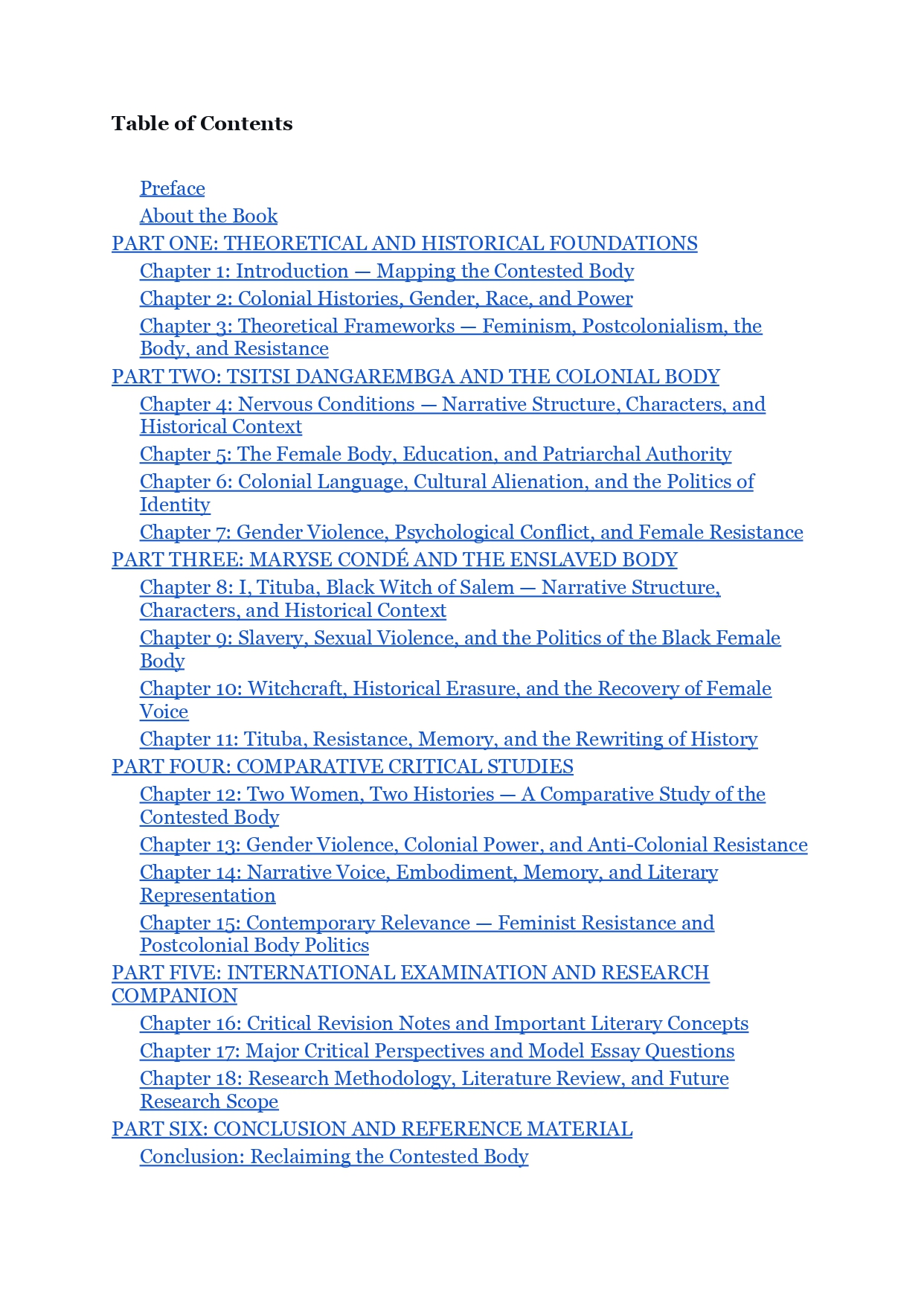
What This Book Offers
Part One: Theoretical and Historical Foundations
Part Two: Tsitsi Dangarembga and the Colonial Body
Part Three: Maryse Condé and the Enslaved Body
Part Four: Comparative Critical Studies
Part Five: International Examination and Research Companion
Part Six: Conclusion and Reference Material
This book is designed for students and scholars at multiple levels. It offers a sustained comparative argument for researchers and postgraduate students; it provides historical context and theoretical tools for undergraduates encountering these novels for the first time; and it includes extensive guidance on close reading, essay writing, examination preparation, and independent research. It is not a study guide in the narrow sense, but a work of criticism that also teaches the skills of criticism.