
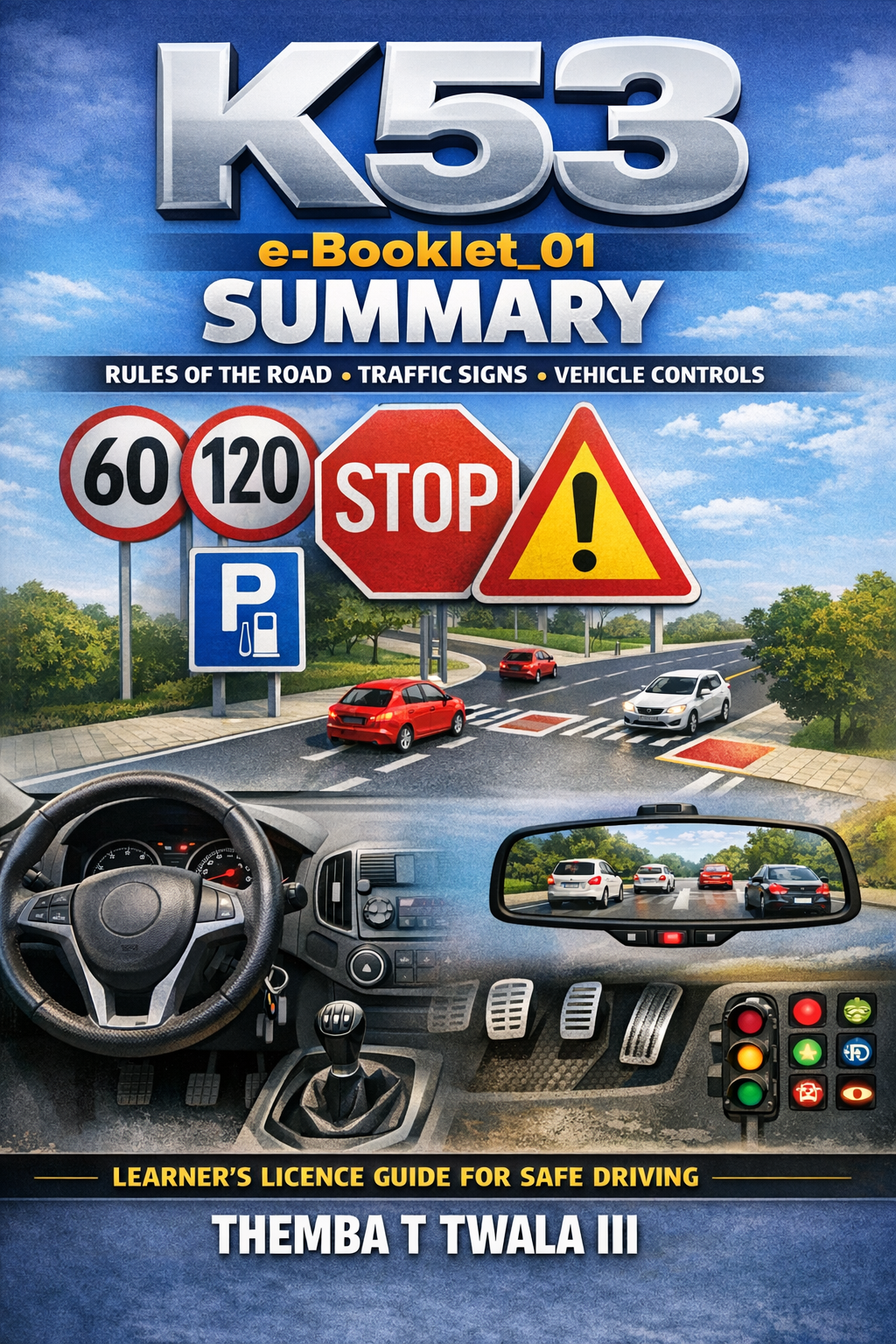
K53 e-Booklet.
On Sale
$2.00
$2.00
🚗 K53 e-Booklet_01 Summary
1. Rules of the Road
These are laws and guidelines that all road users must follow for safety and order. Key points include:
- Speed limits: Vary depending on the area (e.g., 60 km/h in urban areas, 100 km/h on open roads, 120 km/h on freeways).
- Right of way: At a four-way stop, the first vehicle to stop is the first to go. Yield to pedestrians, emergency vehicles, and when turning across oncoming traffic.
- Safe following distance: Always keep a 2-second gap between you and the vehicle ahead.
- Use of indicators: Always signal your intention to turn or change lanes in advance.
- Overtaking: Only overtake when it's safe and legal, and never overtake on a solid white line.
2. Traffic Signs
Signs guide, warn, and regulate traffic. There are three main types:
- Regulatory signs (red or blue): Tell you what you must or must not do (e.g., Stop, No Entry, Speed Limit).
- Warning signs (yellow/white with red triangle): Alert you to hazards (e.g., sharp bends, animals crossing).
- Information signs (blue or green): Provide helpful details (e.g., hospital, fuel station, directions).
Each shape and color has a meaning:
- Octagon = Stop
- Triangle = Warning
- Circle = Command or Prohibition
- Rectangle = Info or Directions
3. Controls of the Vehicle
Every driver must know the basic controls of a car:
- Steering wheel: Used to direct the vehicle.
- Clutch pedal (manual cars only): Disengages engine to change gears.
- Brake pedal: Slows or stops the car.
- Accelerator pedal: Controls the car’s speed.
- Gear lever: Changes the car’s gears.
- Handbrake: Holds the car in place when parked.
- Lights: Headlights, brake lights, indicator lights, and hazard lights — all must be used appropriately.
- Mirrors: Used to monitor traffic behind and beside the vehicle.