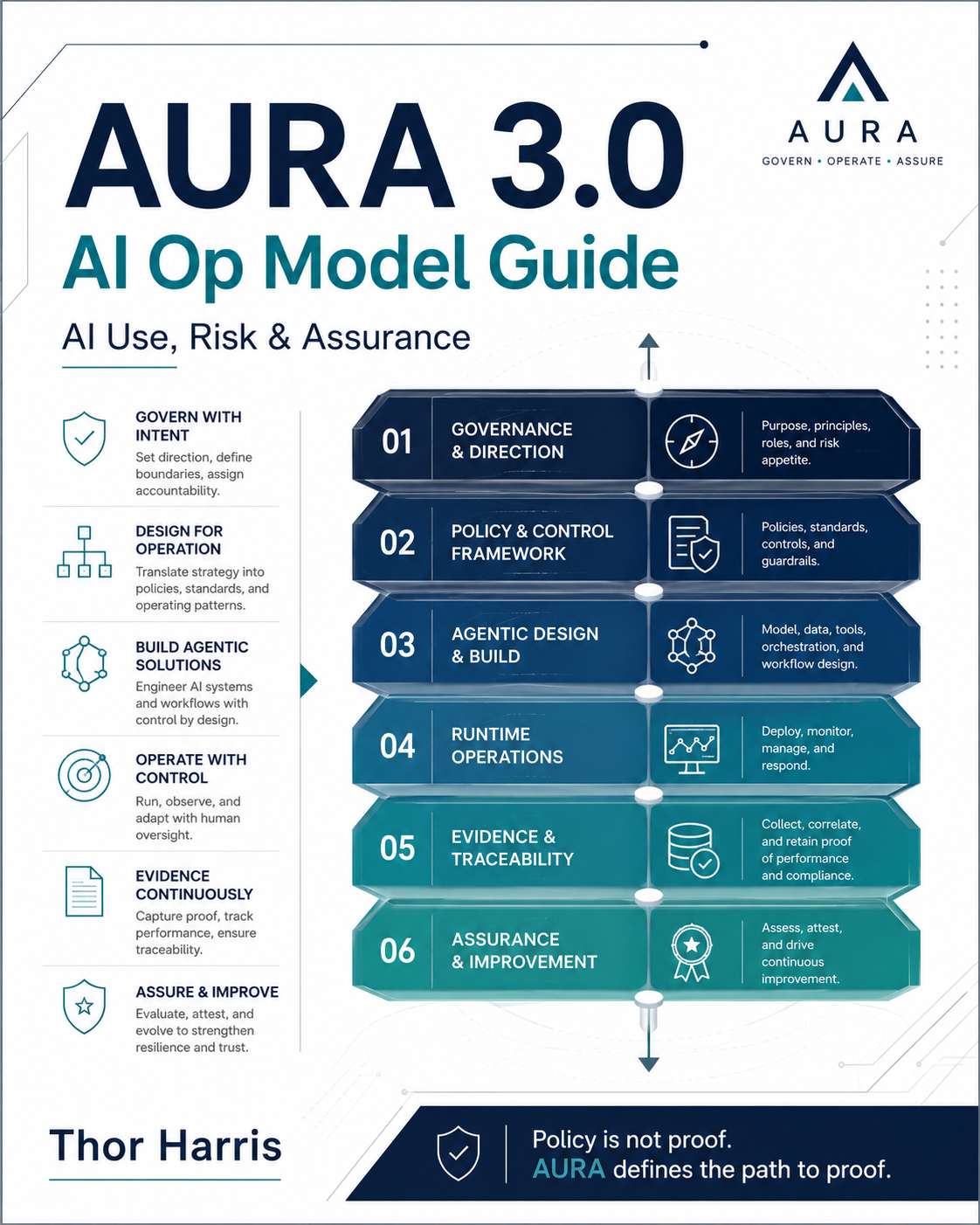

AURA 3.0 Core method and practices: Practitioner Guide
AURA 3.0 Core Method and Practices
A concise practitioner guide to the operating method behind AURA 3.0
AURA 3.0, meaning AI Use, Risk and Assurance, is an Australian-developed operating model for the safe, governed, evidenced and auditable use of artificial intelligence.
This focused e-book extracts the core AURA 3.0 method and its essential operating practices from the full AURA 3.0 AI Op Model Guide. It provides a more direct entry point for readers who want to understand and begin applying the method without first working through the complete reference guide.
AURA is built around a simple proposition:
Policy is not proof. This is proof.
The guide shows how AI governance can be converted from principles, policies and statements into accountable decisions, practical controls, delivery activities, retained evidence, release gates, runtime monitoring and assurance.
What this guide covers
The e-book explains:
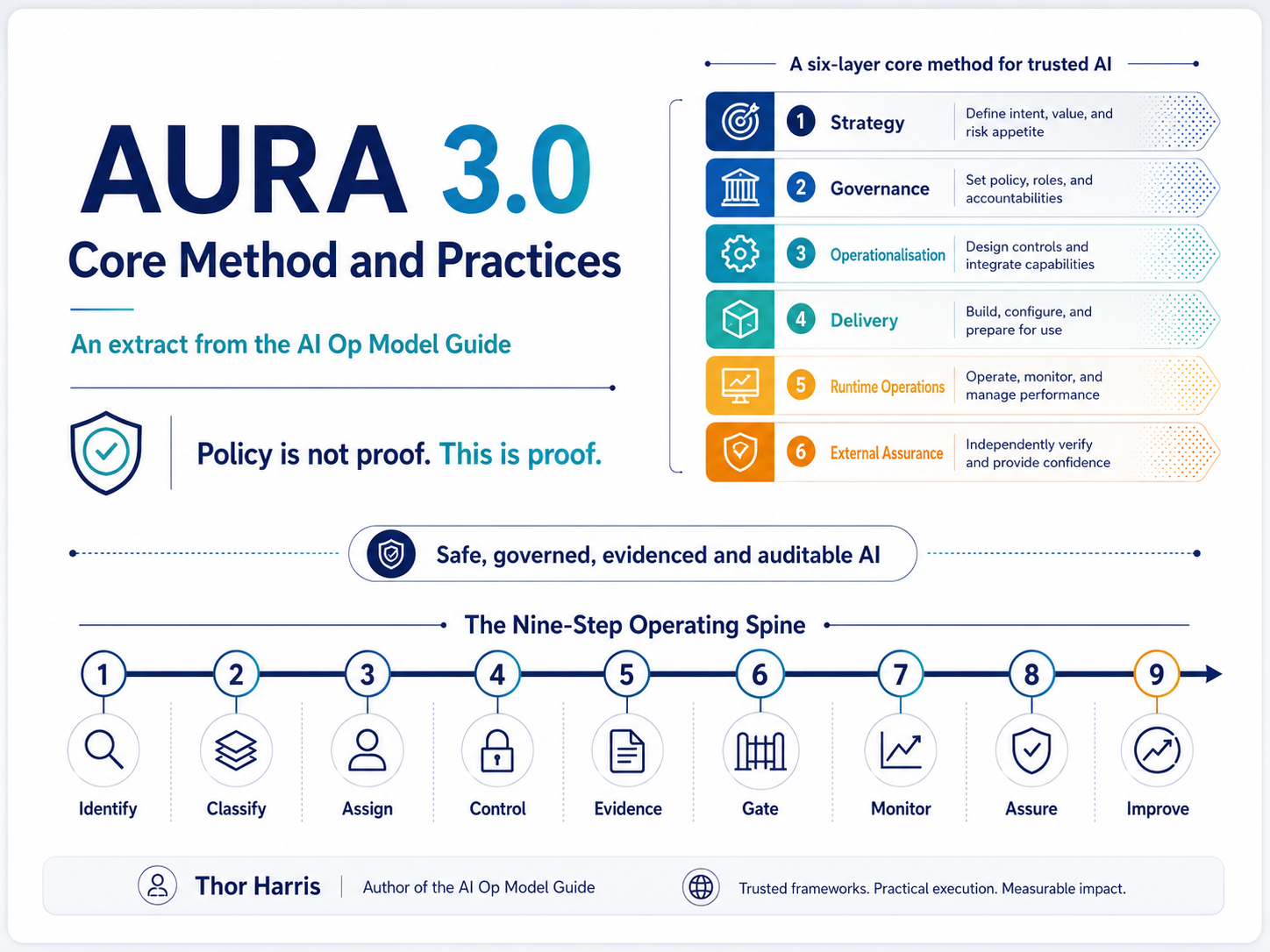
- The six-layer AURA 3.0 operating architecture
- The policy-to-proof conversion chain
- The Assist, Augment, Automate and Agentic authority progression
- The Nine-Step AURA Operating Spine
- AI use-case discovery and inventory
- Risk tiering and proportional control intensity
- Accountability and decision rights
- Control design and evidence requirements
- Governance-ready delivery and DevSecOps evidence
- The seven AI testing disciplines
- The seven release gates
- Human-in-command oversight
- Vendor and SaaS shared responsibility
- Agentic operating envelopes and action boundaries
- Runtime monitoring, intervention and incident response
- The AI Ops Room
- External assurance and audit readiness
- Minimum Viable Governance
- The first 90 days of implementation
- The AURA maturity model
The core operating sequence
AURA connects AI governance and delivery through one repeatable sequence:
Identify → Classify → Assign → Control → Evidence → Gate → Monitor → Assure → Improve
This sequence helps organisations maintain one traceable thread from an AI idea or existing use case through risk assessment, delivery, production operation, incident response and external assurance.
Who this guide is for
This guide is designed for:
- Board members and executives
- Heads of AI and AI governance leaders
- Risk, compliance, privacy and legal teams
- CIOs, CTOs and CISOs
- PMO, programme and project leaders
- Agile, SAFe and product delivery teams
- Business analysts and change practitioners
- DevSecOps, engineering and testing teams
- AI operations and incident-response teams
- Internal audit and assurance professionals
- Organisations beginning an AI governance programme
- Organisations preparing to move from pilots into controlled production
Why it is useful
Many organisations already have responsible AI principles, risk frameworks, cybersecurity controls, delivery methods and governance committees. The challenge is connecting them.
AURA does not replace those disciplines. It helps bind them together through common use-case identifiers, decision rights, controls, evidence requirements, handoffs, operating workflows and assurance activities.
The result is a practical method for answering three questions with evidence:
- What AI is being used?
- What risk does that use create?
- What proves the use remains controlled?
What you will receive
A professionally structured Microsoft Word e-book containing the extracted AURA 3.0 core method and practices.
Format: Microsoft Word .docx
Author: Thor Harris
Edition: AURA 3.0, July 2026
Important notice
This publication is an operating-model and educational resource. It is not legal, regulatory, audit, accounting, cybersecurity, privacy, employment, safety or other professional advice. It does not constitute certification, conformity assessment or a guarantee of compliance. Organisations should adapt the material to their own obligations, systems, risk appetite, workforce and operating environment.