
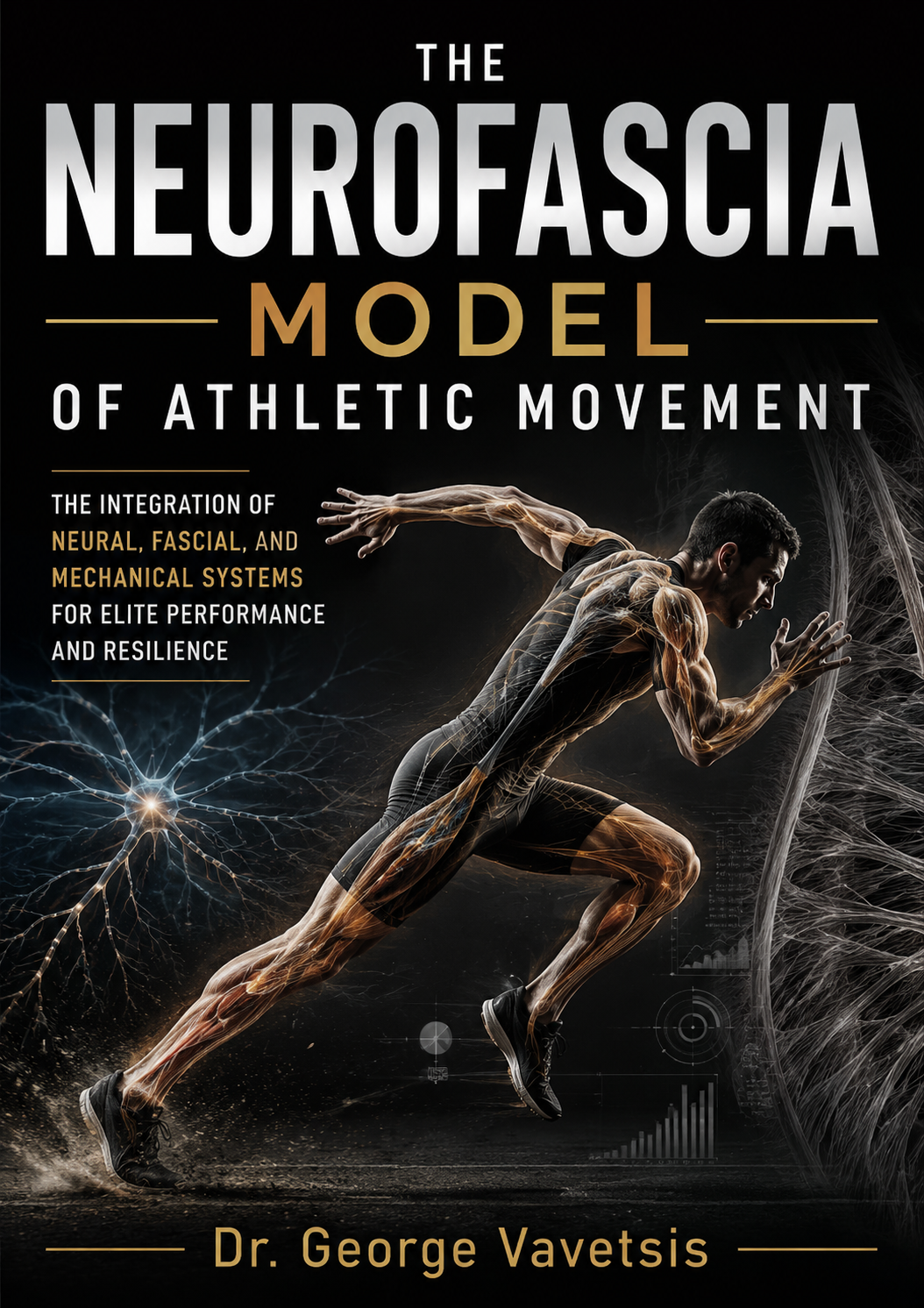
The Neurofascia Model of Athletic Movement
Pages: 1164
Human movement is not merely the expression of muscular force production or neural activation. It is the integrated manifestation of a deeply interconnected biological continuum in which fascia, nervous tissue, mechanotransduction, fluid dynamics, bioelectricity, and motor coordination coexist as a unified adaptive system. The Neurofascia Model of Athletic Movement emerges from the necessity to move beyond reductionist interpretations of performance and toward a systems-based understanding of athletic function, adaptation, fatigue, and resilience.
For decades, sport science has largely interpreted athletic movement through isolated frameworks: biomechanics examined force and motion; neurophysiology investigated motor control and neural conduction; strength and conditioning emphasized tissue loading and adaptation; rehabilitation focused on pain, dysfunction, and return-to-play models. Yet elite athletic performance rarely behaves according to isolated systems. Sprint acceleration, multidirectional deceleration, reactive agility, ballistic jumping, and collision management are not singular muscular events—they are neurofascial events.
The athlete does not move through muscles alone. Movement emerges through the continuous interaction between connective tissue tension, afferent sensory feedback, fascial hydration, motor-unit synchronization, interstitial pressure dynamics, and predictive neural processing. The neurofascial system acts as a distributed communication architecture linking perception, mechanical loading, elastic energy transfer, and adaptive remodeling. Within milliseconds, this system regulates stiffness, force dissipation, fluid redistribution, proprioceptive sensitivity, and reactive motor sequencing.
This book was developed to construct a scientific and applied framework capable of explaining these interactions at the highest levels of sport performance.
The modern athletic environment demands extraordinary neuromechanical precision. Elite sprinting involves ground-contact times frequently below 0.12 seconds. Reactive change-of-direction tasks may occur within perceptual windows shorter than 220 milliseconds. In such environments, even minimal alterations in conduction velocity, tissue stiffness, hydration state, mechanoreceptor density, or fascial strain tolerance can significantly influence performance outcomes and injury risk profiles. Traditional models that isolate muscles from fascia or neural systems from connective tissue fail to fully explain the rapid integrative adaptations observed in elite sport.
The Neurofascia Model proposes that fascia should not be viewed merely as passive connective tissue. Rather, it functions as an active sensory–mechanical interface capable of modulating force transmission, proprioceptive sensitivity, bioelectrical communication, and movement efficiency. Emerging evidence demonstrates that fascial tissues contain dense mechanoreceptor populations, exhibit piezoelectric behavior under deformation, respond dynamically to hydration shifts, and contribute directly to neuromuscular synchronization during high-velocity athletic tasks. These findings fundamentally alter how strength and conditioning coaches, sport scientists, physiotherapists, and rehabilitation specialists should interpret movement preparation and tissue adaptation.
Throughout this text, the reader will encounter a multidisciplinary synthesis integrating:
- Neurophysiology
- Fascial biomechanics
- Mechanotransduction
- Interstitial fluid dynamics
- Connective tissue remodeling
- High-performance sprint mechanics
- Reactive agility science
- Bioelectric signaling
- Elastic energy transfer
- Neuromechanical fatigue modeling
- Tissue stiffness regulation
- Sensorimotor synchronization
The intention is not simply to present theory, but to construct a practical framework for elite sport application.
This book specifically emphasizes quantitative analysis. Athletic movement is explored through measurable variables including mechanoreceptor density, conduction velocity, strain thresholds, oscillatory fluid pressure, stiffness coefficients, piezoelectric voltage generation, reaction-time thresholds, and hydration-dependent conductivity changes. These metrics provide practitioners with a more refined understanding of how neurofascial function influences explosive movement, fatigue tolerance, and tissue resilience.
Importantly, this work also addresses the dynamic relationship between adaptation and overload. Neurofascial systems possess remarkable plasticity, yet they also demonstrate vulnerability under repetitive high-intensity loading. Accumulated stiffness, altered fluid oscillation patterns, decreased compliance, delayed neural conduction, and hydration-mediated conductivity impairment may all contribute to performance degradation and injury susceptibility. Understanding these interactions allows coaches and clinicians to design training systems that optimize adaptation while minimizing destructive neuromechanical accumulation.
A major theme throughout the book is synchronization.
Elite movement depends not solely on force magnitude, but on the timing precision of biological events occurring across multiple systems simultaneously. High-performance acceleration, deceleration, cutting, landing, and collision absorption require synchronized communication between fascial tensioning, neural excitation, elastic recoil, and fluid-mediated mechanical support. When synchronization deteriorates—even subtly—performance efficiency declines and injury probability increases.
The neurofascial perspective also reframes recovery.
Recovery is not simply metabolic restoration. It involves restoration of tissue conductivity, fascial sliding efficiency, hydration equilibrium, mechanoreceptor responsiveness, and neuromechanical timing integrity. Therefore, modalities such as hydration management, thermal interventions, oscillatory loading, plyometric sequencing, recovery density, and tissue unloading strategies acquire far greater importance within an integrated neurofascial model.
This text is intended for advanced readers: strength and conditioning coaches, sport scientists, rehabilitation professionals, biomechanists, exercise physiologists, manual therapists, and researchers seeking a deeper understanding of human performance. The terminology, concepts, and quantitative frameworks presented throughout the book reflect the complexity of elite athletic preparation and are designed to stimulate further scientific inquiry and applied innovation.
The future of sport performance science lies in integration.
The separation between neural systems, connective tissue, and mechanical output is increasingly artificial. Athletic movement is fundamentally a neurofascial phenomenon—a continuously adapting biological network capable of sensing, transmitting, storing, dissipating, and coordinating force under extraordinary temporal constraints.
The Neurofascia Model of Athletic Movement aims to provide both a conceptual and practical foundation for this emerging paradigm. It invites the reader to reconsider movement not as isolated muscular action, but as a living systems process shaped by tension, sensation, conductivity, elasticity, fluidity, and adaptation.