
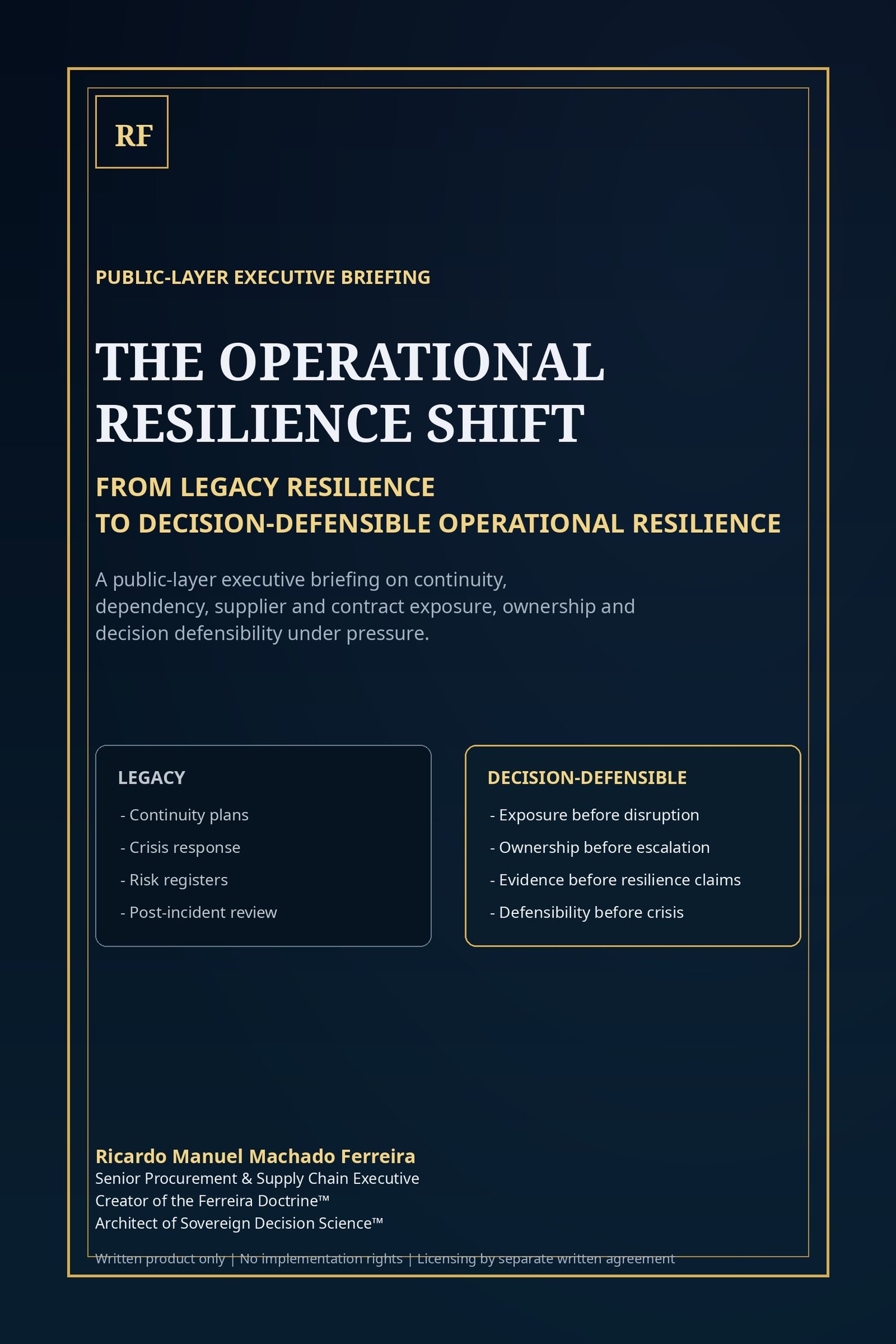
THE OPERATIONAL RESILIENCE SHIFT — From Legacy Resilience to Decision-Defensible Operational Resilience
THE OPERATIONAL RESILIENCE SHIFT
From Legacy Resilience to Decision-Defensible Operational Resilience
A public-layer executive briefing by Ricardo Manuel Machado Ferreira, Creator of the Ferreira Doctrine™ and Architect of Sovereign Decision Science™.
Most operational-resilience models are still managed through a narrow continuity lens:
business continuity plans, recovery procedures, crisis response, incident management, risk registers, backup processes, escalation protocols and post-incident reviews.
Those elements matter.
But they are no longer sufficient.
In volatile, supplier-dependent, technology-enabled, contract-sensitive and consequence-heavy environments, operational failure does not begin only when disruption occurs.
It begins earlier.
It begins when critical dependencies are accepted without defensible evidence, when continuity assumptions are not owned, when supplier and contract exposure are separated from operations, when escalation is late and when decisions cannot be defended before pressure arrives.
This briefing explains the shift from operational resilience as recovery planning to operational resilience as institutional decision defensibility under pressure.
What this briefing clarifies
Traditional operational-resilience models often remain trapped in:
→ recovery planning rather than exposure prevention;
→ crisis response rather than decision defensibility;
→ continuity documentation without ownership clarity;
→ incident management after fragility has already materialised;
→ risk registers that do not change operational decisions;
→ supplier and contract exposure separated from resilience planning;
→ dashboards that monitor activity but miss decision weakness;
→ post-incident explanation instead of pre-crisis defensibility.
This briefing introduces a public-layer operational-resilience logic focused on:
→ dependency visibility before disruption;
→ supplier exposure before impact;
→ contract discipline before pressure;
→ evidence before operational commitment;
→ ownership before escalation;
→ continuity before crisis;
→ decision records before scrutiny;
→ executive defensibility before operational consequence becomes visible.
The central shift
Legacy operational resilience asks:
“Do we have a continuity plan?”
“Can we recover after disruption?”
“Are escalation procedures documented?”
“Have incidents been reviewed?”
“Are risks listed in the register?”
“Is there a crisis-response process?”
Decision-defensible operational resilience asks:
→ What dependency can break the operating model?
→ What exposure exists before disruption appears?
→ What assumptions support the continuity plan?
→ Who owns the decision if operations deteriorate?
→ What supplier, contract or technology dependency creates consequence?
→ What evidence supports the resilience claim?
→ Can this operational decision be defended before a board, auditor, regulator, insurer, client or court?
This is the shift from operational resilience as recovery planning to operational resilience as institutional decision infrastructure.
Why this briefing matters
A continuity plan is not always operational resilience.
A crisis-response process is not always decision control.
A risk register is not always risk reduction.
A recovery procedure is not always a defensible operating model.
A dashboard is not always resilience.
Operational resilience becomes strategically viable when it helps the organisation make decisions that can survive supplier failure, contract pressure, technology disruption, audit challenge, board scrutiny, regulatory pressure, reputational exposure and operational consequence.
This briefing helps the reader examine operational exposure before disruption becomes consequence.
Who this briefing is for
This briefing is designed for:
→ COOs;
→ CFOs;
→ CEOs;
→ Chief Risk Officers;
→ procurement leaders;
→ supply-chain leaders;
→ operations leaders;
→ resilience leaders;
→ business continuity teams;
→ contract owners;
→ contracts/legal teams;
→ transformation leaders;
→ risk teams;
→ compliance teams;
→ audit functions;
→ ERP/MRP and IT decision environments;
→ regulated organisations;
→ supplier-risk and governance teams;
→ executive governance teams.
It connects directly to:
→ continuity risk;
→ supplier exposure;
→ contract fragility;
→ operational disruption;
→ evidence gaps;
→ decision records;
→ escalation ownership;
→ procurement failure;
→ board accountability;
→ executive defensibility.
Use this briefing if you want to understand
→ why recovery planning is not enough;
→ why continuity must be evidenced before disruption;
→ why supplier and contract exposure must be connected to operations;
→ why operational resilience requires ownership before escalation;
→ why dashboards often miss decision fragility;
→ why resilience claims must be defensible under scrutiny;
→ why modern operational resilience must become decision-defensible, not merely reactive.
Recommended next step
For readers who want a practical diagnostic entry point after this briefing, continue with:
→ The 72-Hour Decision Readiness Test;
→ Supplier Failure Before Impact;
→ The Contract Exposure Note;
→ The Public Decision Record Pack;
→ Executive Decision Defensibility Review.
These public written products help examine whether an organisation is prepared to make defensible decisions before disruption, supplier failure, contract pressure or operational consequence appears.
Formal institutional use, deployment, training, software translation, dashboard creation, workflow design, ERP/MRP integration or operational enablement requires separate formal written licensing.
Important rights notice
This is a public-layer written product.
Purchase of this product grants individual public-layer reading access only.
It does not grant implementation, training, organisational-use, derivative, software, AI/LLM ingestion, deployment, integration, consulting, adaptation, redistribution or licensing rights.
Any institutional use of Sovereign Decision Science™, the Ferreira Doctrine™, related decision systems, software layers, dashboards, APIs, ERP/MRP integrations, training, implementation support, deployment or operational enablement requires a separate formal written licence agreement issued by Ricardo Manuel Machado Ferreira.
No licence, implementation right, software right, training right, deployment right, derivative right, AI/LLM ingestion right or institutional-use right is granted unless expressly agreed in writing, under separate scope, separate pricing and formal written authorisation.
This product is not legal advice, financial advice, operational-resilience consultancy, procurement consultancy, software implementation, training, a template package or an implementation system.
The public layer explains the problem.
Protected implementation requires formal written licensing.
Official website:
https://www.ricardoferreira.ai/
Institutional licensing:
General contact:
Rights / IP:
Ricardo Manuel Machado Ferreira
Senior Procurement & Supply Chain Executive
Creator of the Ferreira Doctrine™
Architect of Sovereign Decision Science™