
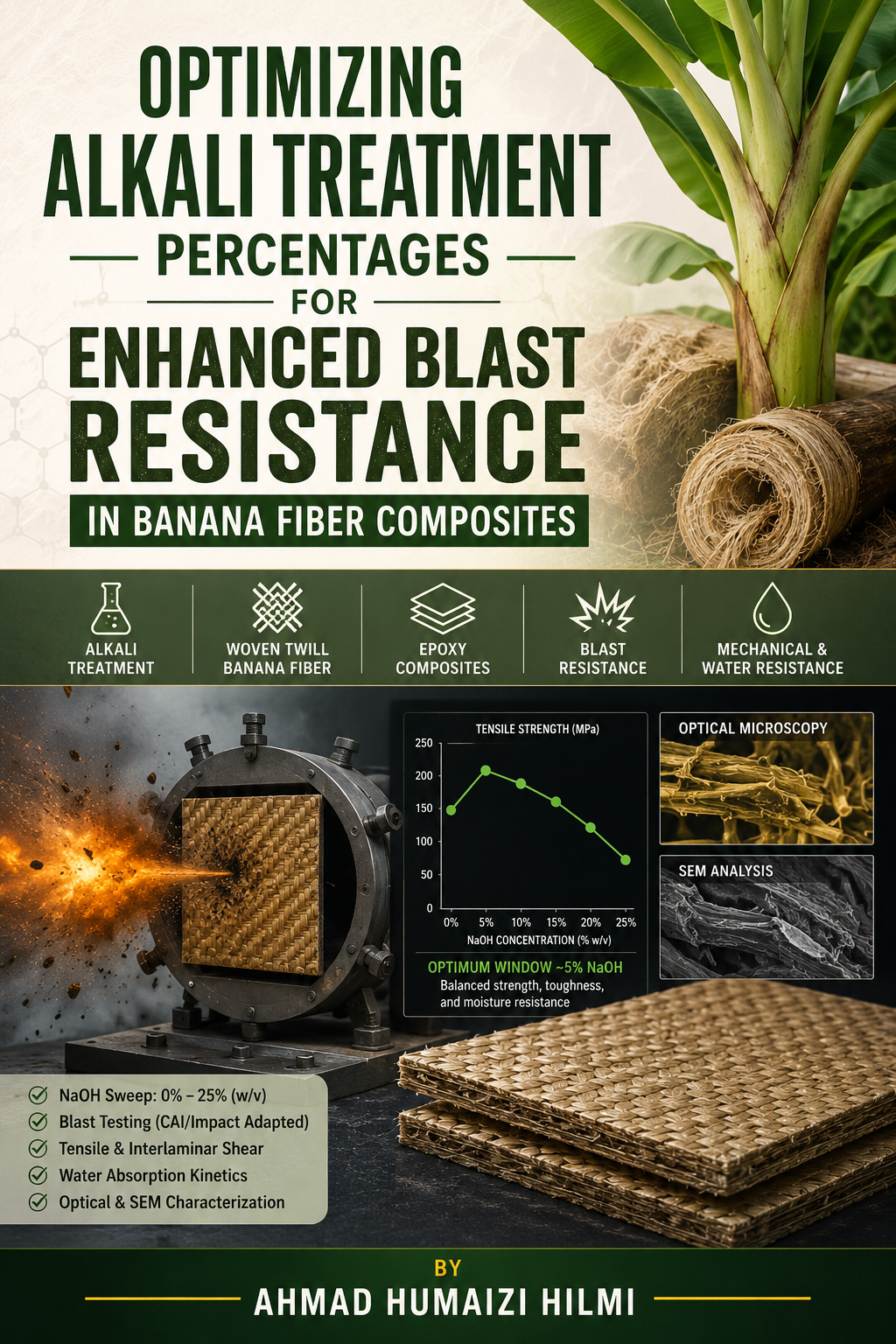
OPTIMIZING ALKALI TREATMENT PERCENTAGES FOR ENHANCED BLAST RESISTANCE IN BANANA FIBER COMPOSITES
This review frames and reports a controlled experimental programme that optimises sodium hydroxide surface treatment for woven twill banana-pseudostem fabric used in epoxy laminates aimed at lightweight, deployable blast protection. We describe a 0%–25% (w/v) NaOH sweep and evaluate the resulting panels with small-scale blast trials adapted from CAI/impact protocols, standard tensile and interlaminar shear tests, water-absorption kinetics, and optical and scanning electron microscopy. Results show a consistent trade-off: moderate alkali exposure improves fiber surface roughness and matrix wetting, raises tensile and flexural strength, shortens pull-out lengths, reduces plug-out and delamination under blast-like loads, and lowers equilibrium water uptake. By contrast, excessive NaOH produces micro-cracking, thinning of cell walls, longer pull-outs and brittle perforation modes that worsen dynamic performance. The optimal engineering window identified aligns with prior reports near 5% NaOH for balancing strength, toughness retention, manufacturability and moisture resistance. The findings support moderate-alkali protocols as a low-cost route for natural-fiber protective panels and highlight the need for hybridization strategies and scaled blast testing to translate small-scale gains to field-relevant systems.