
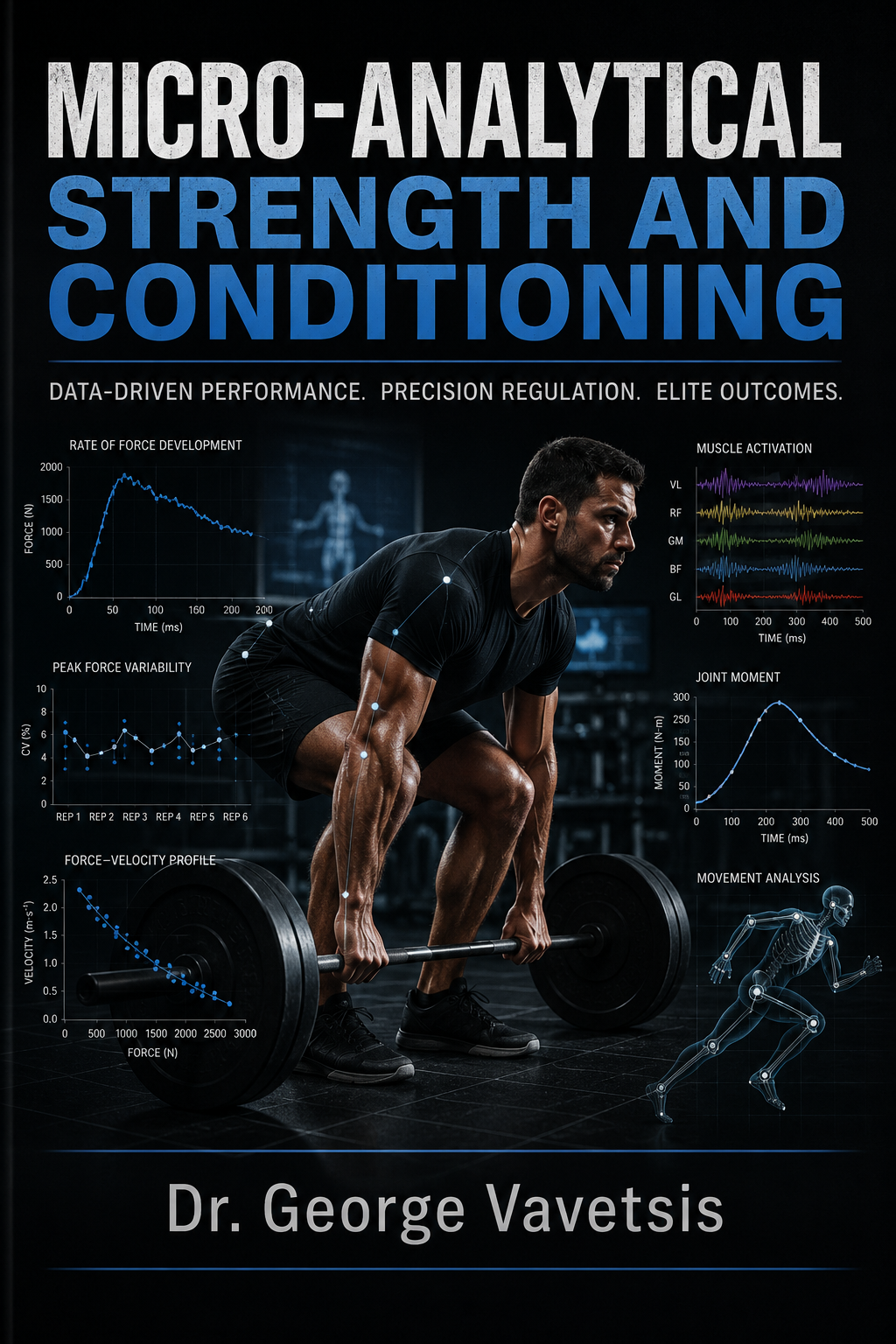
Micro-Analytical Strength and Conditioning
Pages: 290
In elite sport, the margin separating victory from irrelevance is often measured not in seconds, but in milliseconds, force oscillations, neuromuscular synchronization windows, and microscopic fluctuations in mechanical efficiency. Traditional strength and conditioning models have historically focused on broad adaptations: maximal strength, hypertrophy, aerobic development, power production, and general athletic preparedness. While these domains remain foundational, contemporary high-performance sport increasingly demands a more granular perspective—one capable of identifying, monitoring, and manipulating the smallest performance determinants that collectively shape elite athletic execution.
This book, Micro-Analytical Strength and Conditioning, was developed from the recognition that modern sport performance no longer rewards only the strongest, fastest, or most powerful athlete. Instead, elite competition increasingly favors athletes capable of sustaining neuromechanical precision under fatigue, regulating force-time characteristics within narrow variability thresholds, preserving movement efficiency during chaotic environmental demands, and adapting rapidly to high-frequency fluctuations in mechanical and physiological stress. Performance is no longer merely about producing force; it is about controlling force with extraordinary temporal and spatial precision.
The emergence of force-plate technologies, inertial measurement systems, high-frequency barbell tracking, electromyographic analysis, motion-capture systems, accelerometry, and advanced computational modeling has fundamentally transformed the profession of strength and conditioning. Coaches now possess the capacity to analyze human movement and force production at resolutions previously reserved for biomechanics laboratories and engineering environments. Metrics such as rate of force development within the first 50 milliseconds, inter-repetition coefficient of variation, electromechanical delay suppression, reactive-strength index thresholds, dynamic stiffness modulation, braking impulse efficiency, and load–velocity stability profiles now provide unprecedented insight into the athlete’s internal performance architecture.
However, access to data alone does not create performance enhancement.
The true challenge lies in interpretation. Coaches are now confronted with vast quantities of neuromechanical information, yet many systems still fail to translate these metrics into practical training decisions. Numbers without applied context become noise. Monitoring without intervention becomes surveillance rather than coaching. Consequently, the purpose of this book is not simply to present scientific metrics, but to establish an integrated framework through which micro-analytical performance variables can directly inform training design, exercise prescription, fatigue management, and sport-specific neuromechanical development.
Throughout this text, the athlete is viewed as a highly adaptive biological system operating under continuous multi-directional constraints. Every sprint acceleration, deceleration, jump, collision, rotational maneuver, landing, or change-of-direction action reflects a highly coordinated interaction between neural drive, tissue stiffness, intermuscular synchronization, tendon energy return, and motor-unit recruitment behavior. Small disturbances in these systems—often undetectable to the naked eye—may significantly alter performance output or injury risk profiles. Therefore, the micro-analysis of movement becomes indispensable in high-performance environments where marginal gains determine competitive outcomes.
One of the central themes of this book is the transition from generalized programming toward precision-regulated training ecosystems. Rather than prescribing arbitrary loading schemes or universal fatigue models, micro-analytical strength and conditioning emphasizes individualized thresholds, dynamic readiness profiling, velocity-specific adaptation zones, and athlete-specific neuromechanical signatures. A reduction of only 0.05 m·s⁻¹ in concentric barbell velocity, a rise in interlimb asymmetry above 8%, a countermovement jump power decrement greater than 10%, or excessive braking impulse variability may each represent meaningful changes in biological readiness. Within elite sport, these seemingly minor alterations often precede performance deterioration long before overt fatigue becomes visible.
Equally important is the understanding that performance enhancement cannot be isolated from injury resilience. Human movement under high speed, high force, and high uncertainty inherently involves instability. The athlete must constantly negotiate between stiffness and compliance, propulsion and braking, efficiency and adaptability. Micro-analytical monitoring therefore becomes not only a performance tool but also a protective mechanism capable of identifying dysfunctional movement strategies before catastrophic breakdown occurs. Monitoring tendon-loading oscillations, reactive-contact compression, or eccentric force absorption capacity may reveal deficits invisible during conventional testing procedures.
This book also embraces the evolving philosophical identity of the strength and conditioning profession. The modern coach is no longer merely a provider of exercises or workloads. Instead, the coach functions as a systems analyst, biological regulator, performance engineer, and adaptive strategist. The integration of biomechanics, neuroscience, physiology, motor control, data analytics, and complex systems theory has fundamentally expanded the intellectual demands of the profession. High-performance coaching now requires the ability to interpret emergent patterns across multiple physiological and mechanical domains simultaneously.
Importantly, Micro-Analytical Strength and Conditioning does not advocate the replacement of coaching intuition with technology. On the contrary, technology should amplify coaching perception rather than diminish it. Data should refine decision-making, not dictate it blindly. The experienced coach recognizes that athlete behavior, emotional state, competitive psychology, tactical understanding, and environmental stress interact continuously with mechanical variables. Thus, the most sophisticated monitoring system remains incomplete without contextual human interpretation.
The chapters that follow explore highly specialized dimensions of neuromechanical performance regulation, including force-time curve analytics, ultra-specific velocity-based training, reactive stiffness modulation, eccentric braking mechanics, high-frequency acceleration profiling, dynamic asymmetry monitoring, tendon elasticity contributions, corticospinal potentiation windows, and advanced readiness regulation systems. Each section has been written with the applied strength and conditioning professional in mind, bridging scientific complexity with practical implementation in elite sporting environments.
Ultimately, this book is founded on a single principle: elite performance emerges from the mastery of details.
The future of strength and conditioning belongs to professionals capable of understanding the invisible structures governing movement efficiency, neuromuscular adaptability, and biological resilience. In a sporting world increasingly decided by marginal advantages, the capacity to detect, interpret, and manipulate microscopic performance variables may become the defining characteristic of next-generation coaching excellence.
This work is therefore dedicated to the coaches, sport scientists, biomechanists, physiologists, and performance practitioners who seek to move beyond generic training paradigms and toward a deeper understanding of the athlete as a precision-regulated adaptive system. Their pursuit of detail, rigor, and scientific integrity represents the future of high-performance sport.