
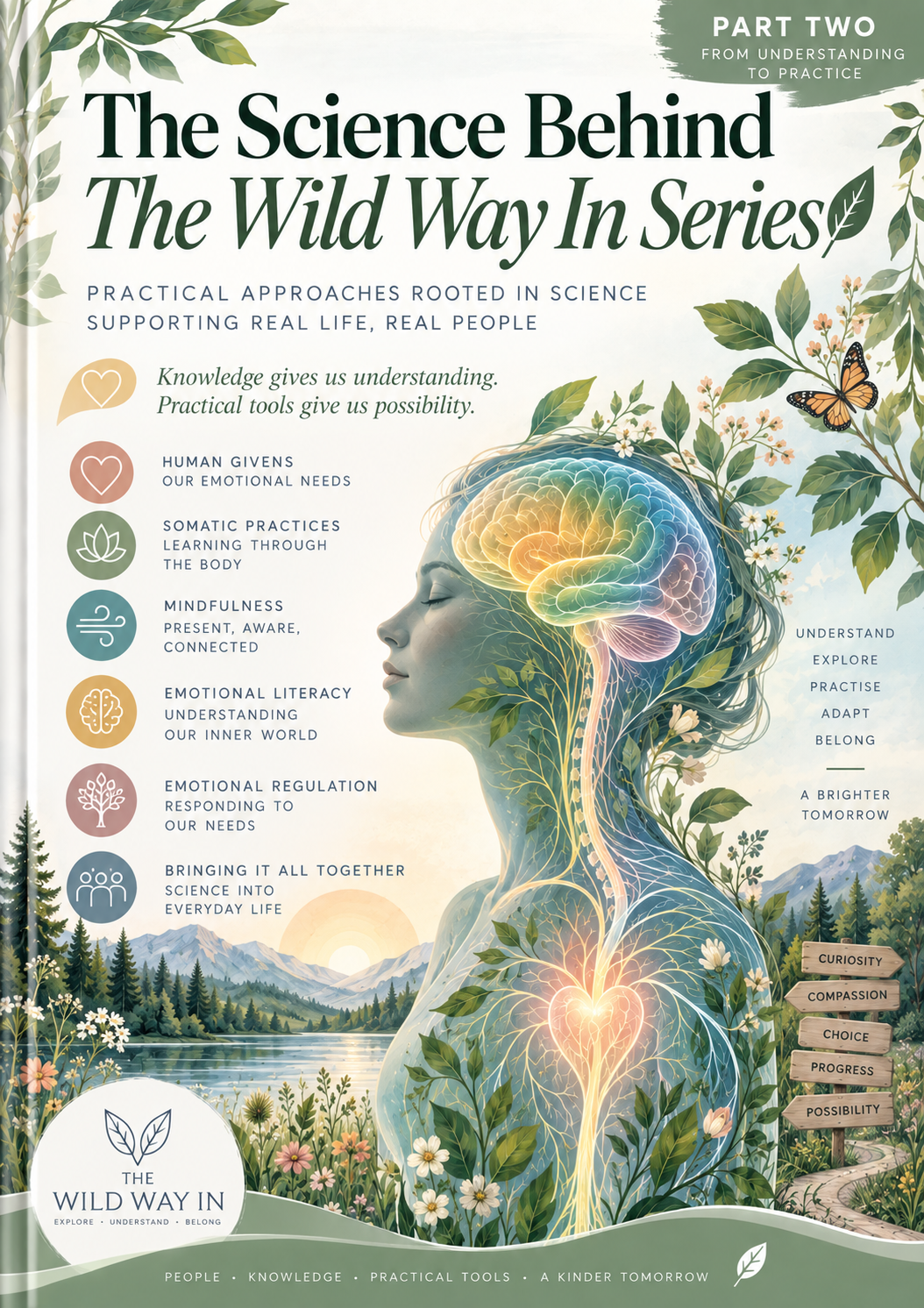
The Science Behind The Series - Part Two
Five approaches. One whole-person picture.
Knowing the biology matters - yet people are more than biology..
Part Two takes the foundations further by exploring five complementary areas used within The Wild Way In: Human Givens, somatic practices, mindfulness and accessible attention, emotional literacy, and emotional regulation. It is designed to help you see how needs, body information, attention, language, relationships, context and regulation can interact.. without pretending that one approach is the answer for everyone.
WHAT PART TWO EXPLORES..
Human Givens: needs, resources and context - Explore what the framework proposes, the role of emotional needs and resources, and why context matters.
Somatic practices: body information and movement - Understand what somatic practice means and explore proprioception, vestibular input, interoception and safe body exploration.
Mindfulness and accessible attention - Reframe mindfulness as attention rather than compulsory stillness, with breathing, choice and learning considered alongside neuroplasticity.
Emotional literacy - Explore how emotional experience can be recognised, understood and communicated, including alexithymia and interoceptive differences, without turning feelings into a test.
Emotional regulation - Look beyond appearing calm to bottom-up and top-down processes, co-regulation, autonomy, recovery and the ways these approaches can work together.
WHY PART TWO IS DIFFERENT?
It does not ask you to pick a camp. Body or brain. Mindfulness or movement. Emotional language or nervous-system support. Instead, it helps you understand what each lens can contribute and where individual choice, context and accessibility matter. That makes it useful not only for learning once, but for revisiting as your understanding, family, work or practice develops.
If you already know that “calm down”, “name the feeling” or “take a breath” is too simplistic, Part Two gives you a much richer framework for understanding what support can involve.
WHO IS IT FOR?
Adults, parents, carers, educators and professionals who want to connect theory with practical, autonomy-centred and neuroinclusive ways of thinking about wellbeing and regulation.
Move beyond isolated techniques. See the person, the context and the whole system.
www.thewildwayin.com