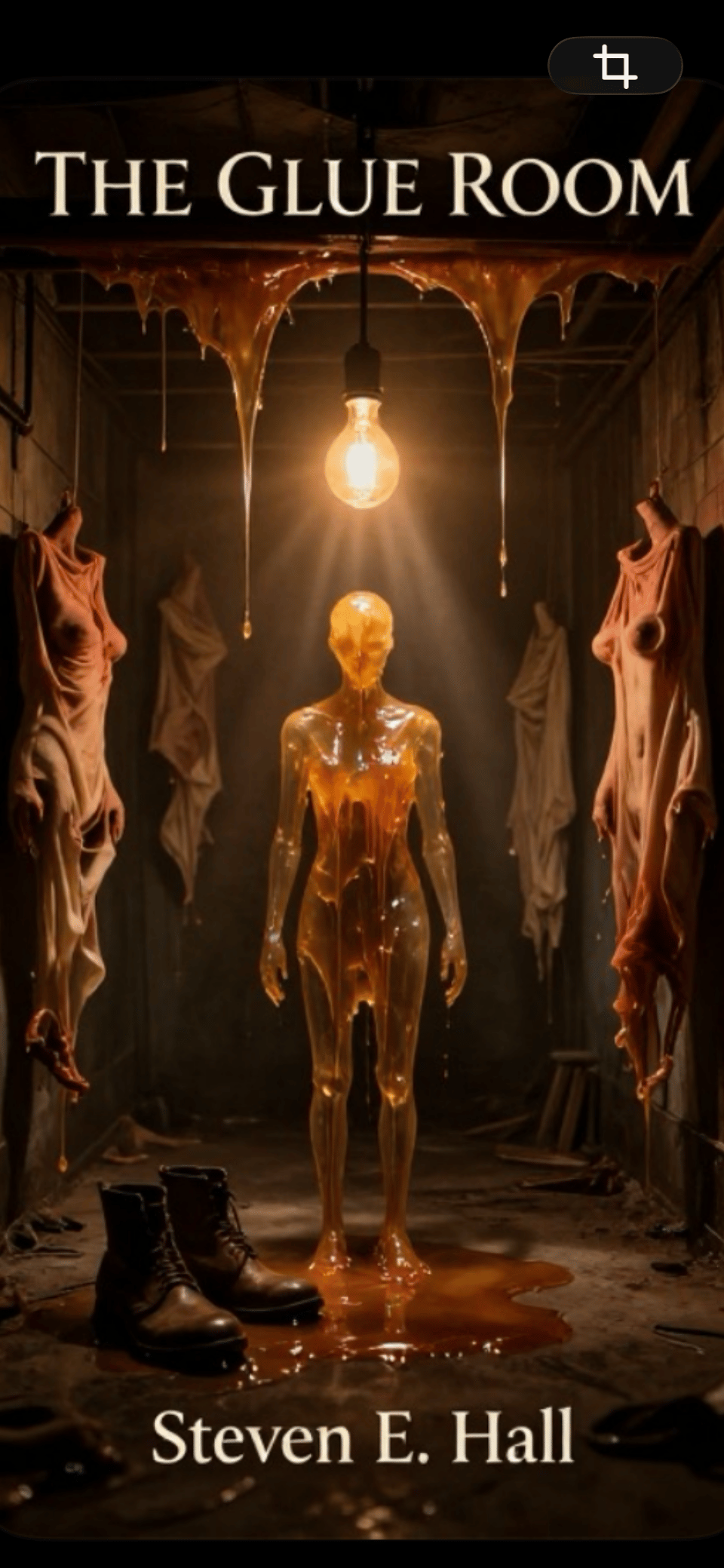
The glue room
Horror : please read content warning at the bottom before reading
In the warm, almond-scented darkness of an abandoned mattress factory, curiosity leads you through a rusted loading dock door.
One soft shkk is all it takes.
Trapped by a living, golden glue that clings with terrible tenderness, you become the latest offering to a quiet cult that does not kill. They reveal. Guided by the gentle, conflicted Brother Ambrose and his sorrowful bait, Lux, they peel away every comforting lie—layer by layer, memory by memory—until nothing remains between you and the raw truth of your own flesh.
This is not torture. This is intimacy.
As your skin is stretched, cured, and framed alongside dozens of others, and as you are preserved in a warm solvent tank—eyes forever open—you will watch new souls make the same fatal step. You will ring a bell no one answers. And you will discover the most horrifying truth of all:
Even when everything has been taken from you, you are still you.
The Glue Room is a devastating work of literary body horror that traps the reader in second-person intimacy. Equal parts poetic and unflinching, it explores empathy, identity, and the terrible mercy of being completely seen.
For readers of Junji Ito, Mariana Enríquez, and Cormac McCarthy.
You shouldn’t have come.
Content Warning for The Glue Room by Steven E. Hall
Reader discretion is strongly advised. This is an extreme literary body horror novel written in second-person present tense (“you”), which creates intense personal immersion.
Major Content Warnings:
• Graphic Body Horror & Mutilation: Extended, detailed depictions of skin removal (flaying/peeling), exposure of muscle and tissue, and prolonged sensory violation.
• Non-Consensual Medical Procedures / Vivisection: Systematic, ritualistic surgical alteration of the body while the victim remains conscious and aware.
• Cannibalism: The protagonist is forced to consume their own cured flesh.
• Helplessness & Entrapment: Prolonged immobility, physical restraint, and inescapable situations.
• Eye Horror: Permanent removal of eyelids and the inability to close one’s eyes.
• Permanent Disability & Mutilation: Loss of skin, facial features, and bodily autonomy with graphic long-term consequences.
• Psychological Horror: Themes of identity erosion, dissociation, forced empathy toward abusers, and existential dread.
• Cult & Philosophical Torture: A cult that justifies extreme violence through sincere philosophical and moral reasoning.
• Sensory Overload: Intense descriptions of pain, touch, smell, and bodily fluids.
• Emotional Trauma: Depictions of grief, betrayal, guilt, and moral conflict.
The novel contains no sexual violence or rape, but it is deeply intimate and invasive in its physical horror.
This book is extremely disturbing and emotionally heavy. It is not intended for readers sensitive to detailed body horror, medical trauma, or prolonged suffering. The second-person perspective is designed to make the reader feel trapped inside the experience.
Proceed with caution.