
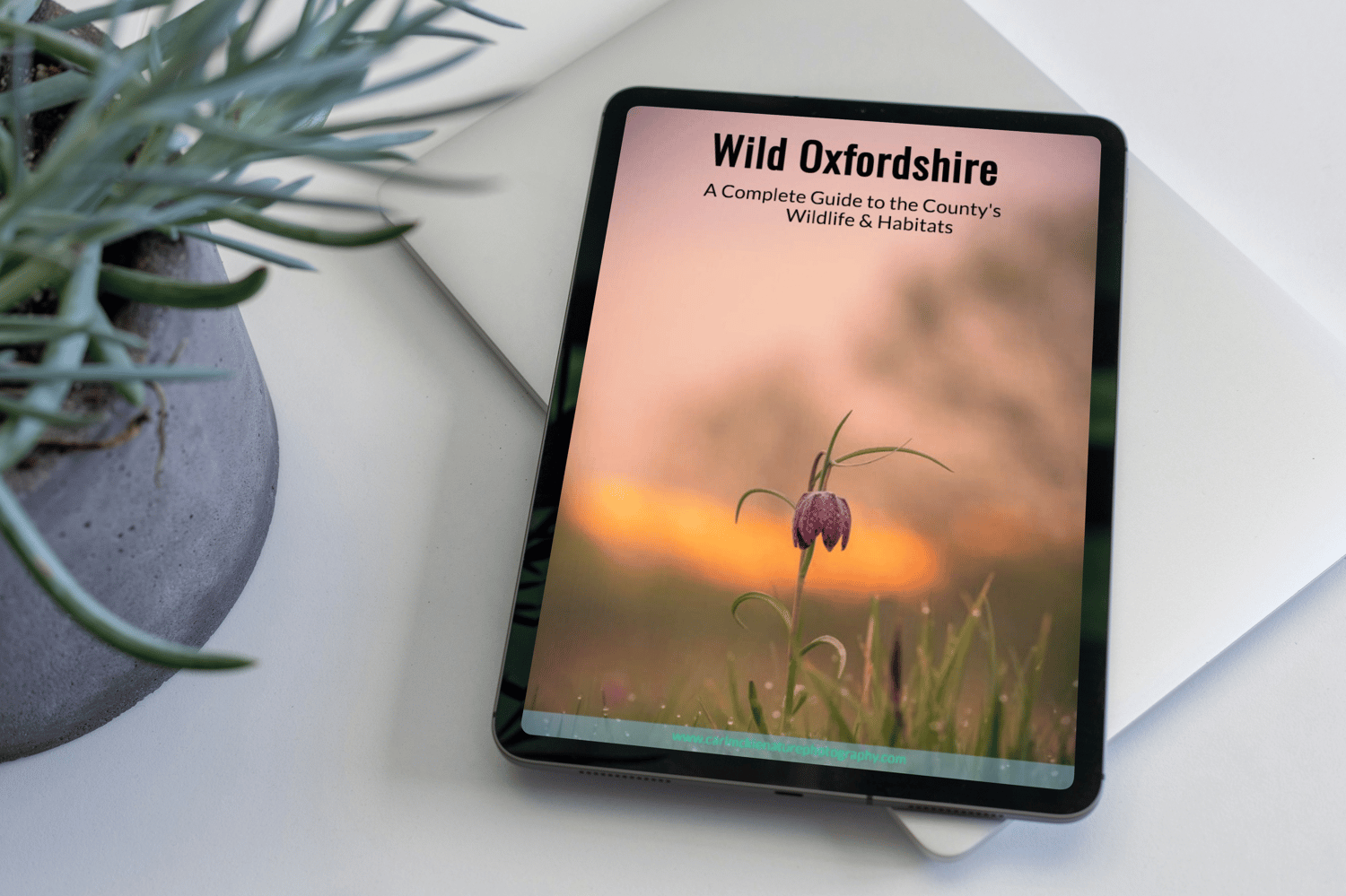
Wild Oxfordshire
WILD
OXFORDSHIRE
A Natural History of the County's Habitats, Flora & Fauna
About This eBook
Wild Oxfordshire is an immersive celebration of one of England's most naturally diverse counties. Nestled in the heart of the Thames Valley and reaching north to the limestone uplands, Oxfordshire harbours an extraordinary richness of wildlife — from ancient flower-rich meadows humming with pollinators to the chalk streams of the Chilterns, the broad-leaved woodlands of Wychwood, and the wetland mosaics along the upper Thames.
This eBook invites you on a journey through the county's wild places across the seasons, exploring the landscapes, plants and animals that make Oxfordshire a special corner of England. Whether you are a seasoned naturalist or a curious newcomer stepping into nature for the first time, these pages offer a rich portrait of wild Oxfordshire as it really is — teeming, surprising, and endlessly rewarding.
Illustrated with evocative descriptions and guided by seasonal rhythms, Wild Oxfordshire is both a practical field companion and a love letter to the landscapes that sustain the county's extraordinary biodiversity.
Habitats of Oxfordshire
Oxfordshire's variety of underlying geology — from Jurassic limestone in the north through Oxford Clay, Greensand, and the chalk of the Chilterns in the south — creates a mosaic of habitats of remarkable richness.
Ancient Woodlands
The ancient woodlands of Oxfordshire are among its most treasured habitats. Wychwood Forest, once a royal hunting ground, survives as a fragment of one of the oldest forests in England. Its ash, oak and field maple canopy shelters a ground flora packed with early-purple orchids, wood anemones and bluebells in spring. Other ancient woods — Shotover Hill, Bernwood Forest and the beechwoods of the Chilterns — provide irreplaceable refuges for rare invertebrates, woodland birds such as the marsh tit and hawfinch, and specialist fungi.
Chalk Downland & the Chilterns
The chalk escarpment of the Chiltern Hills forms the county's southern and eastern edge, producing thin, nutrient-poor soils ideal for chalk grassland — one of Britain's most species-rich habitats per square metre. Ancient trackways, ridge-tops and south-facing slopes support carpets of wild thyme, clustered bellflower, common rock-rose and the unmistakable Chiltern gentian. The steep beech 'hangers' running along the scarp are iconic landscapes, while the valleys host crystal-clear chalk streams — some of the finest in Europe.
The Thames & its Watermeadows
The River Thames rises at Thames Head in the Cotswold fringe and winds through the heart of Oxfordshire, gathering tributaries like the Cherwell, Evenlode and Windrush as it travels east. The floodplain meadows along these rivers are extraordinary reservoirs of biodiversity. Meadows such as Iffley Meadows on the edge of Oxford — famous for their snake's head fritillaries — are a relic of a once widespread but now severely diminished landscape. River margins support reed and sedge beds, while the open water provides feeding habitat for kingfishers, grey herons and otters.
Limestone Grasslands & the Cotswold Fringe
In the north and west of the county, Oxfordshire grades into the oolitic limestone of the Cotswolds. Here, traditional pastures on limestone brash support a distinctive community of plants including cowslips, field scabious, yellow rattle and a variety of orchids including the bee orchid and pyramidal orchid. These grasslands are vital for bumblebees and butterflies, including the marsh fritillary and dingy skipper.
Heathland & Acidic Grassland
Patches of acidic sandy soil, particularly around Shotover Country Park and the Greensand areas near Wheatley and Brill, support fragments of lowland heathland — a nationally scarce habitat. Heather, gorse, and fine-leaved grasses dominate here, supporting specialist species such as the green woodpecker, tree pipit and a rich community of solitary bees and wasps.
Farmland & Field Margins
Much of Oxfordshire remains agricultural, but well-managed field margins, hedgerows and arable edges provide vital corridors for wildlife. Sympathetically managed farmland supports grey partridge, brown hare, lapwing and yellowhammer, alongside a wealth of arable wildflowers including corn marigold and pheasant's eye — once common, now local rarities.
Flora of Oxfordshire
Oxfordshire's botanical diversity is exceptional for an inland English county. The varied geology underpins a flora of over 1,300 recorded vascular plant species.
Signature Wildflowers
Snake's Head Fritillary (Fritillaria meleagris)
One of Oxfordshire's most iconic plants, flowering in April in damp meadows along the Thames and Cherwell. Iffley Meadows, Port Meadow and Magdalen College Meadow hold nationally important populations of this beautiful chequered purple and white flower.
Chiltern Gentian (Gentianella germanica)
Found only in the Chilterns in Britain, this late-summer gentian appears in late August and September on short chalk turf, its vivid blue-purple flowers a highlight of the late-season downland.
Early Purple Orchid (Orchis mascula)
Among the first orchids to flower in spring, lighting up ancient woodlands and limestone grasslands with spires of deep magenta from April onwards.
Bee Orchid (Ophrys apifera)
One of Britain's most extraordinary wildflowers, the bee orchid's flowers mimic female bees to attract pollinators. It appears in limestone grasslands, road verges and churchyards across the county from June.
Bluebell (Hyacinthoides non-scripta)
The native English bluebell transforms Oxfordshire's ancient woods into a sea of blue-violet in late April and May, with strong populations in Wychwood, Bernwood and the beechwoods of the Chilterns.
Cowslip (Primula veris)
A characteristic flower of limestone and chalk grasslands, the cowslip colours roadsides and traditional meadows bright yellow in April, and is an important nectar source for early bumblebees.
Meadow Cranesbill (Geranium pratense)
One of the glories of Oxfordshire's road verges and river meadows, the large, vivid blue-violet flowers of meadow cranesbill are a hallmark of unimproved grassland in summer.
Ragged Robin (Lychnis flos-cuculi)
A jewel of wet meadows and marsh margins, ragged robin's deeply-fringed pink petals flower from May to August in the damp floodplain meadows of the Thames valley.
Common Spotted Orchid (Dactylorhiza fulgida)
Widespread in limestone grassland, road verges and woodland clearings, this is Oxfordshire's most frequently encountered orchid, its pale pink and purple spotted flowers appearing in June and July.
Yellow Rattle (Rhinanthus minor)
Known as the meadow-maker, yellow rattle is a hemiparasitic annual that weakens coarse grasses and allows wildflowers to flourish. It is a cornerstone species in the management of traditional meadows.
Aquatic & Wetland Plants
Oxfordshire's rivers, streams, ponds and watermeadows support a rich flora of wetland plants. Water crowfoot (Ranunculus aquatilis) creates white-flowered rafts on the surface of the chalk streams and the Thames in early summer. Yellow iris, purple loosestrife, meadowsweet, great willowherb and common comfrey fringe the riverbanks, creating a lush and colourful bankside flora from June to August. Water-violet, a nationally scarce aquatic plant, persists in some of the cleaner ditches and backwaters.
Fauna of Oxfordshire
Mammals
Oxfordshire supports a strong mammal fauna, including several species of national and international importance. The European otter has made a remarkable comeback on the Thames, Cherwell and Evenlode following improvements in water quality. Water voles persist in strongholds along calmer stretches of river, though they remain vulnerable to mink predation. The Eurasian badger is common in the county's woodlands and farmland, while the hedgehog — now in national decline — can still be found in gardens and hedgerows. Roe deer and muntjac are widespread; fallow deer occur in some of the larger woods. Both the lesser horseshoe bat and the greater horseshoe bat have been recorded here, along with all five species of pipistrelle likely to be encountered in southern England.
Birds
Over 200 species of bird have been recorded in Oxfordshire. The county is notable for its breeding red kites — a successful reintroduction programme launched in the Chilterns in 1989 has transformed the skies of southern Oxfordshire, where hundreds of birds can now be seen soaring overhead. The kingfisher is a dazzling resident of Oxfordshire's rivers. Peregrine falcons nest on Oxford's towers and spires, hunting over the city and surrounding farmland. The Little Egret, once a rarity, is now a regular sight along the Thames. Other notable species include the hobby, stone curlew (in arable farmland on the Downs and limestone wolds), lapwing, curlew, grey partridge, turtle dove, swift, house martin and — in the ancient woodlands — the lesser spotted woodpecker, marsh tit and hawfinch.
Reptiles & Amphibians
All six native reptile species occur in Oxfordshire, including the adder on heathland fragments and south-facing grassland slopes, and the slow worm in scrubby habitats and gardens. The great crested newt is well represented, benefiting from the county's network of farm ponds; Oxfordshire is among the counties with the highest densities of this European protected species. Common frogs, smooth newts and common toads are widespread in gardens, parks and nature reserves.
Invertebrates
Invertebrate life in Oxfordshire is extraordinary in its diversity. The chalk downlands and limestone grasslands are among the finest habitats in Britain for butterflies, with over 40 species recorded in the county. The silver-washed fritillary, white admiral and purple hairstreak favour the ancient woodlands; the chalkhill blue, Adonis blue, small blue and Duke of Burgundy are associated with specific chalk grassland plants on the Chilterns and Downs. The brown hairstreak — a secretive species associated with blackthorn — has strongholds in the hedgerow-rich north of the county. Oxfordshire's chalk streams support diverse mayflies, stoneflies and caddisflies, indicators of excellent water quality, as well as the white-clawed crayfish in some stretches.
Fish
The River Thames and its tributaries support a varied fish fauna. The chub, perch, roach and pike are characteristic of the main river, while the crystal-clear chalk streams of the Chilterns — the Pang, Chess and Hamble — are renowned for their wild brown trout and grayling populations. The bullhead, a small bottom-dwelling fish, is a good indicator of clean gravel-bedded streams and occurs widely across the county.
Conservation & Wild Places to Visit
Oxfordshire's wild places are protected and managed by a dedicated network of conservation organisations. The Berks, Bucks & Oxfordshire Wildlife Trust — BBOWT — is the county's leading wildlife charity, managing over 90 nature reserves across the three counties and championing wildlife recovery at landscape scale. From intimate chalk grassland fragments to ancient flood meadows, BBOWT's reserves represent the finest surviving examples of Oxfordshire's natural heritage.
Otmoor & the RSPB
Otmoor is one of Oxfordshire's most extraordinary wild places — a vast, low-lying mosaic of wet grassland, reedbeds, scrub and open water lying to the north-east of Oxford. Managed by the RSPB, Otmoor is renowned for its spectacular starling murmurations in winter, which draw thousands of visitors to witness one of nature's great spectacles. In spring and summer, Otmoor holds breeding lapwing, redshank, snipe, curlew and marsh harrier, as well as nationally important populations of dragonflies and wetland butterflies including the rare marsh fritillary. Bitterns boom from the reedbeds in the early morning, and otters are regularly seen along the reserve's dykes and pools.
Warburg Nature Reserve
Warburg Nature Reserve, tucked into a secluded valley in the Chiltern Hills near Bix, is one of BBOWT's most celebrated reserves and a site of outstanding botanical importance. Named after the Oxford botanist Edmund Warburg, the reserve encompasses ancient woodland, chalk scrub, species-rich grassland and a small stream valley, supporting an exceptional diversity of over 450 plant species. Warburg is one of the finest sites in Britain for woodland orchids, including the white helleborine, violet helleborine and bird's-nest orchid. Its butterfly fauna is equally impressive, with the Duke of Burgundy, white admiral, silver-washed fritillary and purple emperor all recorded here.
Wytham Woods
Wytham Woods, owned by the University of Oxford, is one of the most intensively studied woodlands in the world and a Site of Special Scientific Interest of global significance. Covering some 400 hectares on a hill to the west of Oxford, the woods encompass ancient semi-natural woodland, secondary woodland, limestone grassland and scrub. Continuous ecological research at Wytham since the 1940s has produced landmark studies on great tit populations, badger behaviour and woodland food webs that have shaped modern ecology. For the visitor, Wytham offers ancient oaks, bluebells in spring, a rich bird community including all three woodpecker species, and the chance to walk in a wood where nature has been cherished for generations.
The Thames Path National Trail, running the length of the county along the river, offers unrivalled access to watermeadows, riverside woods and wetlands. The Ridgeway National Trail crosses the chalk escarpment of the Chilterns and Downs, passing ancient monuments and flower-rich grassland. Port Meadow — one of the oldest continuously grazed commons in England — provides extraordinary wildlife watching within walking distance of Oxford city centre.
Photography: Carl McKie Nature Photography
The images throughout Wild Oxfordshire were captured by Carl McKie, one of the county's foremost nature photographers. Carl McKie Nature Photography specialises in the wildlife and wild places of Oxfordshire and the wider British countryside, bringing patience, intimacy and a deep knowledge of natural history to every image. From the dawn flight of a marsh harrier over Otmoor to the jewel-like precision of an Adonis blue butterfly resting on chalk downland, Carl's photography reveals the extraordinary beauty of the wild world that exists on our doorstep.
Carl's work is rooted in a genuine love for Oxfordshire's landscapes and their wildlife. His photographs of the county's orchids, rivers, woodland interiors and open skies have been widely exhibited and published, and his images form the visual heart of this ebook — a reminder that wild Oxfordshire is not just a place to read about, but a living, breathing landscape waiting to be discovered.
Wild Oxfordshire reminds us that nature is never far away — it is woven into the very fabric of the county, from the reedbeds of Otmoor to the ancient beeches of the Chilterns, from the orchid-rich slopes of Warburg to the timeless oaks of Wytham Woods.