
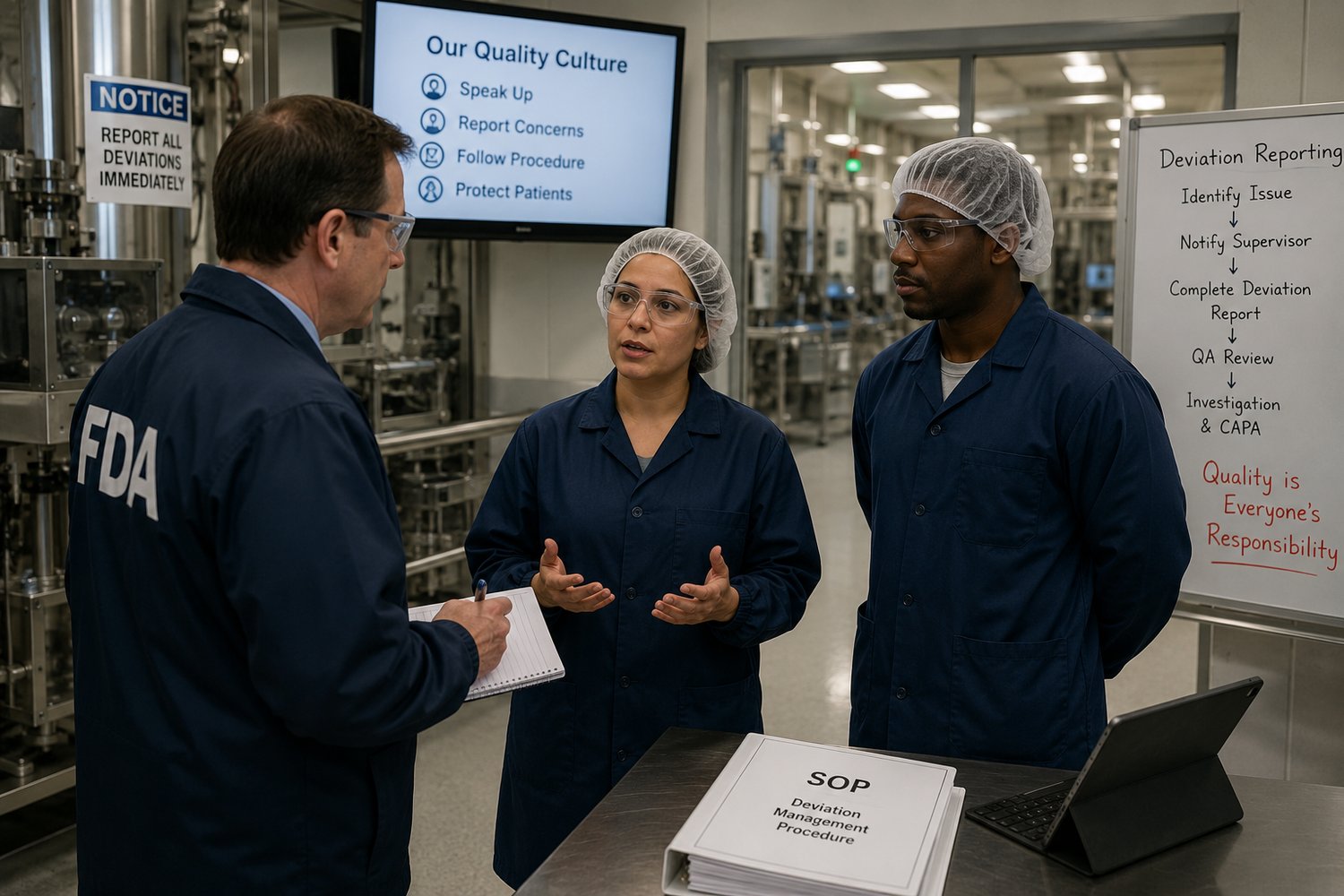
Six Questions Your Floor Staff Will Be Asked During an FDA Inspection
Six Questions Your Floor Staff Will Be Asked During an FDA Inspection (And What the Wrong Answer Costs You)
Written by a former FDA Investigator who spent 14 years issuing Form FDA-483s, then 13 years on the other side of the table as a pharmaceutical quality executive, including work navigating J&J out of consent decree.
Your Quality Director is not the only person FDA talks to during an inspection. Investigators walk the floor and talk to line operators, lab techs, warehouse staff, and QC analysts, people who were never in the opening meeting and have no idea what the "right" answer sounds like. What they say, unscripted, can change the entire trajectory of your inspection.
[This is an employer-reimbursable professional compliance resource. Send this page to your Quality Director, Site Head, Regulatory Affairs leader or Learning and Development department for approval.]
This document lays out the six questions Investigators actually ask on the floor, the reasoning behind each one, and what a strong versus a weak answer reveals:
- The opening question that tests whether an employee actually understands their own escalation pathway, not just their job function
- Why "when did you last receive training on this procedure" is one of the most consistently cited gaps in FDA's enforcement data, and what answer patterns trigger a citation
- How Investigators test whether staff can tell the difference between normal process variability and a true deviation
- The single question that reveals whether your quality culture is real or only exists on a training slide: what happens when a supervisor says keep going anyway
- What floor staff answers about GMP record corrections reveal about your data integrity controls, and the ALCOA gaps that surface without anyone realizing it
- How Investigators uncover the gap between what your SOP says and what your employees were actually trained to do, and why normalizing that gap is worse than not noticing it
Each question includes the deliberate reasoning behind why it's asked, specific red flags that show up in real answers, and a closing readiness checklist your team can run as a self-assessment before FDA runs it for you.
If your quality team has ever walked out of a closeout meeting wondering what your own floor staff said behind closed doors, this tells you exactly what was being listened for.
For informational purposes only. Does not constitute legal advice.