
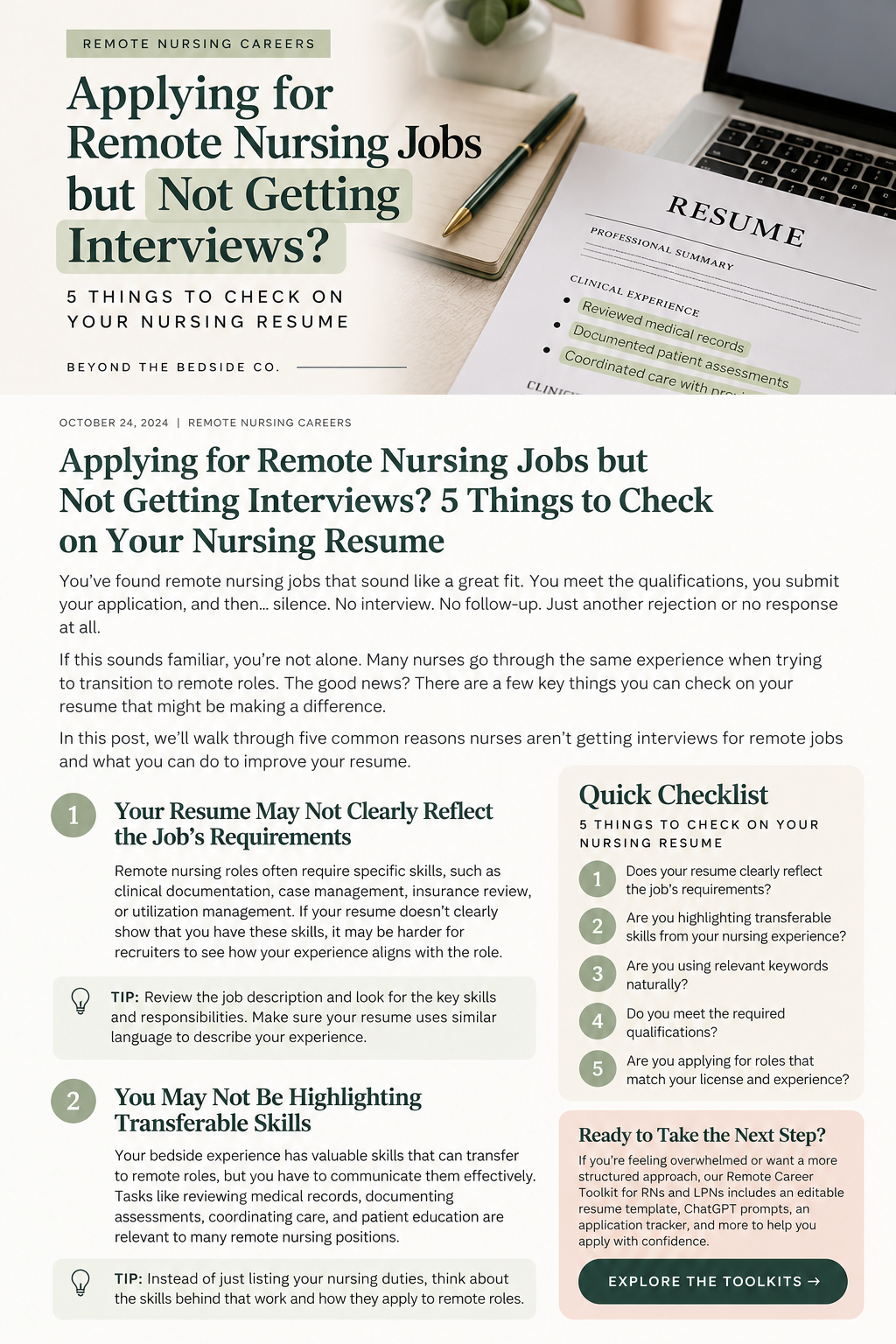
Applying for Remote Nursing Jobs but Not Getting Interviews? 5 Things to Check on Your Nursing Resume
You've found remote nursing jobs that sound like a great fit. You meet the qualifications, you submit your application, and then… silence. No interview. No follow-up. Just another rejection or no response at all.
If this sounds familiar, you're not alone.
When I started applying for remote nursing positions, I didn't realize how different the job search could be outside of traditional bedside nursing. I had clinical experience, but I had to learn how to communicate that experience in a way that made sense for remote and corporate healthcare roles.
The problem isn't always your experience. Sometimes, the issue is how your resume presents it, which positions you're targeting, or how closely your application matches the job description.
Here are five things to check before submitting your next application.
1. Your Resume May Not Clearly Reflect the Job Requirements
One of the biggest mistakes you can make is submitting the exact same resume for every remote nursing position.
Remote nursing jobs aren't all alike. A utilization management position may emphasize medical necessity reviews and clinical criteria, while a care coordination role may focus on patient follow-up, documentation, and coordinating services.
Even though both positions may be appropriate for nurses, employers are looking for different skills.
What to do instead:
Before applying, read the job description and identify three to five key responsibilities or qualifications that genuinely match your experience.
Then review your resume. Are those skills easy to find? Does your experience clearly demonstrate how you've used them?
You don't need to rewrite your entire resume for every application. Start by making sure your most relevant experience is easy for a recruiter to recognize.
2. You May Not Be Highlighting Your Transferable Skills
Your nursing experience is valuable beyond the bedside. The challenge is learning how to describe it in a way that connects with the role you're pursuing.
Think about the work you already do as a nurse. Depending on your actual responsibilities, you may have experience with:
- Reviewing medical records and identifying relevant clinical information
- Documenting assessments and maintaining accurate patient records
- Communicating with providers and members of the care team
- Coordinating care and communicating changes in patient status
- Educating patients and families
- Following clinical protocols and recognizing when concerns need escalation
These skills may be relevant to remote positions in care coordination, clinical review, quality improvement, and other healthcare functions.
Here's an example:
A general resume bullet might say:
Reviewed medical records.
A more descriptive version, if accurate to your experience, could say:
Reviewed medical records to identify relevant clinical information and support accurate documentation.
The second version gives the reader more context about the work you performed.
The key is to describe your actual responsibilities clearly. Never add duties, skills, or accomplishments you haven't performed.
3. Your Resume May Not Use Relevant Keywords
Many employers use applicant tracking systems (ATS) to help manage applications. Depending on the system and the employer's process, these tools may help organize resumes, parse information, or support recruiters in reviewing applicants.
This is why your resume needs to communicate your qualifications clearly in both its wording and its format.
For example, a job posting might mention:
- Clinical documentation
- Care coordination
- Utilization management
- Medical record review
- Quality improvement
If you have experience that matches those requirements, use accurate, relevant language to describe it on your resume.
What to do instead:
- Identify important skills and phrases in the job posting.
- Determine which ones honestly match your experience.
- Incorporate relevant terms into your professional summary, skills section, or experience bullets where appropriate.
- Use a clean, readable resume format with conventional headings.
Don't simply copy every keyword into your resume. The goal is to demonstrate relevant experience, not to stuff your application with phrases or claim qualifications you don't have.
And remember: using the right keywords doesn't guarantee an interview. Employers consider many factors, including qualifications, experience, and their own hiring requirements.
4. You May Be Missing a Required Qualification
Not every remote nursing position is open to every nursing license or level of experience.
Some jobs accept LPNs and RNs, while others require an RN license, a bachelor's degree, a specialty certification, or a specific amount of experience in utilization management, case management, or another clinical area.
A job may sound perfect, but if you don't meet a required qualification, a stronger resume may not change the outcome.
What to do instead:
Read the qualifications section carefully and distinguish between requirements and preferences.
Ask yourself:
- Is my license or degree eligible for this position?
- Do I meet the required years of experience?
- Are any certifications mandatory?
- Does the employer require a particular state license or geographic location?
- Is the role truly remote, or does it have location or occasional onsite requirements?
Don't automatically rule yourself out just because you don't meet every preferred qualification. But pay close attention to requirements the employer identifies as mandatory.
Applying strategically can help you spend less time on positions that aren't a realistic match.
5. You May Be Applying for Roles That Don't Match Your Experience
Searching only for "remote nurse" or "work-from-home nursing jobs" can limit the positions you discover.
Remote healthcare jobs may use titles that don't include the word nurse at all.
Depending on your license, background, and qualifications, you may want to explore titles such as:
- Clinical Reviewer
- Utilization Management Nurse
- Care Coordinator
- Case Manager
- Prior Authorization Nurse
- Appeals and Grievances Nurse
- Clinical Documentation Specialist
- Quality Improvement Nurse
These roles have different eligibility requirements, and not every position is available to LPNs. Always verify the specific qualifications in each posting.
What to do instead:
Search for several job titles that align with your experience. Compare the responsibilities, identify employers that hire for those functions, and keep track of the roles you apply for.
A broader, more targeted search can help you uncover opportunities you might otherwise miss.
Before You Apply: A Quick Resume Checklist
Before submitting your next remote nursing application, take a few minutes to review these questions.
- Does my resume clearly show how my experience relates to this position?
- Have I highlighted relevant transferable skills?
- Have I included appropriate keywords from the job description where they accurately reflect my experience?
- Is my resume easy to read and organized with clear section headings?
- Do I meet the required license, education, and experience qualifications?
- Have I tailored the most relevant parts of my resume to this specific role?
You don't need to fix everything overnight. Start with one application, identify one or two improvements, and build from there.
Your Next Step Toward a Remote Nursing Career
I know how discouraging it can feel to keep applying for remote nursing jobs without hearing anything back. I also know how overwhelming it can be to figure out which positions to search for, how to present your experience, and what employers are actually looking for.
That's why I'm sharing practical lessons to help nurses navigate the process one step at a time.
Start with the free guide: 15 Remote Nursing Job Titles to Search for Today.
Use it to expand your search beyond the same few job titles and discover other career paths worth exploring.
If you're ready for a more structured approach, the Remote Career Toolkits for LPNs and the Remote Career Toolkit for RNs at Beyond the Bedside Co. provide additional guidance, an editable resume template, ChatGPT prompts, an application tracker, and resources to help organize your job search.
You don't have to figure everything out in one day. Start by improving one part of your process, then keep building your skills and confidence with each application.
Your next chapter starts here.
Disclaimer: This article provides general career guidance, not a guarantee of employment or interviews. Job eligibility and hiring requirements vary by employer and position. Always verify the requirements of individual job postings.