

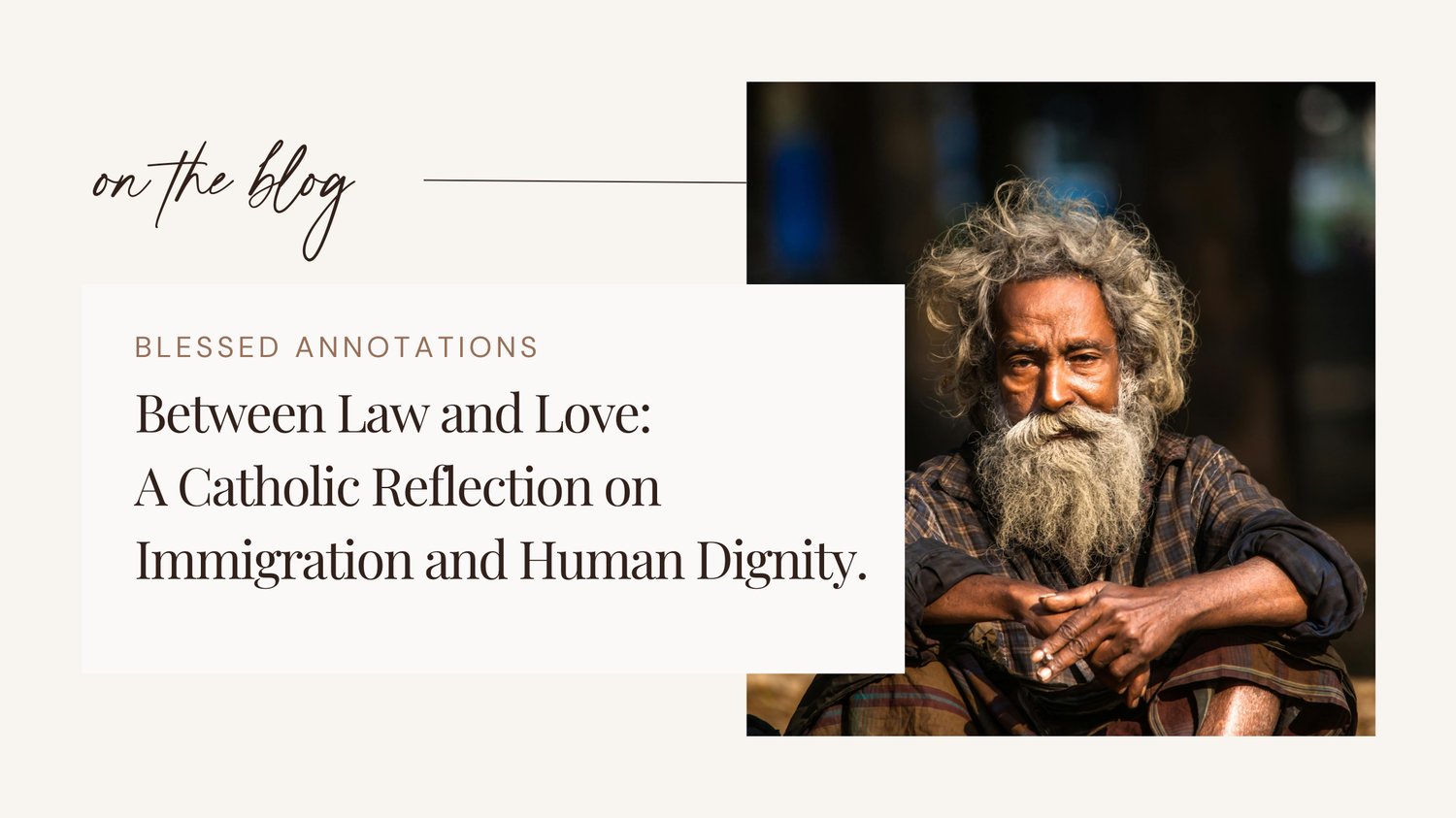
In the heated debates surrounding immigration policy today, we find ourselves at a crossroads where legal frameworks collide with moral imperatives. As Catholics, we are called to navigate this tension with both wisdom and compassion, understanding that while laws serve a necessary purpose, they must never eclipse our fundamental duty to recognize the sacred dignity of every human person.
The Foundation: Imago Dei
Catholic social teaching begins with a non-negotiable truth: every person is created in the image and likeness of God. This reality doesn't depend on legal status, national origin, or documentation. The immigrant crossing borders in search of safety, opportunity, or reunion with family carries within them the same divine imprint as the citizen who has lived generations in one place. When we forget this, we lose sight of what it means to be truly human.
The Catechism of the Catholic Church is clear: political authorities have the right to regulate immigration and secure borders for the common good. This is not in dispute. Nations have legitimate interests in maintaining security, preserving social cohesion, and managing resources. Laws are necessary instruments of justice and order. But the question we must ask ourselves is not whether law matters—it does—but whether our current approach to immigration reflects the fullness of our Catholic values.
When Law Becomes Loveless
Something profound has been lost in our national conversation about immigration. We have become a people who speak fluently the language of "illegal" and "legal," of "documentation" and "enforcement," yet we have grown increasingly silent in the vocabulary of mercy, compassion, and human rights. We have allowed the legitimate function of law to harden into something cold and mechanical, stripping away the human faces behind the statistics and case numbers.
Yes, people who enter a country without authorization have broken a law. This fact must be acknowledged. But the response to that breaking cannot be brutality, family separation, indefinite detention, or treatment that degrades human dignity. We can be a nation of laws without becoming a nation that has lost its soul. As the saying goes, "We can be criminals but not taken-down criminals"—we can enforce our laws without becoming lawless in our treatment of the vulnerable.
The Biblical Mandate
Scripture leaves no room for ambiguity on how we are to treat the stranger. "You shall not oppress a stranger, since you yourselves know the feelings of a stranger, for you also were strangers in the land of Egypt" (Exodus 23:9). This commandment appears, in various forms, thirty-six times in the Hebrew Scriptures—more than almost any other command. God takes the treatment of the foreigner seriously.
Jesus himself was a refugee, fleeing with Mary and Joseph to Egypt to escape Herod's violence. In the parable of the sheep and the goats, Christ identifies himself explicitly with the stranger: "I was a stranger and you welcomed me" (Matthew 25:35). Our Lord doesn't ask about documentation status. He asks about welcome.
Pope Francis has repeatedly called us to resist the "globalization of indifference" that allows us to see human suffering and simply look away. He challenges us to see in the migrant the face of Christ—hungry, thirsty, naked, imprisoned, seeking refuge. This is not sentimentality. This is the Gospel.
Setting a Different Example
We stand today at a moment where we have the opportunity—and the obligation—to set a different example. We can demonstrate that it is possible to be both a nation of laws and a nation of mercy. These are not contradictory positions; they are complementary dimensions of a truly just society.
What would this look like in practice? It means creating immigration processes that are humane, efficient, and proportionate. It means ending the use of detention centers that separate children from parents and house families in conditions unworthy of human beings. It means providing paths to legal status that acknowledge both the rule of law and the dignity of those who contribute to our communities. It means training law enforcement in approaches that maintain security without dehumanization.
Most importantly, it means never losing sight of the person. Behind every immigration case is a mother hoping for her children's safety, a father seeking work to feed his family, a young person fleeing violence, a family torn apart by circumstance. These are not abstractions or numbers. They are our brothers and sisters in Christ.
The Call to Courage
This call to balance law with mercy will not be popular with everyone. Some will accuse us of being "soft on crime" or naïve about security concerns. Others may demand we abandon legal frameworks entirely. But Catholic social teaching has never promised us the easy path—only the right one.
We must have the courage to say that human dignity is not negotiable, even as we affirm the importance of ordered immigration. We must resist both the temptation to ignore legitimate security concerns and the temptation to treat human beings as disposable. We must be willing to advocate for comprehensive reform that serves both justice and mercy.
A Call to Prayer: The Rosary for Immigrants
Before we can change policies, we must change hearts—beginning with our own. I invite you to join me in a powerful spiritual practice: praying the rosary daily for immigrants, refugees, and all those affected by our immigration system.
As we meditate on the mysteries of Christ's life, we can see immigration reflected throughout:
- The Joyful Mysteries remind us of Mary's journey to visit Elizabeth—a pregnant woman traveling to serve and be with family.
- The Sorrowful Mysteries show us the Holy Family's flight to Egypt—refugees fleeing violence, dependent on the mercy of strangers.
- The Glorious Mysteries point us toward hope and resurrection—the promise that suffering is not the final word.
Let us pray for immigrants making dangerous journeys, for families separated by borders and policies, for children growing up in uncertainty, for those detained in facilities far from loved ones. Let us pray for government leaders and immigration officials, that they may act with wisdom and compassion. Let us pray for our own communities, that we may be instruments of welcome and mercy.
Our Lady of Guadalupe, patroness of the Americas and advocate for the marginalized, knew what it meant to bring comfort to those treated as outsiders. Through the rosary, we unite our prayers with hers, asking for her intercession on behalf of all migrants.
This daily practice does more than petition heaven—it transforms us. Each decade prayed softens our hearts, opens our eyes, and strengthens our commitment to see Christ in the stranger. Prayer is not a substitute for action, but it is the wellspring from which authentic action flows.
Will you commit to this spiritual solidarity? Will you let the rosary shape not only your prayer life but your engagement with this critical issue?
Conclusion: A Witness to the World
The world is watching how we respond to the most vulnerable among us. Our immigration policies and practices are not merely administrative matters—they are profound moral statements about who we are and what we value. They reveal whether we truly believe that all human life is sacred or whether our commitment to dignity has limits and conditions.
As Catholics, we are called to be prophetic voices in this conversation, reminding our communities and our leaders that law must serve life, not diminish it. We are called to set an example of a different way—one that holds together both order and compassion, both security and welcome, both law and love.
In the end, we will not be judged by how efficiently we processed cases or how secure we made our borders. We will be judged by how we treated "the least of these." May we have the wisdom to create just laws and the grace to implement them with mercy. May we never become so focused on who is legal that we forget who is human.
The choice before us is clear: we can be a people who uses law as a shield for dignity, or as a weapon against the vulnerable. Let us choose wisely.
Comments ()