

Ask a privacy professional what CIPP-A covers and you will often hear some version of "Asian privacy law," said as though that were a single thing. It is the most persistent misconception about this certification, and it quietly shapes how people prepare for it: read a summary of the region's major laws, notice that several of them look broadly similar, assume the rest follows, and book the exam.
The reality is the opposite. The region the exam covers contains jurisdictions whose privacy regimes differ in structure, in who enforces them, in what rights people have, in how data may leave the country, and in how much they resemble the European model that many candidates use as a mental template. The work the certification describes is navigating that variation deliberately, not finding a single rulebook that applies everywhere.
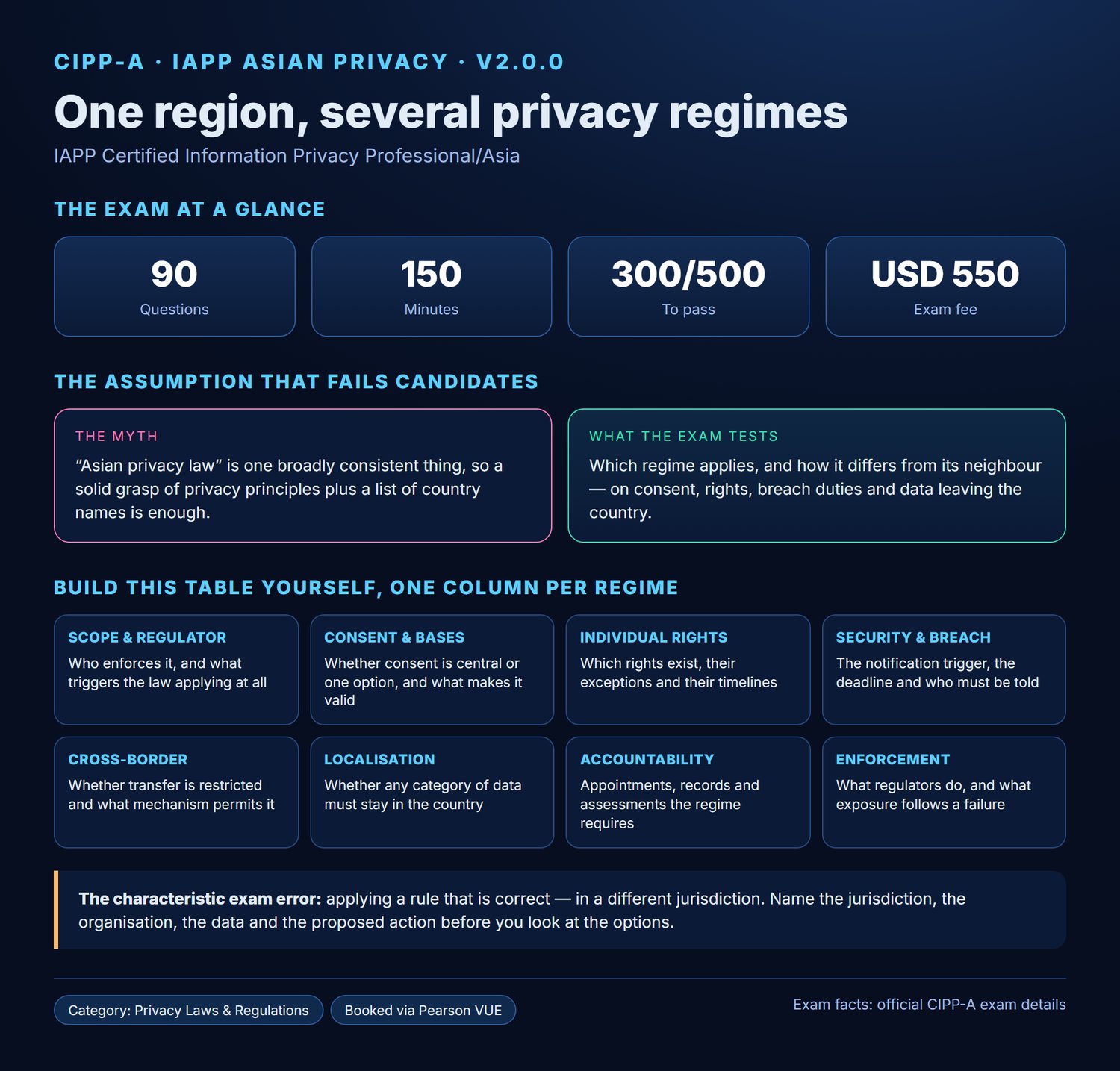
This article is organised around that gap, because closing it is most of the preparation. The exam facts come from the published details: 90 questions, 150 minutes, a passing score of 300 out of 500, a USD 550 fee, and version 2.0.0. Where the details are silent, including on eligibility and retake terms, it points to IAPP's official certification page rather than guessing. The syllabus is the authority on exactly which jurisdictions and topics are in scope, and that is worth checking first rather than assuming.
What Is the IAPP Certified Information Privacy Professional/Asia (CIPP-A)?
CIPP-A is the IAPP's privacy certification focused on Asian privacy law and practice. It sits in the Privacy Laws and Regulations category, and the matching official training is IAPP's Asian Privacy course. The current exam version is 2.0.0.
Like the other certifications in the CIPP family, it is a law and policy credential rather than a technical one. It does not ask how to configure a system. It asks whether you understand what the rules require of an organisation handling personal information, who enforces those rules, what rights individuals have, and what an organisation must do differently when it operates across more than one jurisdiction.
The myth, stated precisely
The misconception is not that candidates think Asia has literally one law. Most know better than that. The misconception is subtler and more damaging: the assumption that the differences are details, and that a solid grasp of one comprehensive privacy regime, usually the European one, plus a list of country names, is enough.
That assumption fails in a specific way. It produces candidates who can describe general privacy principles fluently and still choose wrong answers, because the question turns on something their template does not contain: a regime that treats consent differently, a rule about where data may be stored, an enforcement model that works through a different kind of authority, or a jurisdiction that regulates by sector rather than comprehensively. Recognition of the principle is not the same as knowing which variant applies.
Why the myth is so easy to hold
It survives because the summaries people read are true as far as they go. Many jurisdictions in the region do have comprehensive data protection laws, and those laws do share recognisable ideas: notice, a lawful basis for processing, limits on purpose, security obligations, and rights for individuals. If you stop reading at that level, everything looks consistent.
The divergence appears one layer down, which is exactly where exam questions live. Two jurisdictions can both require a lawful basis while differing on what counts as valid consent. Both can grant access rights while differing on exceptions and timelines. Both can regulate cross-border transfers while allowing entirely different mechanisms. A professional working across the region has to know that the second layer exists and check it every time.
Who takes the exam
It suits privacy and compliance professionals whose organisations operate in more than one Asian jurisdiction, legal and governance staff supporting regional business, security and data professionals who need the regulatory frame around the data they handle, and privacy practitioners who already hold a jurisdiction-specific credential elsewhere and now need regional coverage.
That last group is the one most exposed to the myth, and often the most confident. Holding a credential for another region proves you can learn a regime; it does not tell you how this one differs.
CIPP-A Exam Overview and Details
These are the published facts for the exam:
- Exam name: IAPP Certified Information Privacy Professional/Asia
- Exam code: CIPP-A
- Version: 2.0.0
- Category: Privacy Laws and Regulations
- Number of questions: 90
- Duration: 150 minutes
- Passing score: 300 / 500
- Exam fee: USD 550
- Scheduling: through Pearson VUE's IAPP exam page
Each of those numbers interacts with the myth in a way worth understanding.
Ninety questions in 150 minutes
That is about one minute and forty seconds per question, which sounds generous until you meet the scenarios. A law exam question frequently describes an organisation, the data it handles, where its customers and systems are, and what it wants to do next. Reading that properly takes time, and the detail that decides the answer is often a single clause about location or sector.
A candidate carrying the single-regime assumption tends to read quickly, recognise a familiar principle, and answer. That is how time is saved and marks are lost. The more reliable habit is to identify four things in every scenario before looking at the options: which jurisdiction or jurisdictions are involved, what kind of organisation it is, what data is at stake, and what action is proposed. If a scenario mentions more than one jurisdiction, the question is almost certainly about the difference between them.
Check your pace around the halfway point: roughly forty-five questions at seventy-five minutes. If you are behind, the fix is usually to stop re-reading and commit, flagging anything genuinely uncertain for a second pass.
A scaled score of 300 out of 500
The pass mark is published as a scaled 300 out of 500, not as a count of correct answers, so you cannot calculate how many you may miss. For an exam about regional variation, the practical reading is that uneven preparation is dangerous in a particular way: if you know several regimes well and one or two barely at all, the gaps will not be spread evenly across the paper. They will cluster, and a cluster of misses is harder to absorb than a scatter.
The fee and the cost of the assumption
The exam fee is USD 550. The point worth making is not that this is expensive in the abstract, but that the single-regime assumption is what usually causes a second payment. Candidates who fail this exam are rarely ignorant of privacy; they are usually well informed about privacy in general and under-informed about where this region's rules diverge. That is a preparation problem rather than a knowledge problem, and it is fixable before you book.
For retake, rescheduling, and cancellation terms, and for any eligibility requirements, check IAPP's official certification page and Pearson VUE directly, since those are not part of the exam details summarised here.
Version 2.0.0
The exam is at version 2.0.0. Privacy law in the region has been changing quickly, with regimes introduced and amended in recent years, so material written for an earlier version can be confidently wrong rather than merely incomplete. Match your study to the current version and let the syllabus settle any disagreement.
Key Topics and Syllabus for CIPP-A
The CIPP-A syllabus on CertFun is the authority on the exam's topics, on how they are weighted, and on which jurisdictions are covered at version 2.0.0. Read it before planning anything; for this exam in particular, assuming the scope is a mistake, because the scope is the thing people guess wrong. The sections below describe the kinds of understanding a regional privacy exam expects, organised so the differences between regimes stay visible.
Privacy fundamentals, and the vocabulary problem
The foundation is the set of concepts every regime builds on: what counts as personal information, the roles of the organisation that decides how data is used and the organisation that processes it on their behalf, the principles of notice, purpose limitation, accuracy, security, and retention, and the general idea of rights held by individuals.
The complication, and the first place the myth bites, is that the same concept can carry different names and slightly different boundaries in different regimes. Terms you use confidently may be defined more narrowly or broadly elsewhere, and categories treated as sensitive in one jurisdiction may not be in another. Study the concepts, then study the variation in how they are labelled and bounded. Exam answers often hinge on a definition rather than a principle.
How regimes are structured across the region
Beyond the fundamentals, the exam is about structure. Some jurisdictions regulate comprehensively through a single data protection law; others rely more on sector-specific rules; some have a dedicated regulator, others distribute enforcement differently; some combine privacy rules with broader cybersecurity or data governance obligations.
The useful mental model is a comparison table you build yourself rather than a single narrative. For each regime in the syllabus, record who the regulator is, what triggers the law's application, what lawful bases exist, how consent is treated, what rights individuals have, what obligations apply on security and breach, how data may move across borders, and what enforcement looks like. Building that table is tedious and it is also the single most effective preparation activity for this exam, because it forces the differences into view instead of letting them blur.
Consent, lawful bases, and individual rights
Consent deserves its own attention, because the region contains regimes that lean on it heavily and regimes that treat it as one option among several. Whether consent must be explicit, what makes it valid, whether it can be withdrawn and with what effect, and what alternatives exist when consent is impractical all vary.
Rights vary in parallel. Access, correction, deletion, and objection appear in many places, but the exceptions, the timelines, and the circumstances in which an organisation may refuse are regime-specific. A worked example: an organisation receives a deletion request from a customer in one jurisdiction for data it holds in another. The questions that decide the answer are which law governs the request, whether an exception applies because the data is needed for a legal obligation or an ongoing contract, and what the organisation must tell the individual if it declines. A single-regime instinct answers from habit; a regional professional checks.
Cross-border data transfers and localisation
This is the area where the myth does the most damage, and where regional practice is genuinely distinctive. Jurisdictions differ in whether transfers out of the country are restricted at all, what mechanisms permit them, whether approval or assessment is required, and whether certain categories of data must remain within national borders.
Because most organisations operating in the region move data between countries constantly, these rules shape real architecture decisions: where systems are hosted, which vendors can be used, and what contracts must say. Expect scenario questions that describe a proposed transfer and ask what is required. Build the habit of asking, for each jurisdiction in scope, whether transfer is restricted, what permits it, and whether any category of data is treated specially.
Security, breach, and accountability obligations
Every regime requires organisations to protect personal information, and most now require notification when something goes wrong, but the thresholds, deadlines, and recipients differ. Who must be told, how quickly, and on what trigger are precisely the details that differ between neighbours.
Alongside breach rules sit accountability obligations: appointing responsible individuals, keeping records, assessing risk before certain processing, and demonstrating compliance to a regulator. These are also where several regimes in the region have added requirements recently, which is another reason version-matched material matters.
Operating across several jurisdictions at once
Finally, the exam is about the practical problem the certification exists for: running one privacy programme across many regimes. That means knowing when a single global standard is workable, when local requirements force divergence, how to handle vendors and intra-group transfers, and how to decide which rules apply when an organisation, its customers, and its systems sit in different countries.
This is the competence the credential really certifies, and it is the one the myth prevents. A professional who assumes uniformity builds a programme that is quietly non-compliant in several places. A professional who expects variation builds one that can accommodate it.
CIPP-A Preparation Guide
The plan below is designed to dismantle the single-regime assumption before it costs you an attempt.
Step 1: Establish the real scope before studying anything
Start with the syllabus and IAPP's official page, and write down exactly which jurisdictions and topics version 2.0.0 covers. Do not rely on memory, on an older summary, or on what the exam covered when a colleague took it.
Then rate yourself per jurisdiction rather than per topic. Most candidates discover an uneven picture: one or two regimes they know properly because they work with them, several they know by reputation, and some they have never studied. That distribution, not a general sense of privacy knowledge, is what your study plan should respond to.
Step 2: Build the comparison table yourself
Work through IAPP's Asian Privacy (CIPP/A) training, which is built for this certification, and as you go, fill in the comparison table described earlier: regulator, scope, lawful bases, consent treatment, individual rights, security and breach duties, cross-border rules, and enforcement, for every regime in the syllabus.
Resist the temptation to download someone else's table and read it. The value is in building it, because the act of filling cells forces you to notice where regimes differ and to look up what you cannot recall. A table you have built is also far easier to revise from in the final week.
Step 3: Study the differences, not the similarities
Once the table exists, work across its rows rather than down its columns. Compare how three or four regimes treat consent. Compare their breach notification triggers. Compare their cross-border mechanisms. Differences remembered as contrasts stick far better than facts memorised regime by regime, and contrast is precisely how exam distractors are built.
Pay particular attention to the places where your existing mental template is likely to mislead you. If you know one comprehensive regime well, list the three or four ways each regional regime departs from it. Those departures are your highest-value revision material.
Step 4: Practise scenario reading at exam pace
Move to timed practice at the real pace of 90 questions in 150 minutes. For every scenario, name the jurisdiction, the organisation, the data, and the proposed action before looking at the options.
Review each mistake and classify it: a knowledge gap, a misread scenario, or a template error, meaning you applied a rule that is correct somewhere else. The third category is the myth in action, and it should steadily disappear as the comparison work takes hold. If it does not, go back to Step 3 rather than taking more practice tests.
Step 5: Book when the differences come automatically
The readiness signal for this exam is specific. You are ready when, on seeing a jurisdiction named in a scenario, the relevant differences come to mind before you look at the answers. Book through Pearson VUE at that point, not when your overall practice score first looks acceptable.
In the final week, revise from your own table, stop adding new material, and do one full timed run to rehearse 150 minutes of careful reading. Rest the day before; a tired reader skims, and skimming is how a regional exam is failed.
Benefits and Career Scope of the CIPP-A Certification
The credential is valuable in proportion to how common the misconception is. Organisations operating across the region need people who know that the differences are real and can work with them.
It certifies regional, not generic, privacy knowledge
Many professionals can discuss privacy principles. Far fewer can say what a specific jurisdiction requires and how it differs from its neighbour. CIPP-A evidences the second kind of knowledge, which is what regional roles actually need and what a generic privacy background does not demonstrate.
It supports multi-jurisdiction programme work
The work this certification supports includes building and maintaining privacy programmes that span several countries, advising on cross-border data flows and hosting decisions, reviewing vendor and intra-group arrangements, handling individual rights requests across regimes, supporting breach response where notification duties differ, and advising business teams expanding into new markets.
It complements a credential from another region
For professionals who already hold a jurisdiction-specific privacy certification elsewhere, this one extends coverage rather than repeating it. The combination is a practical fit for organisations whose data crosses regions, and it signals that you understand privacy as a set of regimes rather than as one framework with local footnotes.
It is useful wherever the region's data is handled
Relevance is not limited to people based in the region. Organisations headquartered elsewhere that serve customers, run operations, or use suppliers there face the same questions, and the person who can answer them is frequently the one who studied for this exam. For how this certification sits alongside IAPP's others, see the official certification pages.
Practice Test and Preparation Resources
For an exam about current law in several jurisdictions, resource discipline matters more than volume.
Official resources
- Official IAPP CIPP-A certification page: the authority on the certification's current details and policies, including anything not covered here such as eligibility and retake terms.
- Asian Privacy (CIPP/A) training: IAPP's own training for this certification, linked in the Preparation Guide above. Your primary study source, and version-matched.
- Pearson VUE: where you schedule the exam and confirm testing options.
Sample questions and practice tests
When your comparison table is largely complete, work through the CIPP-A sample questions on CertFun. For this exam they are especially useful for seeing how distractors are built from rules that are correct in a different jurisdiction, which is the exact trap the myth sets.
Use practice tests to find template errors rather than to accumulate scores. A session that reveals two places where you applied the wrong regime is more valuable than one with a higher percentage and no insight. Review carefully, update your table where it was thin, and move on.
Your organisation's own footprint
If your employer operates in more than one jurisdiction in scope, its own policies, transfer arrangements, and records are a working example of the problem the exam describes. Read how your organisation handles a single process in two countries and note what it does differently. That contrast is exam-relevant and immediately useful at work.
Conclusion
CIPP-A tests whether you can work with privacy law across a region whose regimes differ in structure, in how they treat consent and individual rights, in what they require on security and breach, and in how they control data leaving the country. The exam is 90 questions in 150 minutes, needs a scaled 300 out of 500, costs USD 550, and is at version 2.0.0.
The belief that one regional summary plus a solid grasp of privacy principles will carry you is the main reason capable candidates fail it. The preparation that works attacks that belief directly: confirm the real scope from the syllabus, build your own comparison table from the official training, study the differences as contrasts rather than the similarities as a theme, and practise reading scenarios for the jurisdiction before the principle.
Prepared that way, the credential reflects what the job needs: not a privacy professional who knows the rules in general, but one who knows which rules apply here, and why they are not the same as the ones next door.
FAQs
How many questions does CIPP-A have, and how long is the exam?
The exam has 90 questions and a duration of 150 minutes, about one minute and forty seconds per question.
What is the passing score for CIPP-A?
The passing score is 300 out of 500. It is a scaled score, so it does not convert directly into a number of correct answers.
How much does the CIPP-A exam cost?
The exam fee is USD 550. Confirm the amount that applies to you when you book through Pearson VUE.
Which jurisdictions does the exam cover?
The syllabus and IAPP's official certification page are the authorities on the jurisdictions and topics in scope at version 2.0.0. Check them before studying rather than assuming the coverage.
Is CIPP-A just a regional version of another CIPP exam?
No. It is its own certification covering Asian privacy law and practice, and the regimes it deals with differ from one another as well as from those covered by other CIPP credentials.
Which exam version is current?
The current version is 2.0.0. Because privacy law in the region changes quickly, use version-matched material and treat the syllabus as the authority.
Are there eligibility requirements?
The exam details summarised here do not list a prerequisite. Check IAPP's official certification page for current requirements before you book.
Where do I schedule the exam?
You book through Pearson VUE's IAPP exam page, where you can also confirm testing options.