

There is a moment in many sales careers when the relationship stops being enough. You know the account, you know the budget cycle, you get the meetings — and then the customer's architect asks how your product actually handles their traffic, and the conversation moves to a colleague. If that handover happens often enough, you are no longer leading your own deals. Exam 202, F5 Pre-Sales Fundamentals, exists for exactly that moment.
It is the exam behind the F5 Certified Technical Professional - Sales credential, F5-CTP-Sales, and its purpose is the transition most sales and account people eventually face: from selling on relationships and price to selling with enough technical substance that the conversation stays with you. Not becoming an engineer — becoming the person who no longer needs one in the room for the first three meetings.
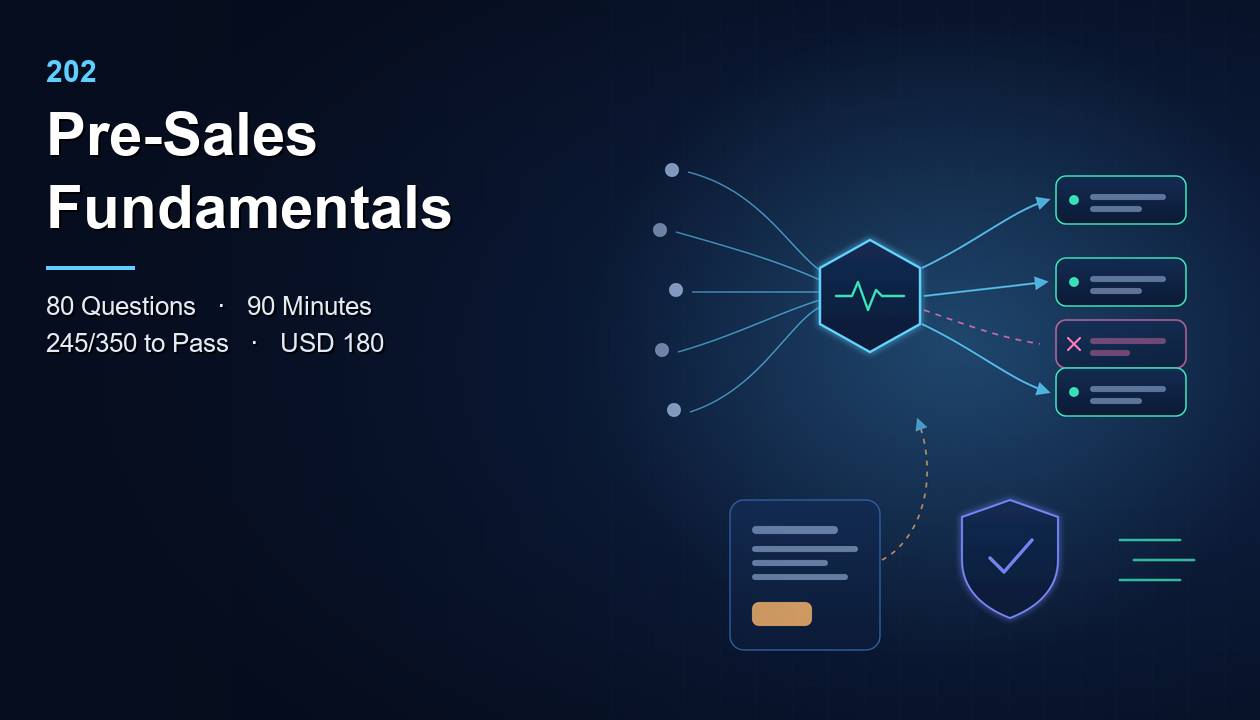
This article treats the exam as that transition. The facts come from the published exam details: 80 questions, 90 minutes, a passing score of 245 out of 350, and a USD 180 fee. Where the details are silent, on prerequisites or retake rules, it points to F5's official pages rather than guessing.
What Is the F5 Pre-Sales Fundamentals (202) Exam?
Exam 202 is F5's pre-sales exam, and passing it earns the F5 Certified Technical Professional - Sales certification. It sits in F5's Fundamental category, which places it at the base of the certification structure: the level that establishes shared ground before the specialist tracks begin.
F5's territory is the layer between applications and the people who use them: keeping applications available when servers fail, keeping them fast when traffic spikes, and keeping them safe when the traffic is hostile. A pre-sales exam in that territory tests whether you understand those problems well enough to recognise them in a customer's description, explain how F5's approach addresses them, and know which conversation to have next.
The transition it certifies, precisely
The move from relationship selling to technical selling is not about memorising specifications. It is a change in what you can do in a meeting. Before: you hear "our checkout slows down every promotion weekend" and note it down for the engineer. After: you recognise a capacity and distribution problem, ask how the application is currently balanced across servers, and sketch where a solution would sit — and only then bring the engineer in, for the design rather than the diagnosis.
That is also why the credential is called Technical Professional - Sales rather than simply Sales. It marks the point where the customer's technical staff stop treating you as the person who schedules meetings with the people who know things.
Who takes it
Three groups, with different distances to travel. Account managers and sales people at F5 partners take it to hold their own in technical conversations — for them the selling is familiar and the application-delivery concepts are the work. Technical people moving toward pre-sales take it as the customer-facing counterpart to their engineering knowledge — for them the concepts are revision and the positioning is new. And people new to the F5 ecosystem take it as the entry point the Fundamental category suggests it is.
It is worth saying plainly that the two transitions meet in the middle. The account manager who learns the technical half and the engineer who learns the selling half end up doing the same job, and this exam is the point where their preparation overlaps. In partner organisations the pair often study together, which works well: each is the other's best tutor for the unfamiliar half.
202 Exam Overview and Details
These are the published facts for the exam:
- Exam name: F5 Pre-Sales Fundamentals
- Exam code: 202
- Certification: F5 Certified Technical Professional - Sales (F5-CTP-Sales)
- Category: Fundamental
- Number of questions: 80
- Duration: 90 minutes
- Passing score: 245 / 350
- Exam fee: USD 180
- Scheduling: through Pearson VUE's F5 exam page
Two of those numbers deserve more attention than they usually get.
Eighty questions in ninety minutes
This is the detail that catches people. Eighty questions in ninety minutes is about sixty-seven seconds per question — the fastest pace of any exam most candidates will have sat recently. There is no time to derive answers from first principles, and barely time to reread a stem.
For someone coming from sales, this sets the standard your preparation must reach: the concepts have to be recognised, not reconstructed. If you still translate "the application must stay up during maintenance" into technical terms by conscious effort, the clock will beat you even when your knowledge would not. The practical test is speed of recognition, and the only way to build it is volume practice under time, which Step 4 below is for.
Pace yourself in quarters rather than halves: twenty questions every twenty-two minutes or so. Falling behind at the first checkpoint is recoverable; discovering it at the halfway mark is not, because there is no slack built into the remaining forty questions.
A scaled score of 245 out of 350
The passing score is published as 245 out of 350 — a scaled score, not a count of correct answers, so there is no safe number of questions to write off. With eighty questions drawn from across the whole scope, the arithmetic favours even coverage. A sales-background candidate who skips the technical half, or a technical candidate who ignores the positioning material, leaves a cluster of questions to chance, and at this pace guessed questions get no second look.
The fee, and what the transition is worth
At USD 180, this is one of the more affordable certification exams, which fits its role as an entry point. The real investment is the preparation time, and the return is specific: deals where the technical conversation stays with you longer, and customers whose architects take your calls. For retake policy, rescheduling, and any prerequisites, check F5's official exam page and Pearson VUE, because those are not part of the exam details summarised here.
Key Topics and Syllabus for 202
The 202 syllabus on CertFun is the authority on the exam's topics and weightings, and F5 publishes an official exam document linked from its own page — read both before planning anything. The sections below describe the kinds of understanding a pre-sales fundamentals exam in F5's territory expects, framed around the transition, so you can see which half of the material is your new ground.
The problems applications actually have
Everything in F5's world answers one of three customer problems: the application is down, the application is slow, or the application is under attack. The foundation of the exam is understanding these problems as a customer experiences them and as an architecture causes them — why a single server is a single point of failure, why distance and connection volume make applications slow, and why anything reachable from the internet is a target.
For the sales-background candidate, this is the half that has to become reflexive. The useful study habit is translation in both directions: hear a business complaint and name the technical problem; see a technical term and state the business consequence. "Users in Asia find the site slow" is a distance and distribution problem. "We failed our audit" is a security and visibility problem. The exam's scenarios are written in exactly this mixed language.
A worked discovery call shows the standard to aim for. A retail customer says: "Black Friday nearly killed us last year — the site stayed up but checkout took forty seconds, and we only got through it by turning off recommendations." The untrained ear hears a war story. The trained ear hears three facts: the infrastructure survived peak load but something in the application path saturated; the slow step was a specific transaction, not the whole site; and the customer already has a crude load-shedding instinct but no mechanism for it. That reading produces three follow-up questions and a reason for a next meeting — which is the entire job of discovery.
How application delivery works
With the problems in place, the mechanics follow: how traffic gets from users to applications, and where a platform like F5's sits in that path. That means the basics of how requests travel across networks, how a device in front of servers can distribute load across them, check their health, and take failing ones out of rotation, and how the same position in the path allows traffic to be inspected, secured, and accelerated.
The depth required is pre-sales depth: you need to explain what intelligent traffic management does and why its position in the architecture matters, not configure it. A good self-test is the whiteboard standard — can you draw users, the F5 platform, and the servers behind it, and narrate what happens when one server fails, without notes? That one diagram, well understood, answers a surprising share of fundamentals questions.
Narrate the failure case out loud at least once, because the exam loves it: a server stops responding, the health checks in front of it fail, the device stops sending traffic to that server, users never notice, and the operations team replaces the server without an outage window. Then narrate the maintenance case, which is the same story run deliberately. If you can tell both stories without hesitation, you understand availability at the depth this exam asks for.
Availability, performance, and security as solution themes
The middle of the exam's territory is matching mechanisms to the three problems. Availability: distributing load, detecting failure, removing failed servers from service, and surviving maintenance without downtime. Performance: reducing the work servers repeat, managing connections efficiently, and serving users from the least costly path. Security: controlling what reaches the application, protecting against hostile traffic, and handling encrypted connections so that inspection and protection remain possible.
Expect questions that describe a customer situation and ask which theme — and which kind of capability — answers it. The characteristic error is reaching for the most technically interesting capability rather than the one the described customer needs, which is the pre-sales version of over-engineering.
Encrypted traffic deserves a special mention because it links all three themes and customers raise it unprompted. More of every application's traffic is encrypted, which is good for privacy and awkward for inspection: a device cannot protect or prioritise what it cannot see. Understanding why handling encryption at the platform level matters — for security inspection, for performance offload, for visibility — gives you an answer to one of the most common objections in the territory, and the exam knows it.
Positioning, qualifying, and the sales motion
The other half of a pre-sales exam is the selling itself: recognising an opportunity in what a customer says, asking the questions that qualify it, knowing where F5's approach fits and what it typically replaces or complements, and moving a conversation toward evaluation and proposal with the right people involved.
Technical candidates underrate this half exactly as sales candidates underrate the other. If you come from engineering, practise the discipline of starting from the customer's stated problem rather than from the product's capabilities, and of knowing when a conversation needs commercial progress rather than more technical depth. The syllabus is the authority on how much of this is in scope, but in a sales-track exam it is never decoration.
Qualification has a worked shape too. An opportunity is real when the customer has a named problem in one of the three themes, a reason to act now — an incident, an audit, a launch, a renewal — and someone who owns the budget for fixing it. A conversation missing all three is education, not sales, and part of pre-sales judgement is telling those apart without being rude about it. Expect at least a few questions where the correct next step is to qualify further rather than to propose anything.
The F5 portfolio at positioning depth
Finally, the exam expects familiarity with F5's offerings at the level the role uses: what each part of the portfolio is for, which customer problems it addresses, and how the pieces fit together — hardware, software, and services. F5's own training and the official exam document linked below are the current authority on what is in scope; study the portfolio from them rather than from memory of older product generations, because this is territory that changes.
202 Preparation Guide
The plan assumes you are preparing around a job, and that one half of the material is familiar while the other is new.
Step 1: Find your half
Split the syllabus down its natural seam: the technical half (application problems, delivery mechanics, the three solution themes) and the selling half (qualifying, positioning, portfolio). Rate yourself honestly on each. Sales people usually need most of their time on the first; engineers on the second. The common mistake is spending the study hours where you are comfortable, which produces a lopsided candidate that this exam's breadth punishes.
Then set the bar correctly for the pace: the target is not "can work it out" but "recognises it in under a minute". Topics you can only derive are not yet exam-ready.
Give the audit a deadline of one evening, not a week. Its purpose is to direct the plan, and candidates who linger on auditing are usually postponing the half they dread. Whichever half that is for you, schedule it first, while your energy is highest, and leave your home ground for the lighter sessions late in the plan.
Step 2: Study from F5's own material
Work from F5's training programs and the official exam page's material, including the exam document it links. Study the technical half in problem order — availability, then performance, then security — because that mirrors how the mechanisms build on each other, and attach every mechanism to the customer problem it answers as you go. A mechanism studied without its problem is a fact; attached to its problem it is an answer.
Step 3: Rehearse the two translations
The transition skill is translation, so practise it deliberately. Take ten business complaints you have actually heard in accounts — slow site, failed audit, outage during a release, traffic spike on launch day — and write the technical problem and the solution theme for each. Then take ten technical terms from your study notes and write the one-sentence business consequence a decision-maker would care about.
If you have account experience, mine it: your own deal history is a set of worked examples no course can match. For each deal you have touched that involved availability, performance, or security, reconstruct what the customer said, what the real problem was, and where the conversation should have gone next. That is both exam preparation and better account work.
Step 4: Build speed with timed blocks
From the midpoint of your preparation onward, practise in timed blocks at the real pace — twenty questions in twenty-two minutes. Review every miss and classify it: a knowledge gap, a misread stem, or a translation failure, meaning you knew the material but took too long to recognise which problem the question described. The third category is the one this exam's pace punishes, and it only improves with more timed volume, not more reading.
Step 5: Book when recognition is boring
Book through Pearson VUE when timed blocks feel routine and your results sit comfortably clear of the line across both halves. In the final week, revisit your weaker half only, run one full eighty-question timed session to rehearse the endurance, and stop the day before. At sixty-seven seconds per question, a rested reader has a measurable advantage over a tired one.
One final habit from the accounts side: after the exam, keep the translation notebook from Step 3 going. The ten complaints you collected become twenty, the twenty become the way you listen in every meeting, and the certification stops being a line you earned and becomes the way you work. That is what the transition looks like when it holds.
Benefits and Career Scope of F5-CTP-Sales
The value of this credential is the transition it marks, and the people who notice are the ones on both sides of your deals.
It keeps the technical conversation with you
The practical difference after the transition: discovery calls where you qualify the technical problem yourself, first meetings that do not need an engineer, and customers whose architects engage with you directly because you speak enough of their language. Deals move faster when the person who owns the relationship can also hold the first technical conversation, and that speed is visible to your management as well as your customers.
It is the recognised sales-track credential in the F5 ecosystem
For people at F5 partners and resellers, F5-CTP-Sales is the certification that matches the pre-sales role by name. Partner organisations track certifications, customers increasingly ask about them, and a credential that says Technical Professional - Sales describes exactly the hybrid the role demands. Check your own partner programme for how it counts there.
It supports the work around the sale
The work this certification supports includes qualifying opportunities in application delivery and security, running discovery with mixed business and technical audiences, positioning F5's portfolio against stated problems, bringing specialist colleagues in at the right depth and moment, and carrying a deal's technical narrative through to proposal. For engineers moving the other way, it evidences the customer-facing half of a pre-sales role.
It is a foundation, deliberately
As a Fundamental-category exam, 202 is a starting point in F5's certification structure, and the natural base for whatever deeper F5 study your role later needs. For the current structure of the levels and tracks beyond it, see F5's official certification pages.
Practice Test and Preparation Resources
Keep the list short, official, and current.
Official resources
- Official F5 Pre-Sales Fundamentals (202) exam page: the authority on the exam's current details and policies, including anything not covered here such as prerequisites and retakes.
- F5's official exam document: the document F5 attaches to the exam page — read it alongside the syllabus before you plan.
- F5 Training Programs: F5's own training catalogue, linked in the Preparation Guide above. Your primary study source.
- Pearson VUE: where you book the exam and confirm testing options.
Sample questions and practice tests
Once your study is underway, work through the 202 sample questions on CertFun. For this exam they serve a specific purpose beyond coverage: building the recognition speed that eighty questions in ninety minutes demands. Treat every practice session as timed from the start, and treat the review as the real study — each miss names either a topic or a translation to rehearse.
Your own accounts
If you already work in sales, your accounts are the best case studies available. Listen in your next few customer conversations for the three problems — down, slow, under attack — and note how they are phrased by people who do not use technical vocabulary. The exam's scenarios are written in that phrasing, and so is the rest of your career after the transition.
Conclusion
Exam 202 certifies the transition from selling on relationships to selling with technical substance in F5's territory: understanding the problems applications have, how application delivery addresses them, how availability, performance, and security map to customer situations, and how to position F5's portfolio through a real sales motion. The exam is 80 questions in 90 minutes — the pace is the hidden difficulty — with a scaled passing score of 245 out of 350 and a USD 180 fee.
Prepare for the half that is new to you, translate relentlessly between business language and technical language, and practise at speed until recognition is boring. The credential that results, F5 Certified Technical Professional - Sales, names exactly what you become: the person in the room who can carry both halves of the conversation.
And the first customer architect who stops asking for your engineer will tell you the transition worked.
FAQs
How many questions does exam 202 have, and how long is it?
The exam has 80 questions and a duration of 90 minutes — about sixty-seven seconds per question, which makes pace a real factor.
What is the passing score for 202?
The passing score is 245 out of 350. It is a scaled score, so it does not convert directly into a number of correct answers.
How much does the exam cost?
The exam fee is USD 180. Confirm the amount for your location when you book through Pearson VUE.
Which certification does exam 202 lead to?
Passing it earns the F5 Certified Technical Professional - Sales certification, F5-CTP-Sales.
Is this a technical exam or a sales exam?
Both, by design. It covers application delivery fundamentals at positioning depth and the pre-sales motion around them, which is why it suits people crossing between the two.
Do I need another F5 exam first?
The exam details summarised here do not list a prerequisite. Check F5's official exam page for current requirements before you book.
Where do I schedule the exam?
You book through Pearson VUE's F5 exam page, where you can also confirm testing options.
Where can I find the official topic list?
The 202 syllabus on CertFun is the authority on the exam's topics and weightings, alongside the official exam document F5 publishes. Use both to plan your study and to check coverage before booking.