

The first time an engineer sits in a customer meeting as the technical voice on a sales call, something uncomfortable usually happens. Someone asks a question that has no technical answer: not "can your firewall do this?" but "why should we buy this rather than what we already have?" The engineering reflex is to answer with capability. The presales answer starts somewhere else, with what the customer is trying to protect, what is pushing them to act now, and what the decision will cost them in money, disruption, and risk.
H21-212 sits exactly on that change of footing. It is the exam for Huawei Certified Specialist Associate-Presales-Network Security (Distribution), an associate-level presales credential in network security, aimed at the people who help customers and partners choose security solutions rather than the people who configure them afterwards.
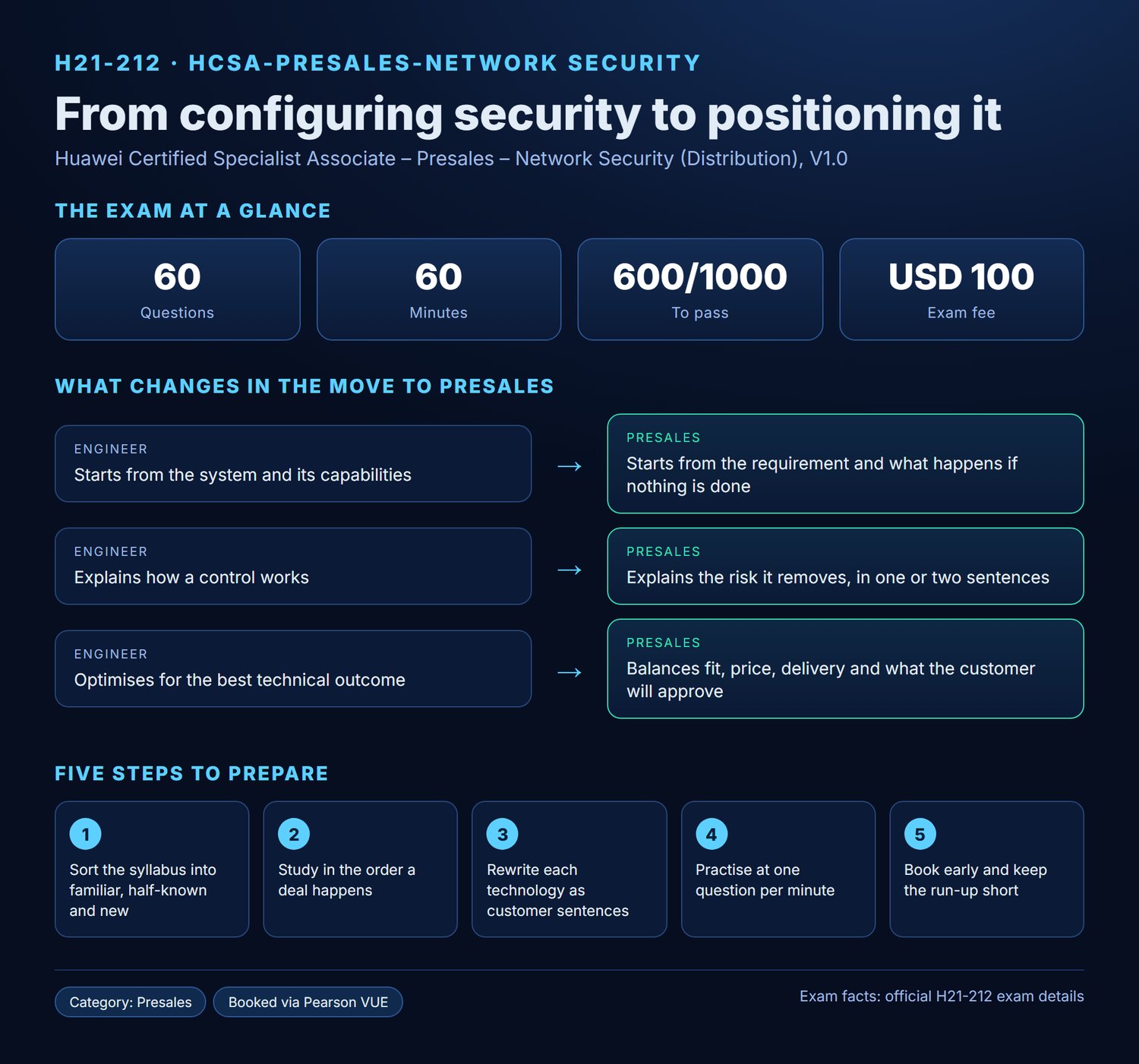
This article is written for the move itself: what carries over from technical work, what has to change, and how to prepare without spending more time than the exam needs. The facts come from the published exam details: 60 questions, 60 minutes, a passing mark of 600 out of 1000, a USD 100 fee, and version V1.0. Where the details are silent, on prerequisites or retake rules, this article points to Huawei's official certification page rather than guessing.
What Is the Huawei HCSA-Presales-Network Security (Distribution) Certification?
H21-212 awards the Huawei Certified Specialist Associate credential for presales in network security, in the distribution channel. Its category in the exam data is simply Presales, and that word sets the whole tone. The exam is about the work done before a sale: understanding what a customer needs, matching it to a solution, explaining why that solution fits, and supporting the commercial process that follows.
The "Distribution" part matters too. In a distribution model, products reach customers through a chain: the vendor, distributors, and resellers or system integrators who deal with the end customer. Presales staff in that chain often support partners rather than end users directly, which means explaining a portfolio to someone who will then explain it to someone else. Clarity and positioning matter more than depth of configuration knowledge.
What carries over from a technical role
Plenty carries over, and candidates often underestimate it. If you have configured or supported security equipment, you already know what the technology does, which problems it genuinely solves, and which claims do not survive contact with a real network. That credibility is exactly what a customer wants from the technical person in the room.
Your troubleshooting instinct transfers as well. Diagnosing a fault and qualifying an opportunity use the same underlying skill: asking questions in a sensible order until the real problem appears. The difference is what you are diagnosing, a network in one case and a customer's situation in the other.
What has to change
Three things change, and they are what the exam concentrates on.
First, the starting point. Technical work starts from the system; presales starts from the requirement. "What problem is the customer trying to solve, and what happens if they do nothing?" comes before any discussion of products.
Second, the audience. A configuration answer can assume shared vocabulary. A presales answer frequently goes to someone who controls a budget and does not care how a feature works, only what risk it reduces and what it costs. Being able to explain the same solution at two levels of detail is a presales skill in itself.
Third, the commercial frame. Engineers optimise for the best technical outcome. Presales has to balance fit, price, deliverability, and what the customer is actually ready to buy. The best design that nobody approves is worth nothing, and the exam's scenario questions tend to reward the answer that fits the situation, not the most capable product.
Who tends to take it
The exam suits engineers moving toward customer-facing work, presales staff who are new to network security or new to the Huawei portfolio, and sales or channel staff at distributors and resellers who need enough technical grounding to hold a security conversation. For the first group, the technology is familiar and the commercial reasoning is new. For the third, it is the other way round, and the security fundamentals need the most study time.
H21-212 Exam Overview and Details
These are the published facts for the exam:
- Exam name: Huawei Certified Specialist Associate-Presales-Network Security (Distribution)
- Exam code: H21-212
- Version: V1.0
- Category: Presales
- Number of questions: 60
- Duration: 60 minutes
- Passing score: 600 / 1000
- Exam fee: USD 100
- Scheduling: through Pearson VUE's Huawei exam page
Those numbers describe a short, brisk exam, and they shape how you should prepare.
Sixty questions in sixty minutes
One question per minute is a quick pace. It tells you that most questions are meant to be answered from recognition rather than worked out from first principles. If you are reasoning your way through a question from scratch, you are already behind.
For someone coming from a technical role, this has a specific implication. Engineers tend to read a scenario carefully, consider edge cases, and look for the technically precise answer. At one question per minute, that habit is expensive. Read the scenario, identify what the customer wants, and choose the option that addresses it. The exam is testing whether your presales reflexes are quick, not whether you can design the perfect architecture.
A simple pacing check helps: thirty questions at the thirty-minute mark. If you are behind, commit to your best answer, flag it, and keep moving. With sixty minutes there is no time to rescue a slow start in the final stretch.
A scaled score of 600 out of 1000
The passing mark is 600 out of 1000, published as a scaled score rather than a count of correct answers. You cannot calculate exactly how many you may miss, so aiming for a narrow pass is risky. Aim instead for even coverage: the security fundamentals, the portfolio positioning, and the presales process all need to be solid, because you cannot predict which of them a given question draws on.
A USD 100 fee, and what it really costs
At USD 100 this is one of the more affordable certification exams, which changes the calculation. The main cost is your preparation time, not the fee. That argues for a tight, focused study plan rather than an exhaustive one: cover the syllabus properly, practise at speed, and sit the exam rather than polishing indefinitely.
It also makes the credential a sensible first step when you are testing whether a presales direction suits you. For retake terms, rescheduling, and any prerequisites, check Huawei's official certification page and Pearson VUE, since those are not part of the exam details summarised here.
Version V1.0
The exam is at version V1.0. Security portfolios and threat landscapes both move quickly, so match your study material to the current version and treat the syllabus as the authority when sources disagree.
Key Topics and Syllabus for H21-212
The H21-212 syllabus on CertFun is the authority on the exam's topics and weightings. Read it before planning your study. The sections below do not replace it or invent a breakdown; they describe the kinds of competence an associate presales exam in network security expects, with the engineer-to-presales shift marked in each, so you can judge where your time should go.
Network security fundamentals
Presales conversations rest on a shared understanding of what the customer is defending against and how. That means the common categories of threat, the principle of layered defence, how traffic is controlled and inspected at network boundaries, how encrypted connections are used to join sites and remote users safely, and how detection and response fit alongside prevention.
For an engineer, this is revision. The shift is in how you hold the knowledge. Instead of knowing how a control is configured, you need to be able to say in one or two sentences what risk it addresses and what it does not. "This stops the attack at the perimeter, but it does nothing once an attacker is already inside" is a presales sentence. Practise reducing each technology to that form.
Watch for the opposite failure too. Reducing everything to slogans leaves you unable to answer the follow-up question, and customers ask follow-ups. The useful depth is one layer below your summary sentence: enough to say how the control works in general terms, what it needs from the network around it, and what operational effort it adds. An associate presales exam tends to test exactly that layer, which is why both pure engineers and pure salespeople find parts of it unfamiliar.
Understanding and qualifying customer requirements
This is the heart of presales work, and the part most new to a technical candidate. Qualifying means finding out what the customer actually needs: what they are protecting, what has changed to make them look at this now, what constraints they have in budget, skills, and timing, who is involved in the decision, and what happens if nothing is done.
A worked example shows the difference. A customer says "we need a next-generation firewall." The engineering response is to discuss models and throughput. The presales response asks why now, what prompted the conversation, what the existing device cannot do, how many sites are involved, who manages it day to day, and when they need it working. Only then does a product recommendation make sense, and the questions often reveal that the real requirement is different from the stated one. Scenario questions frequently test whether you qualify before recommending.
Qualification also decides what not to pursue. Part of presales discipline is recognising when a requirement is not real yet, when the budget does not exist, or when the customer is gathering comparisons rather than preparing to buy. That judgement protects your own time and the partner's, and it appears in scenario questions as options that involve asking a further question or declining to quote rather than rushing a proposal.
Solution positioning and the portfolio
With a requirement understood, presales matches it to the vendor's offering. That means knowing the portfolio well enough to say which product or combination fits which kind of customer, how products complement one another, and where the practical boundaries are, such as scale, deployment model, and management.
The skill here is positioning, not recitation. For each offering, know the customer profile it suits, the problems it solves, what it typically replaces or sits alongside, and the two or three reasons a customer chooses it. Expect questions that describe a customer's size, sector, or situation and ask what to propose. The official product documentation linked from Huawei's certification page is where the current detail lives; the syllabus defines how much of it is in scope.
Working through a distribution channel
Because this certification is channel-specific, expect attention to how business is done through distributors and partners: the roles of vendor, distributor, and reseller, how opportunities are registered and supported, what presales support partners need, and how a deal moves through the chain.
Candidates from a pure engineering background often find this the least familiar material and skip it, which is a mistake, since it is named in the certification title. If you work for a distributor or partner, this is your home ground; map the exam's model onto what your company already does, noting where the terminology differs.
A practical way to learn this material is to trace one deal end to end. Who identified the opportunity, who registered it, what support did the vendor provide to the partner, who produced the quotation, who delivered and who supports it afterwards? Following a single real example through the chain fixes the roles better than memorising a diagram, and it gives you concrete examples to use in interviews for channel roles.
Building and presenting a proposal
Finally, presales produces something: a solution proposal, a quotation, a response to a tender, or a presentation and demonstration. Knowing what belongs in each, and how to present technical content to a mixed audience of technical and business people, is part of the role.
The transition point is the shape of the argument. An engineer explains how it works; a proposal explains what the customer gets, why this approach, what it costs, and what happens next. A good test is whether your summary slide would make sense to someone who leaves after five minutes, which in practice is often the person who signs.
Expect the exam to test the structure rather than the prose. What belongs in a proposal, which parts a customer reads first, how a quotation reflects the agreed scope, and what a tender response must address are all learnable patterns. If you have never written one, read two or three real examples from your own organisation and note what each section is trying to achieve.
H21-212 Preparation Guide
Given a short exam and a modest fee, the right plan is focused rather than exhaustive.
Step 1: Sort the syllabus into familiar, half-known, and new
Go through the syllabus and mark each topic. For an engineer the pattern is usually predictable: security fundamentals are familiar, portfolio positioning is half-known, and the channel and proposal material is new. For a sales-background candidate it inverts.
Be strict about "half-known." The test is whether you can explain the topic to a customer in two sentences, not whether you recognise it. Half-known topics are where most marks are lost, because recognition feels like knowledge until a question demands a decision.
Step 2: Study in the order a deal happens
Work through the material in the order presales actually runs: fundamentals first, then requirement qualification, then portfolio positioning, then the channel, then proposals. This order matters because each stage feeds the next. Positioning a product is impossible until you know what qualification produces, and a proposal is just a document until you understand both.
Huawei's official certification page for this exam is the authority on the current scope and on what study resources are available for V1.0. Use the syllabus alongside it as your checklist.
Step 3: Rewrite everything as customer sentences
This is the exercise that converts technical knowledge into presales knowledge, and it is worth more than extra reading. For each technology or product in scope, write three lines: what problem it solves for a customer, who typically needs it, and what it does not do.
Then rehearse out loud. Explain a security solution to an imaginary customer in two minutes without using configuration vocabulary. If you cannot do it, you do not yet own the positioning. Engineers often discover that this exercise, not the technology, is where their preparation time really needs to go.
Step 4: Practise at one question per minute
Timed practice matters more than usual here because the pace is tight. Work in blocks at the real rate, and treat time as part of the test.
Review every mistake and classify it: a knowledge gap, a misread question, or an engineer's answer, meaning you chose the technically ideal option rather than the one that fits the customer's stated situation. That last category is the signature error in a presales exam, and each instance points back to Step 3.
Step 5: Book early and keep the run-up short
Because the exam is short and inexpensive, a long preparation often means forgetting the early material before you sit. Pick a date a few weeks out, work the plan, and in the final week do a timed full run and revisit your half-known list. Rest the day before; at one question per minute, a tired reader loses marks to carelessness rather than ignorance.
One more habit is worth building before the exam and keeping afterwards: write down, in a sentence each, the three questions you would ask any customer who mentions a security problem. If those three come to you automatically under exam pressure, they will come to you in a meeting as well, which is the point of the credential.
Benefits and Career Scope of HCSA-Presales-Network Security
The value of a presales credential is that it makes a career change credible before you have a track record in the new role.
It evidences the move from technical to customer-facing work
Moving into presales is usually a chicken-and-egg problem: you need presales experience to be hired into presales. A presales-specific certification is one of the few ways to show the intent and the knowledge before the experience exists, and it tells a hiring manager that you have studied the commercial side deliberately rather than assuming your technical skills would carry you.
It fits the channel, where many of these roles are
A large share of presales positions sit with distributors, resellers, and integrators rather than with vendors. Because this certification is explicitly about the distribution channel, it maps directly onto those roles and signals that you understand how partner business works, not only how products work.
It supports the work presales actually does
The work this certification supports includes qualifying opportunities, running technical discovery with customers, positioning security solutions against requirements, supporting partners with proposals and quotations, responding to tenders, and presenting and demonstrating solutions. For an engineer, those tasks also tend to broaden what you are consulted about internally, since you become the person who can translate between technical and commercial language.
It is an associate-level starting point
As an associate credential, it is a beginning rather than a destination. It gives you the vocabulary and structure to work in presales security, and it establishes a base you can extend with deeper technical or solution-level study later. For what Huawei offers beyond this level, see the official certification pages.
Practice Test and Preparation Resources
Keep the list short, since the exam is short.
Official resources
- Official HCSA-Presales-Network Security (Distribution) certification page: the authority on the certification's current details, available training for V1.0, and policies including prerequisites and retake terms.
- Pearson VUE: where you schedule the exam and confirm testing options.
Sample questions and practice tests
Once your study is underway, work through the H21-212 sample questions on CertFun. For a presales exam they are especially useful for learning to spot the distractor that is technically excellent but wrong for the customer described.
Use practice tests in timed blocks at one question per minute, and review them properly. The review is what turns a score into a study plan: every miss names a topic, and every lucky guess names something you have not yet reduced to a customer sentence.
Your own deals and conversations
If you already work around sales, your organisation's own proposals, quotations, and tender responses are the best supplementary material available. Read a recent proposal and identify the requirement behind each recommendation. If you cannot find one, that gap is itself a lesson in what good presales work looks like.
Conclusion
H21-212 certifies associate-level presales competence in network security through the distribution channel: the security fundamentals you need to hold a credible conversation, the discipline of qualifying what a customer actually needs, positioning the portfolio against that need, working through distributors and partners, and producing proposals that a mixed audience can act on. The exam is 60 questions in 60 minutes, needs a scaled 600 out of 1000, costs USD 100, and is at version V1.0.
For most candidates it is a transition exam. Your technical knowledge carries over and gives you credibility; what changes is where you start, who you are speaking to, and what counts as the right answer. Preparation that respects that shift, rewriting technology as customer sentences and practising at one question per minute, is faster and more effective than studying the product documentation harder.
Make that shift and the certification does more than add a line to your profile. It gives you the frame that customer-facing work runs on, which is what the job asks for on the first day.
FAQs
How many questions does H21-212 have, and how long is it?
The exam has 60 questions and a duration of 60 minutes, an average of one minute per question.
What is the passing score for H21-212?
The passing score is 600 out of 1000. It is a scaled score, so it does not convert directly into a number of correct answers.
How much does the exam cost?
The exam fee is USD 100. Confirm the amount for your location when you book through Pearson VUE.
What does the "(Distribution)" in the title mean?
It identifies the certification as being for the distribution channel, where products reach customers through distributors and resellers, so the exam covers presales work in that model.
Which exam version is current?
The current version is V1.0. Match your study material to it and use the syllabus to settle any disagreement between sources.
Do I need a technical background to take it?
The exam details summarised here do not list a prerequisite; check Huawei's official certification page for current requirements. In practice, a technical background shortens preparation on the security fundamentals, while a sales background shortens it on the channel and proposal topics.
Where do I schedule the exam?
You book through Pearson VUE's Huawei exam page, where you can also confirm testing options.
Where can I find the full list of exam topics?
The H21-212 syllabus on CertFun is the authority on the exam's topics and weightings. Use it to plan your study and to check coverage before you book.