

An architect's mistakes are expensive in a way an engineer's are not. A misconfigured server is fixed in an afternoon. A computing platform sized for the wrong workload, bought on a three-year cycle, is lived with. That asymmetry is the reason employers care whether someone can design before they are allowed to, and it is the useful way to think about what H13-222 costs and what it is worth.
H13-222 is the exam for Huawei Certified ICT Professional - Computing Solution Architect, the HCIP-level credential for designing computing solutions rather than operating them. The attempt itself is USD 300. The larger number is the study time, and the largest is what a badly designed platform costs an organisation that has to run it.
This article works through all three. The exam facts come from the published details: 60 questions, 90 minutes, a passing mark of 600 out of 1000, a USD 300 fee, and version V1.0. Where those details are silent, on prerequisites or retake policy, it sends you to Huawei's official certification page instead of guessing.
What Is the Huawei HCIP-Computing Solution Architect (H13-222) Certification?
H13-222 awards Huawei Certified ICT Professional - Computing Solution Architect, at V1.0. It sits in Huawei's ICT Infrastructure category, alongside the other credentials dealing with the physical and platform layers that applications run on.
The title names the job precisely. A computing solution architect decides what a customer's computing platform should look like: what compute resources the workloads need, how servers and the infrastructure around them are arranged, how the result is made resilient and manageable, and how it will grow. The emphasis is on design decisions and their consequences rather than on configuration steps.
If you watch one thing before reading further, watch this. It covers the same ground this article does, from a different angle:
HCIP means design accountability
Huawei's professional level sits above associate, and the step matters. An associate credential says you understand the technology and can work with it competently. A professional one says you can be handed a requirement and produce a design that other people will build, fund, and depend on.
That shift changes what the exam rewards. Expect fewer questions that check whether you recognise a component and more that describe a customer situation and ask what you would propose, or what the consequence of a particular choice would be. Judgement under constraints is the thing being measured, because judgement under constraints is the job.
It also changes how wrong answers are built. At associate level a distractor is usually a component that does something else. At professional level it is often a design that would work, but costs more than the customer can spend, takes longer than the deadline allows, or solves a problem the scenario never mentioned. Reading for what the customer actually asked for is half the exam technique.
Who sits it
Three groups predominate. System and infrastructure engineers who already run computing platforms take it when they want to move from keeping systems alive to deciding what gets built. Presales and solution staff take it because a design credential supports the recommendations they already make. Technical staff at partners and integrators take it because professional-level certification carries weight with customers and inside partner programmes.
Each group pays a different price in study time. Engineers usually have the technology and need the design and justification habits. Solution staff often have the commercial framing and need more depth on the platform itself. Knowing which you are shortens the preparation considerably.
There is a fourth group worth naming: people who already design on other vendors platforms and need a Huawei-specific credential. For them the architecture reasoning transfers almost entirely, and the study time goes into the portfolio and the terminology, which is the shortest preparation of all.
H13-222 Exam Overview and Details
These are the published facts for the exam:
- Exam name: Huawei Certified ICT Professional - Computing Solution Architect
- Exam code: H13-222
- Version: V1.0
- Category: ICT Infrastructure
- Number of questions: 60
- Duration: 90 minutes
- Passing score: 600 / 1000
- Exam fee: USD 300
- Scheduling: through Pearson VUE's Huawei exam page
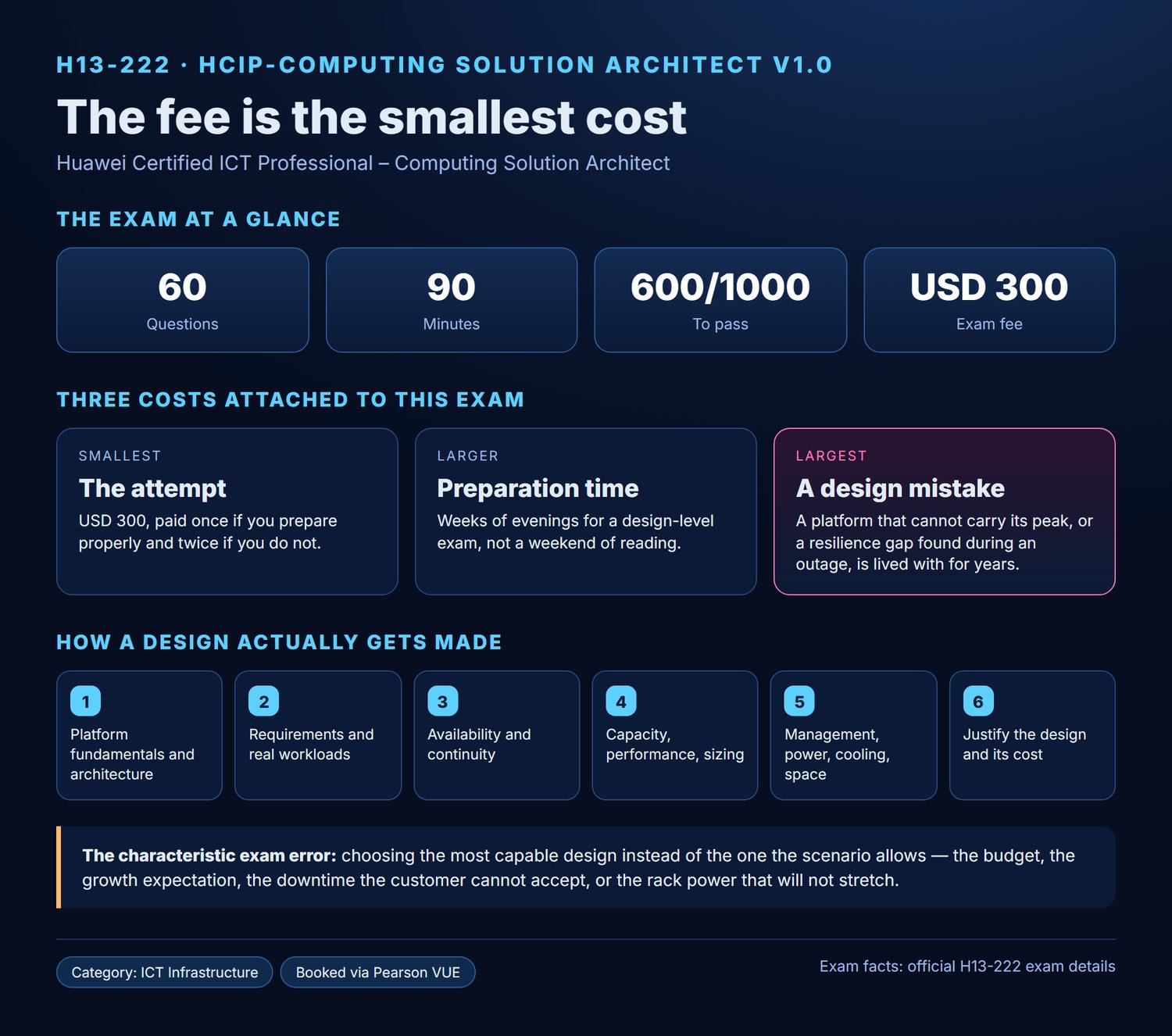
Each number carries a cost implication worth reading properly.
Sixty questions in ninety minutes
Ninety seconds per question is comfortable for recall and tight for design scenarios, which is what most of this exam consists of. A scenario that describes a customer, their workloads, their constraints, and a proposed direction takes time to read before the options mean anything.
The cost of poor pacing is specific: you spend your reserve on early questions and then rush the later ones, which are no easier. Check yourself at the halfway point, about thirty questions at forty-five minutes. When two options both look defensible, the deciding factor is almost always a constraint stated in the scenario rather than a technical nuance, so reread the constraint rather than re-reasoning the technology.
A scaled score of 600 out of 1000
The pass mark is published as a scaled 600 out of 1000, not as a count of correct answers, so there is no safe number of questions you can write off. For a design exam the practical reading is that gaps cluster. If you have never thought hard about, say, resilience or capacity planning, the questions touching those areas will all be shaky at once, and a cluster is much harder to absorb than scattered misses.
USD 300, and the costs behind it
The fee is USD 300. It is the smallest of the three costs attached to this exam, and worth putting in order.
The first is the attempt itself. The second is preparation time, which for a design-level exam is measured in weeks of evenings rather than a weekend. The third, and the one the certification exists to reduce, is the cost of design mistakes in production: a platform that cannot carry its peak, a resilience gap discovered during an outage, a configuration that cannot grow without being replaced. Set against that, both the fee and the study time are cheap.
For retake rules, rescheduling, and any prerequisites, check Huawei's official certification page and Pearson VUE, because those policies are not part of the exam details summarised here.
Version V1.0
The exam is at V1.0. Computing platforms move quickly, and a first-version exam tends to track the current portfolio closely, so material written for other Huawei computing certifications or for older product generations may not line up. Match your study to V1.0 and treat the syllabus as the authority.
Key Topics and Syllabus for H13-222
The H13-222 syllabus on CertFun is the authority on the exam's topics and weightings; read it before planning your study. The sections below do not replace it or invent a breakdown. They describe the kinds of competence a computing architect exam expects, arranged the way a design actually gets made, so you can see where your own experience stops.
Computing fundamentals and platform architecture
The foundation is what a computing platform is made of and why it is arranged that way: processors and memory and how workloads consume them, the forms servers take and what each suits, the storage and networking the platform depends on, and how virtualisation and containerisation change the relationship between an application and the hardware under it.
Engineers usually know these parts individually. The architect's version is relational: what each choice forces elsewhere. More memory per node changes consolidation ratios, which changes how many nodes are needed, which changes power, cooling, rack space, and licensing. Being able to follow that chain in both directions is what the exam is checking.
The same relational thinking applies to virtualisation and containers. Consolidating many workloads onto fewer, larger hosts saves hardware and licences, and it concentrates risk: when one host fails, more services go with it. Containers change the unit of deployment and what the platform must provide underneath. Neither is better in the abstract. The architect's question is which arrangement suits this customer's workloads, staff, and tolerance for a bad day.
Reading requirements and workloads
Design starts with the requirement, and requirements are rarely stated in architectural terms. A customer says they need a platform for a virtualised estate, a database, an analytics workload, or an application their business depends on. The architect turns that into demand: how much compute, what kind of memory profile, what storage behaviour, what network, and how each will change over the planned life of the system.
A worked example shows the reasoning. A customer wants to consolidate ageing servers running a mix of business applications and one database that matters more than the rest. The naive design sizes for the total of today's workloads. The architect's design asks what the peak looks like rather than the average, whether the important database should share a platform with everything else, what headroom is needed for three years of growth, and what happens to the whole estate when one node fails. The answers change the configuration and the price.
Requirements also arrive incomplete, and the exam reflects that. A scenario may mention growth without quantifying it, or name an application without saying how critical it is. The architect's move is to identify which missing fact would change the design most, because that is the one worth asking about. In a question, the stated facts are usually enough to eliminate two options outright, and the remaining choice turns on the one constraint the scenario does specify.
Designing for availability and continuity
Computing designs are risk designs. A platform has to keep running when a component fails, degrade sensibly when something larger fails, and be recoverable when data or a site is lost. Redundancy within a system, clustering across systems, backup, and arrangements across sites each address a different failure, and none covers all of them.
The discipline worth building is mapping each mechanism to the failure it answers and to what the business expects: how much data can be lost, and how long a service can be unavailable. Questions in this area usually describe an expectation and ask which design meets it, so a design that is merely "resilient" in general terms will not be the answer.
Be precise about what each layer protects against. Redundant components inside a server keep that server running through a part failure, and do nothing if the server is lost. Clustering carries a service across the loss of a host, and will faithfully carry a corrupted database with it. Backup recovers from corruption and deletion, at the cost of time to restore. A second site answers the loss of the first, and costs most. Scenario questions usually describe one of these failures specifically, and the correct answer is the layer that addresses it rather than the most comprehensive combination.
Capacity, performance, and sizing
Sizing is where architecture becomes arithmetic. The platform has to carry today's load, the peaks that actually matter, and the growth expected before the next refresh, with enough margin that a single failure does not take the rest over the edge.
Two mistakes cost money in opposite directions. Undersizing produces a platform that works at handover and strains within a year, usually fixed by unplanned spending. Oversizing wins the technical argument and loses the commercial one, or spends the customer's budget on capacity that sits idle for three years. Expect scenario questions where both a larger and a smaller option are technically workable and the stated budget or growth expectation decides which is right.
Management, operations, and efficiency
A design is delivered to people who have to run it. That brings in the management tooling that monitors and maintains the platform, how deployment and updates are handled, and the operational effort the design creates or avoids. It also brings in the physical realities: power draw, cooling, and space, which are real constraints in many data centres and a recurring cost in every one.
Architects who come from an engineering background often underrate this area because it rarely appears in the technology documentation. It appears in the exam and in real projects, where a design that nobody can operate comfortably is a failed design.
Power and cooling deserve a sentence of their own, because they are hard limits rather than preferences. A rack has a power budget, and a design that exceeds it does not get smaller after purchase; it gets split, moved, or refused. When a scenario mentions a constraint of this kind, it is rarely decoration.
Proposing and justifying the design
Finally, a design has to be presented and defended: why this configuration, what it costs to buy and to run, what risk it removes, how it grows, and why the alternatives were not chosen. The architect is usually the person who explains the same decision twice, once technically and once commercially.
Practise reducing a design to three sentences, covering what the customer gets, why this shape fits their situation, and what it will cost them to own. That compression is what the role asks for, and it is also a good test of whether you understand your own design.
H13-222 Preparation Guide
The plan below is aimed at spending the fee once and the study time efficiently.
Step 1: Audit against decisions, not topics
Go through the syllabus and, for each topic, ask a sharper question than whether it is familiar: have you ever made this decision, or watched it being made and understood why it went that way? Architecture knowledge is decision knowledge, and recognition is a poor proxy for it.
Most candidates find their gaps in the same places: sizing arithmetic, resilience trade-offs, and the operational and physical constraints that engineers rarely own. Put your evenings there rather than rereading the technology you already work with daily.
Step 2: Study the V1.0 material in design order
Huawei publishes HCIP-Computing Solution Architect V1.0 training through its learning portal, which opens on a Huawei sign-in page. Because it is written for this exam version, make it your primary source.
Work through it in the order a design is made: fundamentals and platform architecture, then requirements and workloads, then availability, then sizing, then management and operations, then justification. Studying in that order means every later topic has somewhere to attach, and it mirrors how the exam's scenarios are built.
Step 3: Design two real platforms on paper
This is the step that converts reading into architecture. Take an environment you know and design for it from scratch: list the workloads and what each demands, size the compute with headroom, decide the resilience model and justify it against a stated expectation, account for power, cooling, and space, and write down what the operators will have to do.
Then do it again for a deliberately different case, such as a small organisation with a tight budget and one critical application. The contrast teaches more than either design alone, because the right answer changes completely while the method stays the same. Keep both documents; they are your best revision material in the final week.
Step 4: Practise reading for the constraint
Move to timed practice at ninety seconds per question. For each scenario, name the constraint before looking at the options: the budget, the growth expectation, the downtime the customer cannot accept, the rack or power limit, or the staff who have to run it.
Review every mistake and classify it as a knowledge gap, a misread constraint, or an over-engineered answer. The third is the characteristic error at this level and the most expensive in real work, since it is how budgets are lost and proposals rejected.
Keep a short list of the constraints you misread, with the question beside each. After two or three practice sessions the list usually shows a pattern, such as consistently ignoring operational effort or growth expectations, and that pattern is more useful than the score.
Step 5: Book when the design questions feel routine
Book through Pearson VUE when timed results sit comfortably above the pass level across every stage, not just overall. In the final week, stop adding material, reread your two designs, and do one full timed run. Rest the day before; design scenarios punish tired reading more than recall questions do.
Benefits and Career Scope of HCIP-Computing Solution Architect
A design credential pays back in the kind of work you are handed, which is where its real value sits.
It moves you from building to deciding
Many infrastructure careers stall at execution: deploy this, patch that, resolve the ticket. Architecture is the decision-making layer above it. This certification is evidence that you understand how computing platform decisions are made and what they cost, which is the main thing that gets an engineer invited into design discussions rather than briefed after them.
It supports presales and solution work
For people in presales, solution design, or consulting, a professional-level design credential backs up recommendations with a recognised standard. It also helps in partner and integrator settings, where customers increasingly ask what qualifications sit behind a proposed design.
It covers work that keeps appearing
The work this certification supports includes designing and sizing computing platforms, planning consolidation and refresh projects, specifying resilience to match business expectations, reviewing proposals and tenders critically, and advising on growth and operational effort. Those responsibilities do not disappear when technology changes; the specifics move, the reasoning stays.
It is a professional-level marker in ICT infrastructure
Sitting at HCIP in Huawei's ICT Infrastructure category, it is a visible step beyond associate-level knowledge and a sensible base for further specialisation. For what sits beyond this level, see Huawei's official certification pages.
Practice Test and Preparation Resources
A short, version-matched list is worth more than a long one, especially for a V1.0 exam.
Official resources
- Official HCIP-Computing Solution Architect certification page: the authority on current details, available training, and policies including prerequisites and retake terms.
- HCIP-Computing Solution Architect V1.0 training: Huawei's own training for this exam version, linked in the Preparation Guide above. Your primary study source.
- Pearson VUE: where you schedule the exam and confirm testing options.
Sample questions and practice tests
Once your study is underway, work through the H13-222 sample questions on CertFun. For a design exam they are most useful for seeing how constraints are buried in scenarios and how the over-specified option is made to look like the safe choice.
Use practice tests in timed blocks and review them carefully. Each miss names a design stage to restudy; each lucky guess marks reasoning that is not yet yours. Tracking which stage your errors cluster in is the quickest way to decide where the next evening goes.
The platforms you already work with
Your own environment is free, version-current study material. Take a platform you support and reconstruct the decisions behind it: why this many nodes, why this resilience model, why this much headroom. Where you cannot reconstruct the reason, you have found a topic worth studying, and often a design question worth asking at work.
Conclusion
H13-222 certifies that you can design a computing solution rather than only run one: understanding the platform and its architecture, turning requirements and workloads into demand, designing resilience that matches what the business expects, sizing with proper headroom, accounting for management and physical constraints, and justifying the result. The exam is 60 questions in 90 minutes, requires a scaled 600 out of 1000, costs USD 300, and is at version V1.0.
Read as an investment, the fee is the smallest part. The study time is larger, and the cost of design mistakes in production is larger still, which is exactly the cost this credential is meant to reduce. Prepare accordingly: audit yourself against decisions rather than topics, study the V1.0 material in the order a design is made, design two real platforms on paper, and practise reading scenarios for the constraint before the technology.
Do that, and you pay once for the exam and considerably less, later, for the designs you put your name to.
FAQs
How many questions does H13-222 have, and how long is the exam?
The exam has 60 questions and a duration of 90 minutes, an average of ninety seconds per question.
What is the passing score for H13-222?
The passing score is 600 out of 1000. It is a scaled score, so it does not convert directly into a number of correct answers.
How much does the exam cost?
The exam fee is USD 300. Confirm the amount for your location when you book through Pearson VUE.
What does the HCIP level mean here?
HCIP is Huawei's professional level, above associate. For this exam it means being able to produce and defend a computing solution design, not only understand the technology in it.
Which exam version is current?
The current version is V1.0. Match your study material to it and use the syllabus to settle any disagreement between sources.
Do I need an associate certification first?
The exam details summarised here do not list a prerequisite. Check Huawei's official certification page for current requirements before you book.
Where do I schedule the exam?
You book through Pearson VUE's Huawei exam page, where you can also confirm testing options.
Where can I find the official topic list?
The H13-222 syllabus on CertFun is the authority on the exam's topics and weightings. Use it to plan your study and check your coverage before booking.