

You walk a site at seven in the morning and notice that the side gate has been propped open with a brick again, because the delivery drivers cannot get through quickly enough any other way. The camera that covers that gate points slightly too far left after someone knocked it. The badge reader works, but half the warehouse staff hold the door for each other anyway. None of this is in a report yet, and all of it is the real security posture of the site.
If that scene is familiar, you are already doing the work the ASIS Physical Security Professional exam describes. PSP certifies the discipline behind those observations: assessing what a facility actually needs, designing measures that fit it, and seeing them properly implemented so they keep working after the installers leave.
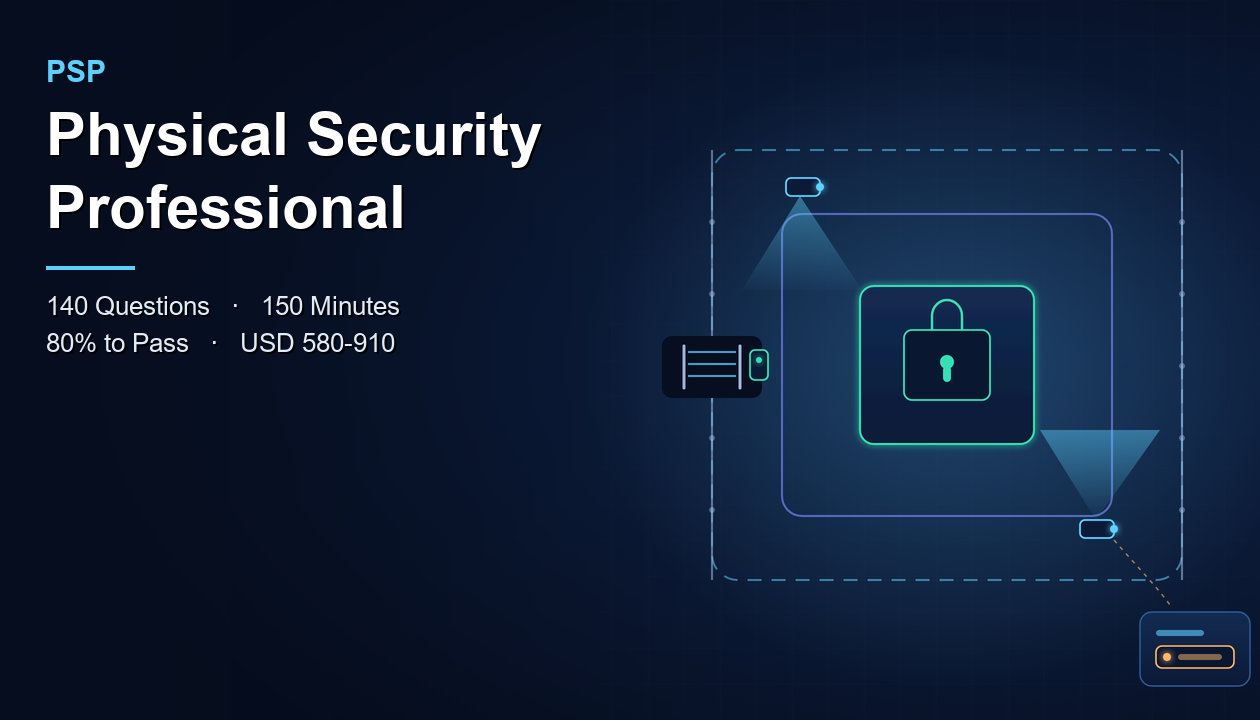
This article looks at the exam from that angle, as a formalisation of practitioner knowledge rather than an academic exercise. The exam facts come from the published details: 140 questions, 150 minutes, a passing score of 80, and a fee that depends on ASIS membership, USD 580 for members and USD 910 for nonmembers. Where those details are silent, including on eligibility requirements and retake rules, this article does not guess. ASIS publishes those on its own certification pages, and PSP is one of the certifications where eligibility is worth checking before anything else.
What Is the ASIS Physical Security Professional (PSP) Certification?
PSP is the ASIS certification for physical security, as its category in the exam data states. It is aimed at people who work on the physical protection of sites, buildings, and the assets and people inside them: security managers and supervisors, consultants, systems designers and integrators, facility and operations staff with security responsibility, and specialists who survey and assess premises.
The credential describes a cycle rather than a single skill. It starts with assessment: understanding what a site is exposed to and where it is vulnerable. It continues into design: choosing measures that address those findings within real constraints of budget, operations, and building fabric. It ends with implementation: specifying, procuring, installing, testing, and handing over systems that work in practice. Most practitioners are strong in one or two parts of that cycle and weaker in the rest, which is exactly where exam preparation pays off.
Why practitioners find it recognisable but still demanding
Day-to-day security work teaches you a great deal that the exam asks about, but it teaches it unevenly and without the vocabulary. You learn that a particular door is a weak point because it failed once. You learn how a camera behaves in low light because you reviewed footage of an incident. You learn which contractor cuts corners because you inherited their work.
What the exam adds is structure: a way of reasoning about risk and protection that applies before an incident teaches you the lesson. Candidates with field experience usually find that they already know the answers to many questions, but not why those answers are correct in general. Closing that gap is most of the preparation, and it is also what makes the credential useful at work.
Who takes it, and what each group has to learn
Three groups predominate. Operational security staff moving into management need the assessment and design reasoning that turns daily observations into a defensible plan. Technical specialists, such as systems integrators and designers, usually know equipment thoroughly and need the risk-based framing that justifies it. People from facilities, engineering, or project management backgrounds know how buildings and projects work and need the security-specific body of knowledge.
Knowing which group you belong to is the fastest way to plan your study. The exam covers the whole cycle, so your effort belongs where your experience thins out, not where it is already strong.
PSP Exam Overview and Details
These are the published facts for the exam:
- Exam name: ASIS Physical Security Professional
- Exam code: PSP
- Category: Physical Security
- Number of questions: 140
- Duration: 150 minutes
- Passing score: 80
- Exam fee: ASIS members USD 580; nonmembers USD 910
- Applying and scheduling: through ASIS's apply for certification page
Those numbers shape preparation more than they might appear to.
One hundred and forty questions in 150 minutes
This is the detail most candidates underestimate. One hundred and forty questions in 150 minutes leaves roughly sixty-four seconds per question. That is a fast pace for a discipline where questions often describe a site, a threat, or a system and ask what should be done.
The practical consequence is that recognition has to be close to automatic. If you are deriving principles from scratch during the exam, you will run out of time regardless of how much you know. Preparation therefore needs to include timed practice, not only reading. Keep a simple checkpoint in mind: about seventy questions answered at the seventy-five minute mark. If you fall behind, answer your best option, flag it, and move on rather than perfecting one question while five others go unread.
A passing score of 80
The passing score is published as 80. With a large question count, that is a demanding standard: you cannot carry a whole weak area and expect the rest to compensate. For a practitioner, the implication is specific. Your field experience will carry some topics comfortably, but the parts of the cycle you rarely touch, often the formal assessment methods or the implementation and testing stages, need deliberate study rather than confidence.
A fee that depends on membership
The fee is listed as USD 580 for ASIS members and USD 910 for nonmembers. That is a significant difference, and it is worth checking your own status and what the current membership arrangements are before you apply, through ASIS directly. Either way, the exam is expensive enough that one well-prepared attempt is the sensible plan.
Eligibility deserves the same early attention. Certifications of this kind commonly set requirements around experience or education, and PSP is applied for through ASIS rather than simply booked. Check the official certification pages for the current requirements, the application process, and retake terms before you build a study timetable around a date.
Key Topics and Syllabus for PSP
The PSP syllabus on CertFun is the authority on the exam's domains and their weightings. Read it before planning your study. What follows does not replace that list or invent a breakdown; it describes the kinds of competence the exam covers, organised the way the work happens on a site, so you can map your own experience onto it.
Assessing a site and its risks
Everything begins with assessment. That means identifying what needs protecting, what could threaten it, how likely and how damaging each scenario is, and where current measures fall short. A practitioner usually does a version of this informally during every walk-around. The formal version is structured: the asset, the threat, the vulnerability, the consequence, and the resulting priority.
The discipline worth building here is separating those elements. A propped-open gate is a vulnerability, not a threat. The threat is whoever might use it, and the consequence depends on what sits behind it. Exam questions reward candidates who can keep those distinctions straight, because many plausible wrong answers come from mixing them up: treating a control failure as a threat, or jumping to a countermeasure before the risk is understood.
Surveys and the evidence behind them matter too. Knowing how to conduct a site survey, what to record, how to document existing conditions, and how to report findings so that a decision-maker can act on them is part of the professional competence being certified.
A short worked example makes the difference concrete. A manager asks for "better security" at a staff entrance after a laptop goes missing. An assessment-led answer starts by establishing what was actually exposed: which assets sit within reach of that entrance, who has legitimate access, what the current controls record, and whether the loss came through that door at all. Only then does a measure follow, and it may be a procedural change rather than equipment. Questions on the exam frequently test whether you reach for the assessment before the solution.
Designing physical protection
Once you know what you are protecting against, design is about choosing measures that deter, detect, delay, and allow a response in time. That framing is the backbone of the discipline. A fence that only deters is not a plan. A sensor that detects without enough delay to respond is a notification, not protection.
The design topics span the perimeter inward: site layout and the use of the environment itself to discourage and channel movement, barriers and gates, lighting, locks and door hardware, entry control for people and vehicles, intrusion detection, video surveillance, and the control room where it all comes together. The practitioner's instinct that "we need a camera there" becomes, in exam terms, a question of what function is missing at that point, what the environment allows, and what the whole system does with the result.
A worked example helps. A distribution centre suffers occasional theft from an unmanned side entrance. The practitioner's fix is often a camera. The PSP reasoning asks a broader set of questions: is the aim to deter, detect, or gather evidence; is anyone watching the feed and able to respond in time; would hardening the door or changing the delivery process remove the need entirely; and what does lighting do for both the camera and the deterrent effect? The right answer in an exam question is usually the one that matches the stated objective, not the most technology-heavy option.
Integrating systems rather than stacking them
Modern protection depends on parts working together: access control that shares information with video, alarms that reach a monitored point and produce a response, and records that survive long enough to be useful afterwards. Understanding how the parts connect, and what happens when one fails, is a distinct competence from knowing what each one does.
This is also where practitioners often discover a gap. Many sites accumulate equipment over years, with the result that nothing quite talks to anything else. The exam expects you to think about the system as a whole, including power, communication paths, redundancy, and what degrades gracefully versus what fails outright.
Ask the failure questions about any system you study. If mains power is lost, what keeps working and for how long? If the network link to a remote building drops, do its card readers still permit entry, and are the events recorded for later? If a monitoring station is unstaffed overnight, who receives an alarm and how long do they take to arrive? A design that only works when everything works is not a design, and scenario questions frequently hinge on that distinction.
Implementation, testing, and handover
A design that is never properly installed protects nothing. Implementation covers specifying what is required, selecting and managing suppliers, overseeing installation, and confirming through testing that the result performs as intended before it is accepted.
Practitioners who have inherited poorly installed systems know the cost of skipping this stage: cameras aimed at walls, readers that fail in the rain, documentation that never existed. The exam treats this as professional work in its own right, including commissioning tests, acceptance criteria, and the records that let the next person understand what was installed and why.
Specification deserves particular attention, because it is where most problems are either prevented or created. A specification that states the function required, the conditions it must perform under, and the tests that will prove it, leaves little room for argument at handover. One that names a product and little else invites substitutions and disputes. For a practitioner used to inheriting other people's installations, learning to write the first kind is one of the most immediately useful parts of the syllabus.
Operating, maintaining, and improving
Finally, protection has to be sustained. That includes the procedures that govern how measures are used, training for the people who operate them, maintenance so that equipment keeps performing, and review after incidents or changes to the site.
This area is closest to daily practice and easiest to take for granted. The exam angle is that measures degrade: doors get propped, procedures drift, equipment ages, and the threat picture changes. A professional plans for that rather than treating installation as the end of the job.
Build the habit of asking what keeps a measure honest over time. Who checks that doors still latch and close, and how often? What happens when a camera's view is slowly obscured by a growing hedge or a stacked pallet? Who notices when a procedure stops being followed because it makes a routine task take twice as long? The propped-open gate from the start of this article is rarely a failure of equipment. It is a failure to design around how people actually work, and then to review what they did instead.
PSP Preparation Guide
The plan below assumes you work in or around physical security and are preparing around a job.
Step 1: Confirm eligibility, then audit your cycle
Start with ASIS's official pages to confirm the current eligibility and application requirements. There is no point building a study plan around a date you cannot yet apply for.
Then audit yourself against the cycle described above: assessment, design, integration, implementation, and operation. For each, decide whether you do this work regularly, have seen it done, or have never been involved. Most practitioners find a clear pattern. Operational staff are strong on operation and weak on design justification. Integrators are strong on systems and weak on formal assessment. Your study time belongs in the weak stages.
Step 2: Study the body of knowledge the syllabus defines
Use the syllabus as your map of scope, and study it in the order the work happens rather than in whatever order your sources present it. Assessment first gives everything else a reason to exist; design follows from assessment; implementation and operation follow from design.
As you study, write each topic in the form you will need it: what problem this measure solves, what it depends on, how it fails, and how you would verify it works. That format converts reading into the kind of judgement the exam asks for, and it is far more durable than summarising definitions.
Step 3: Rehearse on sites you already know
This is the practitioner's advantage, and it costs nothing. Take a site you know well and work it through formally. List the assets. Identify credible threats. Walk the perimeter and record vulnerabilities. For each finding, ask what function is missing: deterrence, detection, delay, or response. Then propose measures and ask what you would test to prove they work.
Do this for two or three different environments if you can, such as an office, a warehouse, and a site with public access, because the right answer changes with the setting. An entry control approach that suits a secure depot would be unworkable at a reception open to the public. Exam questions turn on exactly that kind of fit.
Step 4: Practise at speed
Given sixty-four seconds per question, timed practice is not optional. Work in timed blocks and watch your pace. Review every mistake and classify it: a knowledge gap, a misread question, or a practitioner shortcut, meaning you chose what your own site does rather than what the principle requires. That last category is the characteristic error for experienced candidates, and spotting it repeatedly is a sign to go back to the principle behind the practice.
ASIS also publishes a practice exam document, listed in the resources below. Use official practice material to calibrate the style of questioning, then use volume practice to build speed.
Step 5: Apply, then plan the final week
Apply through ASIS once your timed results are consistently strong across all stages of the cycle. In the final week, stop adding material, revisit your weakest stage, and complete one full timed run of 140 questions to rehearse the pace. Rest the day before; at this question count, concentration in the final third decides more results than knowledge does.
Benefits and Career Scope of the PSP Certification
For a practitioner, the value of PSP is that it converts accumulated site experience into a recognised professional standard.
It makes field judgement legible
Experienced security staff often struggle to evidence what they know. Their expertise lives in incidents handled and problems quietly prevented. A certification in physical security states that the judgement behind that work rests on a recognised body of knowledge, which matters when you are being considered for responsibility rather than tasks.
It supports assessment, design, and project work
The work this certification supports includes conducting security surveys and risk assessments, specifying and designing protective measures, reviewing contractor proposals critically, overseeing installation and acceptance testing, and advising on security during building or refurbishment projects. Those are the responsibilities that move someone from supervising a site to shaping how it is protected.
It carries weight with people outside security
Much of the job involves persuading others: a finance manager to fund a measure, a facilities team to accept an inconvenient door regime, a contractor to meet a specification. A recognised credential in physical security, combined with the structured reasoning it teaches, makes those conversations easier because the recommendation arrives with a method behind it rather than as an opinion.
It fits consultancy and specialist roles
For consultants and integrators, the certification is a credible signal to clients that recommendations are grounded in assessment rather than in a product catalogue. For the current structure of ASIS's certification options and what else is available alongside PSP, see the official certification pages.
Practice Test and Preparation Resources
Keep the resource list short, official, and current.
Official resources
- Official ASIS PSP certification page: the authority on the certification's current details, eligibility, and policies, including anything not covered here.
- ASIS PSP practice exam (PDF): official practice material, useful for seeing how ASIS frames its questions.
- ASIS application page: where you apply for certification and arrange your exam, linked in the overview above.
Sample questions and practice tests
Alongside the official material, work through the PSP sample questions on CertFun. They are particularly useful for building speed and for spotting answers that look right because they describe common practice rather than correct principle.
Use practice tests in timed blocks, and let the review drive your study. Each mistake names a stage of the cycle to revisit; each lucky guess marks something not yet solid. Given the pace of this exam, tracking how long you take per block is as informative as the score itself.
Your own sites
Do not overlook the resource you already have. Survey notes, incident records, maintenance logs, and project documents from your own work are worked examples of nearly every syllabus topic. Reading the syllabus with a specific site in mind turns abstract topics into questions you can answer from memory.
Conclusion
PSP certifies the full cycle of physical security work: assessing a site and its risks, designing measures that deter, detect, delay, and enable response, integrating systems so they function together, implementing and testing them properly, and keeping them effective afterwards. The exam is 140 questions in 150 minutes with a passing score of 80, and the fee is USD 580 for ASIS members or USD 910 for nonmembers.
For a working practitioner, the preparation is less about learning a new subject than about giving structure to judgement you already exercise. Confirm eligibility first, audit yourself across the whole cycle, study the stages you rarely touch, rehearse formal assessments on sites you know, and practise at a pace that matches sixty-four seconds per question.
Done that way, the certification does more than add letters after your name. It gives you a defensible method for the decisions you are already being asked to make, which is what turns a propped-open gate from an irritation into an argument you can win.
FAQs
How many questions does the PSP exam have, and how long is it?
The exam has 140 questions and a duration of 150 minutes, which works out to about sixty-four seconds per question.
What is the passing score for PSP?
The passing score is published as 80.
How much does the PSP exam cost?
The fee is USD 580 for ASIS members and USD 910 for nonmembers. Confirm the amount that applies to you when you apply through ASIS.
How do I book the exam?
PSP is applied for through ASIS, using its apply for certification page, rather than booked directly.
Are there eligibility requirements?
The exam details summarised here do not list them, and certifications of this kind commonly set requirements around experience or education. Check the official ASIS certification page for the current requirements before you plan your study.
Is PSP a technical or a management certification?
It spans both. It covers assessing risk and designing protection as well as implementing and operating physical security measures, so it suits practitioners who work across those stages.
Does ASIS publish practice material?
Yes. ASIS publishes a PSP practice exam document, linked in the resources section above, which is useful for seeing how its questions are framed.
Where can I find the full list of exam topics?
The PSP syllabus on CertFun is the authority on the exam's domains and weightings. Use it to plan your study and to check coverage before you apply.