


The IAPP Certified Information Privacy Manager (CIPM) certification validates the essential expertise required to establish, maintain, and manage a privacy program across its entire operational lifecycle. This credential is an invaluable asset for privacy professionals, especially as artificial intelligence (AI) increasingly integrates into business operations, bringing new complexities to data governance and ethical use. This comprehensive article delves into the transformative power of IAPP CIPM certification, exploring its benefits, the core principles it instills, and effective preparation strategies for those aiming to lead privacy initiatives in an AI-driven world. It will cover the exam's structure, key syllabus areas, and why this certification is critical for career advancement and organizational resilience.
Validating Leadership in AI-Driven Privacy Programs
Successfully managing privacy within an organization, particularly one leveraging advanced AI systems, demands more than just legal knowledge; it requires strategic vision and practical implementation skills. The IAPP CIPM credential equips professionals with the foundational framework and operational understanding necessary to integrate privacy principles into everyday business functions. As AI systems process vast amounts of data, often making autonomous decisions, the potential for privacy infringements escalates, making certified privacy management skills indispensable. This certification is designed for individuals responsible for the day-to-day operation of a privacy program, ensuring that AI initiatives comply with global data protection regulations and ethical standards from conception to deployment.
Understanding the CIPM Examination Framework
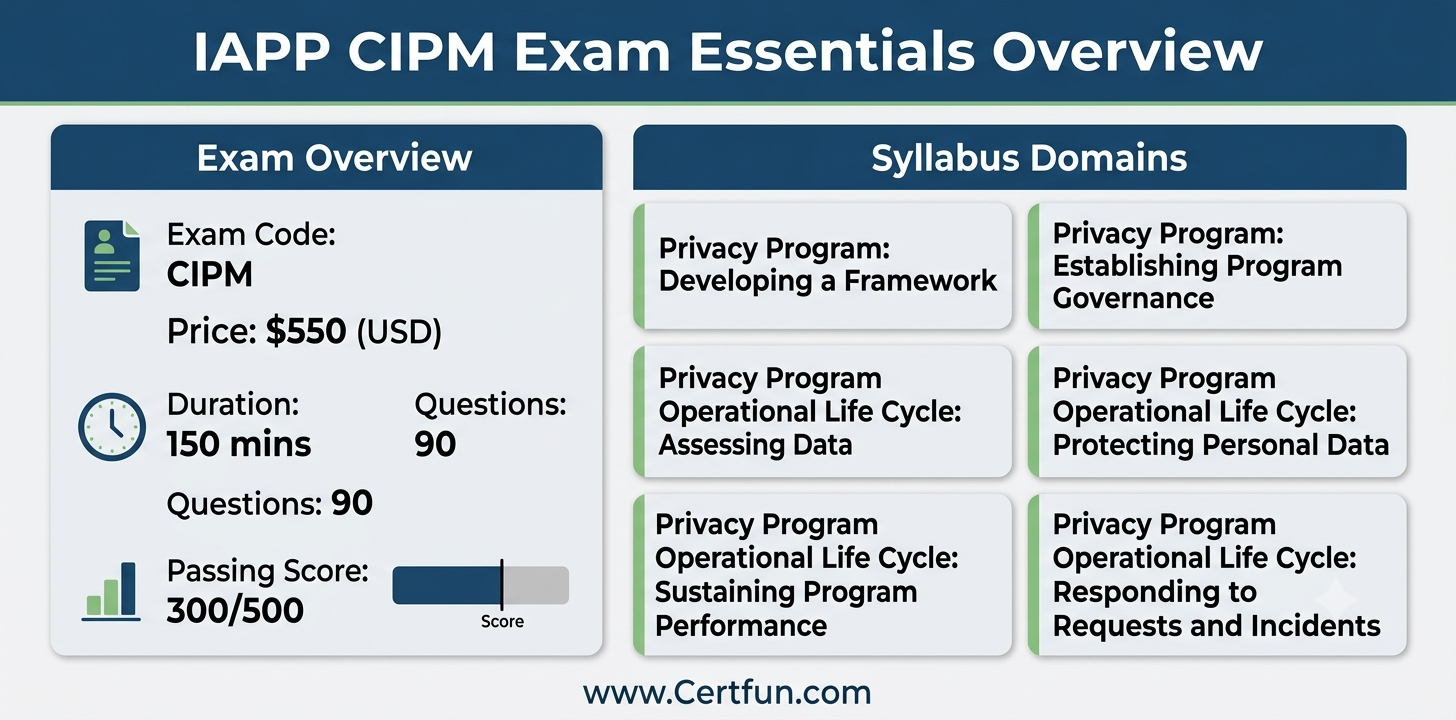
Embarking on the journey to earn the IAPP CIPM certification begins with a clear understanding of the examination's structure and requirements. The CIPM exam, developed by the IAPP, is designed to thoroughly assess a candidate's practical knowledge in privacy program management. It stands as a benchmark for professionals looking to demonstrate their capability in navigating the complexities of data privacy and governance, especially in the context of emerging technologies like AI.
The exam details are structured to ensure a robust evaluation of managerial competencies:
- Exam Name: IAPP Certified Information Privacy Manager (CIPM)
- Exam Code: CIPM
- Exam Price: $550 (USD)
- Duration: 150 minutes
- Number of Questions: 90 multiple-choice questions
- Passing Score: Candidates must achieve a scaled score of 300 out of 500
This format challenges candidates to apply their knowledge to various real-world scenarios, ensuring that those who pass possess not only theoretical understanding but also the practical acumen required to manage privacy programs effectively.
Core Tenets of AI Privacy Management: Exploring the CIPM Syllabus
The CIPM syllabus provides a structured curriculum that covers the critical aspects of establishing, maintaining, and evolving a privacy program. These domains are particularly relevant when considering the unique challenges posed by AI, from data collection and processing to model deployment and accountability. Each section builds upon the next, offering a holistic view of privacy management best practices.
Developing a Robust Privacy Framework
The initial phase of any effective privacy program involves laying a strong foundation. This entails understanding the organizational context, identifying stakeholders, and defining the program’s scope and objectives. For AI systems, this means considering data minimization principles, purpose limitation, and the lawful basis for processing data used in AI training and operation. Establishing clear policies and procedures from the outset helps guide ethical AI development and deployment.
Establishing Program Governance Structures
Effective governance is the backbone of a sustainable privacy program. This involves assigning roles and responsibilities, defining reporting lines, and ensuring accountability across the organization. Within an AI context, this translates to establishing governance boards or committees specifically tasked with overseeing AI ethics, data usage, and compliance. These structures ensure that privacy considerations are embedded into the AI development lifecycle, from data scientists to executive leadership.
Assessing Data in AI Operational Lifecycle
Data assessment is a continuous process that evaluates the privacy risks associated with data processing activities. For AI, this frequently involves conducting Data Protection Impact Assessments (DPIAs) or Privacy Impact Assessments (PIAs) to identify and mitigate risks related to algorithmic bias, data security, and individual rights. Understanding how data flows through AI models, how it's stored, and how long it's retained is crucial. Comprehensive assessments help in anticipating and addressing potential privacy vulnerabilities before they manifest as incidents.
Protecting Personal Data in AI Systems
Implementing robust technical and organizational measures is paramount to safeguarding personal data. This includes deploying encryption, access controls, and pseudonymization techniques, particularly for sensitive data used in AI applications. Furthermore, the CIPM syllabus emphasizes the importance of secure development practices, ensuring that AI systems are designed with privacy-by-design principles. This extends to protecting data at rest, in transit, and during processing by AI algorithms, minimizing unauthorized access or disclosure.
Sustaining Program Performance and Adaptation
A privacy program is not a static entity; it requires continuous monitoring, auditing, and adaptation to evolving legal landscapes and technological advancements. This involves regular training for personnel involved in AI development, conducting internal audits, and reviewing performance metrics. In the dynamic field of AI, staying abreast of new regulations and ethical guidelines, like those surrounding explainable AI and fairness, is crucial for maintaining compliance and public trust. Sustaining performance ensures the program remains effective and resilient against emerging threats.
Responding to Requests and Incidents
Despite best efforts, privacy incidents and individual rights requests can occur. The CIPM certification prepares professionals to develop and implement effective incident response plans, ensuring timely detection, containment, and remediation of breaches. This also covers handling data subject access requests (DSARs), ensuring individuals can exercise their rights regarding their data used by AI systems. A well-defined response strategy minimizes harm to individuals and legal repercussions for the organization.
Benefits of Achieving IAPP CIPM Certification
The IAPP CIPM certification offers a multitude of advantages that transcend individual career growth, directly impacting an organization's ability to manage privacy effectively, especially with the proliferation of AI. Earning this credential signals a profound understanding of privacy program management, positioning professionals as strategic assets in today's data-driven economy.
Elevating Your Professional Credibility and Expertise
Attaining CIPM certification instantly elevates a privacy professional's standing. It serves as an internationally recognized badge of expertise, demonstrating that you possess the advanced knowledge and skills required to navigate complex privacy landscapes. This credibility is particularly valuable when organizations are seeking leaders who can responsibly steer their AI initiatives, ensuring they are compliant and trustworthy. The certification showcases a commitment to the highest standards of privacy protection.
Unlocking Enhanced Career Opportunities and Advancement
For those aiming to advance their careers, the CIPM is a significant accelerator. It opens doors to leadership roles such as Chief Privacy Officer, Privacy Program Manager, and Data Protection Officer, especially in organizations heavily invested in AI and data analytics. Employers actively seek CIPM-certified individuals to fill critical positions where privacy risk management and compliance are paramount. It demonstrates readiness to tackle challenges presented by rapidly evolving data regulations and technologies, including the ethical deployment of AI.
Cultivating a Culture of Privacy by Design
The CIPM methodology emphasizes integrating privacy considerations into the earliest stages of product and system development, often referred to as "Privacy by Design." For organizations developing or deploying AI, this means embedding privacy principles into algorithm design, data collection processes, and user interfaces from the ground up. Certified professionals are equipped to champion this approach, ensuring that AI systems are inherently privacy-preserving rather than having privacy added as an afterthought.
Navigating Complex Regulatory Landscapes with Confidence
Global data protection regulations, such as GDPR, CCPA, and emerging AI-specific regulations, are constantly evolving. The CIPM certification provides a comprehensive understanding of these frameworks, enabling professionals to interpret and apply them effectively. This expertise is crucial for organizations deploying AI across multiple jurisdictions, as a CIPM-certified manager can ensure that AI systems meet diverse legal requirements, mitigating legal and reputational risks.
Driving Ethical AI Development and Data Governance
Ethical AI development is a growing concern, and privacy is a cornerstone of ethical practice. CIPM-certified professionals understand how to conduct data privacy impact assessments for AI systems, identify potential biases, and implement safeguards that uphold fairness and transparency. They play a pivotal role in shaping ethical guidelines and policies for AI use, ensuring that technological advancements align with societal values and individual rights. This ethical leadership becomes increasingly important as AI models become more sophisticated and impactful. You can explore how Certfun also provides resources for other certifications that support a secure data environment by visiting their page on Symantec VIP Technical Specialist, further expanding your knowledge base in cybersecurity.
Mastering Effective CIPM Exam Preparation Strategies
Achieving CIPM certification requires a strategic and disciplined approach to preparation. Given the depth and breadth of the syllabus, candidates benefit from a multi-faceted study plan that covers both theoretical knowledge and practical application.
Official IAPP Study Guide and Training Programs
The IAPP offers official resources specifically designed for the CIPM exam. Utilizing the official study guide and participating in IAPP-approved training programs can provide a structured learning path. These resources are often developed by subject matter experts and align directly with the exam objectives, providing comprehensive coverage of all key concepts. Engaging with official materials ensures you are studying the most relevant and up-to-date information.
Deepening Understanding of IAPP AI Privacy Principles
Beyond general privacy concepts, dedicate specific time to understanding how IAPP principles apply to artificial intelligence. This involves grasping topics like privacy by design in AI, data minimization for AI training sets, fairness and transparency in algorithmic decision-making, and the challenges of explainable AI (XAI) from a privacy perspective. Focus on scenarios where AI could inadvertently create privacy risks and how to mitigate them.
Crafting a Personalized Study Schedule
Successful exam preparation hinges on consistent effort over time. Create a realistic study schedule that allocates dedicated time each day or week for CIPM material review. Break down the syllabus into manageable sections and set specific goals for each study session. Regularly revisit challenging topics and integrate short, frequent review sessions to reinforce learning. The duration of study can vary depending on existing knowledge, but typically, candidates spend several months preparing.
Engaging with Practice Exam Questions
Practice is critical for solidifying understanding and becoming familiar with the exam format. Regularly work through CIPM practice exam questions to assess your comprehension and identify areas requiring further attention. Analyze both correct and incorrect answers to understand the underlying privacy principles and reasoning. This not only builds confidence but also helps refine your test-taking strategies under timed conditions. Platforms offering simulated exam environments can be particularly beneficial for this stage of preparation.
Forming Study Groups and Discussing Concepts
Collaborating with peers can significantly enhance the learning experience. Forming study groups allows for the discussion of complex topics, sharing insights, and clarifying doubts. Explaining concepts to others reinforces your own understanding, and hearing different perspectives can reveal new angles to privacy challenges, particularly those unique to AI implementation. Group discussions can also make abstract concepts more concrete through real-world examples.
Leveraging Professional Experience and Real-World Scenarios
The CIPM exam often presents scenario-based questions that require applying theoretical knowledge to practical situations. Reflect on your own professional experiences in privacy or data management and draw parallels to the concepts covered in the syllabus. Consider how you would implement CIPM principles within an organization utilizing AI, thinking through potential roadblocks and solutions. This practical orientation will be invaluable in answering application-focused questions effectively.
Building an IAPP Framework for AI Governance
Establishing a robust framework for AI governance is not just a regulatory mandate; it's a strategic imperative for organizations aiming to harness AI's potential responsibly. The IAPP CIPM certification provides the blueprint for privacy professionals to lead this charge, ensuring that AI development and deployment are aligned with ethical considerations and legal requirements.
Integrating Privacy Principles from Conception to Deployment
An effective AI governance framework mandates the integration of privacy from the earliest stages of an AI project. This means adopting privacy-by-design principles where data protection mechanisms are embedded into the architecture of AI systems, rather than added as an afterthought. CIPM professionals guide teams to consider data minimization, purpose limitation, and consent mechanisms when designing data pipelines for AI training. They advocate for impact assessments that proactively identify and mitigate privacy risks associated with AI algorithms before deployment, ensuring that ethical AI development is a core tenet.
Establishing Cross-Functional Collaboration for AI Ethics
AI governance cannot exist in silos. It requires a collaborative effort involving legal, IT, data science, and business units. CIPM-certified managers are adept at fostering this cross-functional engagement, creating channels for dialogue and decision-making on AI ethics and privacy. They facilitate the development of internal policies and guidelines that clarify acceptable AI use, data handling, and accountability mechanisms. This collaborative environment ensures that diverse perspectives inform the governance framework, making it comprehensive and adaptable.
Continuous Monitoring and Auditing of AI Systems
The dynamic nature of AI models necessitates continuous monitoring and auditing to ensure ongoing privacy compliance and ethical performance. A CIPM-guided framework includes provisions for regular assessments of AI systems in production, checking for drift in data usage, algorithmic bias, and adherence to privacy policies. This involves setting up metrics for privacy performance, conducting periodic audits, and implementing mechanisms for rapid response to identified issues. Such vigilance helps in sustaining program performance and adapting to new AI-related risks and regulations.
Optimizing Data Privacy Impact Assessments for AI Systems
Data Privacy Impact Assessments (DPIAs) are crucial tools for identifying and mitigating privacy risks. When applied to AI systems, DPIAs take on an even greater significance due to the complexity, scale, and potential for autonomous decision-making inherent in AI. CIPM professionals are equipped to conduct these specialized assessments.
Identifying Unique AI-Specific Privacy Risks
Traditional DPIAs often focus on structured data processing activities. For AI, the assessment must expand to cover risks such as algorithmic bias, lack of transparency (the "black box" problem), and the potential for re-identification from aggregated or anonymized data sets used in training. It also considers the unique risks of inferred data or classifications made by AI, which might reveal sensitive personal attributes. A thorough DPIA for AI systems evaluates the entire lifecycle of data within the AI, from collection and preparation to model training, validation, and deployment.
Evaluating Algorithmic Fairness and Transparency
A key component of DPIAs for AI systems involves assessing algorithmic fairness and transparency. This means evaluating whether AI models produce equitable outcomes across different demographic groups and whether their decision-making processes can be sufficiently explained to data subjects. CIPM managers work to ensure that appropriate measures are in place to detect and address bias in training data, model design, and output interpretation. They also advocate for explainable AI techniques where feasible, aligning with the principles of accountability and due process.
Implementing Risk Mitigation Strategies for AI Data Flows
Once AI-specific privacy risks are identified, the next step is to implement effective mitigation strategies. This could include using privacy-enhancing technologies like differential privacy or federated learning, employing data minimization techniques during AI model training, or establishing robust access controls for AI development environments. CIPM-certified professionals guide the selection and implementation of these controls, ensuring they are proportionate to the identified risks and align with the organization's privacy posture. Regular review of these mitigation strategies is essential to adapt to evolving AI capabilities and threats.
Ensuring Ethical AI Development with IAPP Certification
The proliferation of AI brings immense opportunities but also significant ethical challenges. The IAPP CIPM certification plays a pivotal role in empowering privacy professionals to champion ethical AI development within their organizations, transforming abstract principles into actionable practices.
Integrating Ethical Principles into the AI Lifecycle
Ethical AI development goes hand-in-hand with robust privacy management. CIPM professionals learn to integrate ethical considerations, such as fairness, accountability, transparency, and data minimization, into every stage of an AI system's lifecycle. This means questioning data sources for bias, assessing the societal impact of AI decisions, and ensuring human oversight where autonomous systems have significant impact. The certification reinforces the idea that technology should serve humanity responsibly.
Fostering Transparency and Explainability in AI Systems
One of the most pressing ethical challenges in AI is the "black box" problem, where the decision-making process of complex algorithms is opaque. CIPM training emphasizes the importance of transparency and explainability, where possible, to build trust and ensure accountability. This involves advocating for methodologies that allow for a better understanding of how AI models arrive at their conclusions, especially when those conclusions affect individuals' rights or opportunities. Ethical AI development demands clear communication about an AI system's capabilities and limitations.
Establishing Accountable AI Practices and Oversight
Accountability is a cornerstone of ethical AI. CIPM-certified individuals are trained to establish clear lines of responsibility for AI systems, ensuring that there are designated individuals or teams accountable for their ethical performance and compliance. This includes implementing mechanisms for independent oversight, such as ethics review boards, and establishing processes for auditing AI decisions. By promoting accountable AI practices, organizations can foster public trust and demonstrate their commitment to responsible innovation.
Choosing the Best Study Materials for IAPP CIPM
Selecting the right study materials is a cornerstone of effective CIPM exam preparation. A combination of official resources, supplementary guides, and practical tools can create a well-rounded study experience.
Official IAPP Resources: Your Primary Guide
The primary and most authoritative source for CIPM preparation is the IAPP itself. This includes:
Official IAPP CIPM Textbook: Provides in-depth coverage of all syllabus domains.
- IAPP CIPM Body of Knowledge (BoK): Outlines the specific topics and concepts tested on the exam.
- IAPP Training Courses: Whether in-person or online, these structured courses offer expert instruction and interactive learning.
- Official Practice Exams: Essential for familiarizing yourself with the question style and difficulty.
These materials ensure alignment with the exam content and current privacy standards.
Leveraging Certfun for Practice Exam Questions
Beyond official materials, supplementing your preparation with high-quality practice questions from reputable third-party providers can significantly enhance your readiness. Websites like Certfun offer CIPM practice exam questions that simulate the actual test environment. These questions can help you:
- Identify knowledge gaps.
- Improve your time management skills.
- Build confidence by practicing under exam-like conditions.
Consistent practice with a wide range of question types is crucial for exam success.
Supplementary Books and Online Communities
Expand your knowledge by consulting other reputable privacy and data governance books that delve into specific aspects of privacy law or technology, especially those focusing on AI ethics or data protection. Additionally, joining online forums and communities dedicated to IAPP certifications can provide a valuable platform for discussion, clarification, and peer support. Engaging with others preparing for the CIPM can offer different perspectives and insights into challenging topics.
Measuring IAPP CIPM Certification Cost and Value
Investing in an IAPP CIPM certification involves both financial commitment and a significant investment of time. Understanding the true value proposition requires weighing these costs against the substantial professional and organizational benefits.
Initial Financial Outlay for Exam and Study
The immediate costs associated with the CIPM certification include the exam fee, which is $550 (USD). Beyond this, candidates may incur expenses for official IAPP training courses (ranging from hundreds to thousands of dollars), study guides, and potentially third-party practice exams. These upfront costs represent a considerable investment for individuals and, if company-sponsored, for organizations.
Quantifying the Return on Investment (ROI)
The value of CIPM certification extends far beyond its monetary cost. For individuals, it often translates into:
- Higher earning potential: Certified privacy professionals, especially those skilled in AI privacy, command competitive salaries.
- Career mobility: Opens doors to advanced leadership roles and greater professional influence.
- Enhanced job security: As privacy regulations tighten and AI use grows, certified expertise becomes indispensable.
- For organizations, the ROI includes:
- Reduced compliance risk: Expert privacy management mitigates the financial penalties and reputational damage from data breaches or regulatory non-compliance.
- Increased customer trust: Demonstrates a commitment to protecting data, fostering loyalty and brand value.
- Ethical innovation: Enables responsible adoption of AI and other data-driven technologies, leading to sustainable business growth.
The long-term benefits typically far outweigh the initial investment, making the CIPM a strategically valuable credential for both personal and organizational success.
Is IAPP CIPM Certification Worth the Investment?
The decision to pursue the IAPP CIPM certification is a significant one, prompting many to ask: is it truly worth the investment? Given the current global landscape of data privacy and the rapid advancements in AI, the value proposition for the CIPM has never been stronger.
Strategic Advantage in a Privacy-First World
Organizations globally are increasingly prioritizing data privacy, driven by stringent regulations and heightened consumer expectations. The CIPM positions professionals as crucial strategists who can not only ensure compliance but also build trust and enable responsible innovation, especially in AI. This makes the certification not just a mark of technical skill but also a testament to a strategic business mindset, which is invaluable in today's privacy-first economy.
Future-Proofing Your Privacy Career Amidst AI Evolution
The intersection of privacy and AI is one of the most dynamic and critical areas in technology and business. As AI systems become more pervasive, the demand for professionals who understand how to manage their privacy implications will only grow. The CIPM directly addresses this need, equipping individuals with the knowledge to manage privacy programs specifically designed to handle AI complexities. This makes the certification an investment in future-proofing your career against technological shifts and regulatory changes.
Demonstrating Leadership and Organizational Value
Earning the CIPM demonstrates a profound commitment to professional development and leadership in privacy. It signifies an ability to implement and manage a comprehensive privacy program, a skill set highly valued by employers. In an era where data breaches can lead to significant financial penalties and reputational damage, CIPM-certified professionals are vital assets who help organizations navigate these risks, protect sensitive information, and sustain public confidence. The certification provides tangible evidence of your capability to drive value and mitigate risk within any organization.
Career Opportunities Expanded with IAPP CIPM Certification
The IAPP CIPM certification serves as a powerful catalyst for career advancement, opening doors to a diverse range of opportunities for privacy professionals. As businesses increasingly navigate complex data protection landscapes and integrate advanced technologies like AI, the demand for certified privacy managers is surging.
Leading Privacy Programs in Diverse Industries
With a CIPM, professionals are well-positioned to take on leadership roles across various sectors, including technology, finance, healthcare, and retail. These roles often involve establishing and managing an organization's privacy framework, ensuring compliance with global regulations, and fostering a culture of data protection. The universality of privacy concerns means that CIPM-certified individuals can apply their expertise in virtually any industry that handles personal data.
Specializing in AI Privacy and Governance Roles
The explicit focus of the CIPM on managing privacy programs is particularly beneficial for roles specializing in AI. This includes positions such as AI Privacy Specialist, AI Ethics Manager, or Data Governance Lead for AI Systems. In these capacities, CIPM professionals are tasked with developing and implementing policies to address AI-specific privacy risks, conducting AI-focused DPIAs, and ensuring the ethical deployment of machine learning models. Their expertise is crucial for organizations looking to innovate responsibly with AI.
Consulting and Advisory Positions
Many CIPM-certified individuals also find rewarding careers in privacy consulting. As external advisors, they help organizations of all sizes develop, implement, and audit their privacy programs, offering specialized guidance on compliance, risk management, and ethical data practices. The growing complexity of AI regulations creates a strong demand for consultants who can provide expert advice on navigating the unique privacy challenges presented by artificial intelligence. This offers a dynamic career path with exposure to a wide array of clients and privacy scenarios.
Conclusion
The IAPP Certified Information Privacy Manager (CIPM) certification is more than just a credential; it's a strategic imperative for professionals navigating the intricate world of data privacy, especially as AI continues to redefine how organizations operate. It equips individuals with the indispensable skills to architect, implement, and oversee robust privacy programs, ensuring compliance, fostering trust, and driving ethical innovation. From understanding complex regulatory frameworks to mastering the nuances of AI governance and impact assessments, the CIPM prepares privacy leaders to mitigate risk and unlock strategic value.
Embrace the future of privacy leadership by pursuing your CIPM certification. This investment in your expertise will not only accelerate your career but also position you at the forefront of responsible AI development and data stewardship. To effectively prepare and maximize your chances of success, explore diverse study materials and practice resources. Take the next step in enhancing your professional journey by visiting Certfun's product page
Frequently Asked Questions
1. What does the IAPP CIPM certification validate?
- The IAPP CIPM certification validates a professional's expertise in establishing, maintaining, and managing a comprehensive privacy program across its entire operational lifecycle, including critical aspects like governance, risk assessment, and incident response.
2. Who should pursue the IAPP CIPM certification?
- The CIPM certification is ideal for privacy officers, privacy program managers, data protection officers, and any professional responsible for the day-to-day operations and strategic oversight of an organization's privacy program, especially those integrating AI technologies.
3. How does CIPM address AI-specific privacy challenges?
- The CIPM syllabus covers principles like privacy by design, data privacy impact assessments for AI systems, ethical AI development, and managing risks such as algorithmic bias, directly equipping professionals to address the unique privacy challenges posed by artificial intelligence.
4. What study resources are recommended for the CIPM exam?
- Recommended study resources include the official IAPP CIPM textbook and training courses, the IAPP Body of Knowledge, official practice exams, and supplementary materials like those offered by Certfun for additional practice questions.
5. What career benefits can I expect after achieving CIPM certification?
- CIPM certification enhances professional credibility, unlocks leadership roles in privacy management and AI governance, facilitates career advancement across diverse industries, and increases earning potential by positioning you as a crucial asset in a privacy-first economy.