

A nightly ingestion job finishes forty minutes late. A downstream report runs against yesterday's partition because today's has not landed yet, and the first question anyone asks is not "which tool broke" but "where in the pipeline did the data stop moving?" If that kind of morning is familiar, you are already doing the work the H13-711 exam describes. The HCIA-Big Data certification is Huawei's associate-level check on whether you understand how a big data platform stores, moves, and processes data, and whether you can reason about its components well enough to keep one running.
This article is written for people in that position: data engineers who inherited a Hadoop-style cluster, platform administrators who were handed a cloud big data service, database professionals who keep getting pulled into analytics projects, and developers who write jobs against a cluster they did not build. The question it tries to answer is practical. Does this exam match the work you already do, and if it does, what is the shortest honest route from daily familiarity to a pass?
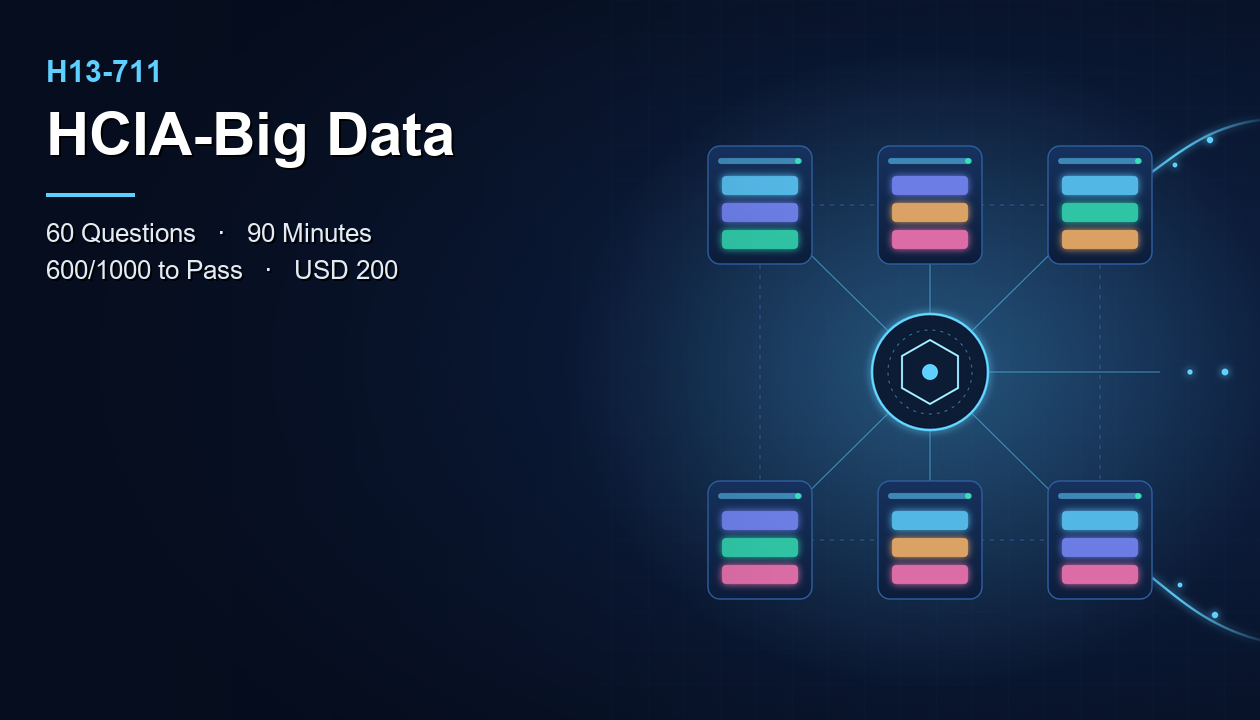
Everything below about the exam's format, cost, and scoring comes straight from the published exam details: 60 questions, 90 minutes, a passing mark of 600 out of 1000, and a USD 200 fee for the V3.5 version. Where those details are silent, on formal prerequisites or retake rules for example, this article says so and points you to the official page instead of guessing.
What Is the Huawei HCIA-Big Data (H13-711) Certification?
HCIA-Big Data is the Huawei Certified ICT Associate credential for big data, and H13-711 is the exam that awards it. The current exam version is V3.5, and the exam sits in the Cloud Platform & Cloud Services category. That placement tells you something about the framing: big data is treated less as a standalone discipline and more as a set of services running on infrastructure that someone has to deploy, configure, and use well.
"Associate" marks the entry point of a certification track. That does not mean the exam is written for someone who has never touched a cluster. It means the exam checks foundational understanding across a broad surface rather than deep specialisation in one component. You are expected to know what each major part of a big data platform is for, how the parts hand data to one another, and what the basic operational decisions look like. You are not expected to tune a production cluster under load from memory.
For a practitioner, the useful way to read the credential is as a vocabulary and architecture check. Most people who work around big data systems learn them piecemeal. You learn the file system because a disk filled up. You learn the resource manager because a job sat in a queue for an hour. You learn the SQL layer because an analyst asked why their query scanned every partition. That produces real competence, but it is patchy. The exam asks you to fill the gaps between the patches, so that your understanding of one component connects to the others.
Who the exam fits
The exam tends to fit three kinds of working professional. The first is the operator who already keeps a cluster alive and wants a credential that reflects it. The second is the developer or analyst who writes jobs and queries against a platform and wants to understand what happens underneath them. The third is the infrastructure or database professional moving sideways into data platforms, who knows storage, networking, or SQL well and needs to learn how those ideas change at distributed scale.
H13-711 Exam Overview and Details
These are the published facts for the exam:
- Exam name: Huawei Certified ICT Associate - Big Data (HCIA-Big Data)
- Exam code: H13-711
- Exam version: V3.5
- Number of questions: 60
- Duration: 90 minutes
- Passing score: 600 / 1000
- Exam fee: USD 200
- Scheduling: through Pearson VUE's Huawei exam page
Numbers on their own do not tell you much, so here is what they mean when you are actually sitting in front of the exam.
Sixty questions in ninety minutes
Ninety minutes for sixty questions gives you an average of ninety seconds per question. That is comfortable for a recall question and tight for one that describes a scenario and asks you to pick the right component or the right explanation. In practice your time will not be spread evenly. Some questions you will answer in fifteen seconds because you recognise the concept immediately. Others will make you reread the stem to check whether it is asking about storage, scheduling, or processing.
A workable pacing habit is to check your position at the halfway mark. If you have answered around thirty questions by the forty-five minute point, you are on schedule. If you are well behind, the likely cause is overthinking questions you actually know. Mark the ones you are unsure of, choose your best answer, and move on. Returning with fresh eyes at the end is usually worth more than grinding on a single question in the middle.
A scaled passing score, not a percentage
The passing mark is written as 600 out of 1000. Treat that as a scaled score, not as "60 percent of the questions." The threshold is published in that form, without a conversion from raw correct answers to the scaled figure. The practical conclusion is to avoid preparing for a borderline pass. If your practice results sit just above where you guess the line to be, you have no margin. Aim to be clearly comfortable across the whole syllabus instead.
The fee and what it asks of you
At USD 200, the attempt is modest next to many professional-level certifications, but it is enough that you want to sit it once. The cost argument for preparation is straightforward: an extra week of structured study is cheaper than a second exam fee, and it also saves the time it takes to schedule and prepare for a retake. For retake rules, rescheduling, and cancellation terms, check the official Huawei certification page and Pearson VUE directly, because those policies are not part of the exam details summarised here.
Key Topics and Syllabus for H13-711
The H13-711 syllabus on CertFun is the authority on the official topic list and how the exam is organised. Read it before you plan anything, and read it again before you book the exam. What follows is not a replacement for that list. It describes the kinds of understanding a big data associate exam tests, organised the way a practitioner experiences the platform, so that you can map your own experience onto the official topics.
How a big data platform is put together
The foundation is architectural. Before any individual component makes sense, you need a clear picture of why big data platforms are built the way they are. Data volumes outgrow a single machine, so storage is spread across many nodes. Processing moves to where the data sits, because moving terabytes across a network is slower than moving code. Failures are expected rather than exceptional, so the platform replicates data and retries work automatically.
A practitioner usually knows these ideas by their symptoms. You have seen a job survive a node going down. You have seen a cluster rebalance after new hardware was added. The exam asks you to explain the principle behind the symptom: why replication gives fault tolerance, why data locality matters for performance, why a platform separates storage from compute scheduling. If you can draw the path a piece of data takes from ingestion to query result, naming each layer it passes through, you have the backbone the rest of the syllabus hangs on.
Distributed storage
Storage is where most operators start, often under pressure. A distributed file system splits files into blocks, spreads those blocks across nodes, and keeps copies so that losing a disk does not lose data. A central service tracks where every block lives. Understanding that split between metadata and data is essential, because it explains both the strengths and the weak points of the design.
Questions in this area tend to test whether you understand consequences rather than definitions. Why is a huge number of very small files a problem? Because every file costs metadata, and that metadata is held by a coordinating service. What happens when a node holding a block copy fails? The platform notices the missing replica and creates a new one elsewhere. Why does the design favour writing once and reading many times? Because that pattern is what makes large sequential reads fast. If your working week includes cleaning up small-file problems or watching replication recover after a failure, you already hold the intuition. Make sure you can state the mechanism.
Most platforms also offer distributed, key-based storage for low-latency access alongside the file system. It is worth knowing when a workload belongs in a store built for fast lookups by key, and when it belongs in files scanned in bulk. Mixing up those two access patterns is a common design mistake, and a common source of plausible wrong answers.
Resource management and scheduling
A cluster is shared, so something has to decide which job gets which resources and when. The resource management layer allocates memory and CPU to applications, tracks what is running, and enforces queues and priorities so that one heavy job cannot starve everyone else.
If you have ever explained to a frustrated analyst why their query is waiting, you have touched this material. Expect to need a clear model of the roles involved: a central manager that sees the whole cluster, per-node agents that run and monitor work, and per-application coordination that negotiates for resources. You should also understand scheduling policy at a conceptual level, such as the difference between running jobs strictly in order, reserving capacity for separate queues, and giving each user a fair share over time. The practitioner question behind all of this is always the same: when a job is slow to start, is the problem the job, the queue, or the cluster?
Batch, interactive, and stream processing
Processing is the heart of the platform, and this is where the material is likely to feel broadest. Batch processing handles large volumes of data in scheduled jobs, dividing the work into parallel tasks and combining the results. In-memory engines speed that up by keeping intermediate data in memory rather than writing it to disk between steps. Stream processing handles data continuously as it arrives, which changes the questions you ask: instead of "how long does the job take," you ask "how far behind real time are we?"
For each style you should know what kind of problem it suits and what it costs. Batch is simple and robust but slow to deliver fresh results. In-memory processing is faster for iterative work but depends on having enough memory. Streaming delivers low latency but has to cope with late data, ordering, and state that must survive failures. A typical scenario describes a business need, such as a nightly report, an ad-hoc analysis, or checks on live transactions, and asks which approach fits. Practitioners who have chosen between these under real constraints tend to do well here, provided they can say why.
SQL on big data deserves attention too. Many users never write a processing job; they write SQL, and a query engine turns it into distributed work. Understanding how tables map onto files, why partitioning cuts the amount of data a query reads, and why a filter on the partition column matters so much is exactly the knowledge that turns an analyst's slow query into a fast one.
Data ingestion and messaging
Data has to get into the platform before anything else happens. Ingestion covers collecting logs and events from many sources, moving bulk data between relational databases and the cluster, and buffering high-volume event streams in a distributed messaging layer so that producers and consumers can work at different speeds.
The practitioner's view of ingestion is usually shaped by failure. A source system sends a burst, and a consumer falls behind. A bulk import collides with a busy business database. A collector silently stops forwarding after a configuration change. The exam-relevant skill is understanding the design choices that prevent those problems: why a message queue decouples producers from consumers, how splitting a stream into partitions allows parallel consumption, and why coordination services exist to keep distributed components in agreement about who is doing what.
Platform services, operations, and search
Because the certification sits in the cloud platform and services category, expect the managed-service view of big data to matter: deploying a cluster as a service, choosing its components, and managing it through a console rather than assembling everything by hand. Coordination, security, and search round out the picture. Coordination services keep configuration and leadership consistent across nodes. Security controls who can reach which data and how users authenticate. Search engines index data so that it can be queried by content rather than scanned end to end.
The syllabus will tell you exactly which components and services are in scope for V3.5 and at what depth. Use it as a checklist. For each item, ask yourself three questions: what is it for, what does it hand data to, and what goes wrong with it in practice? If you can answer all three, that topic is in good shape.
H13-711 Preparation Guide
The route below assumes you have some working exposure to a big data platform, even if it is narrow. If you are starting from nothing, add time at the first two steps. If you run a cluster daily, you may move through the first step quickly, but do not skip it, because it is where hidden gaps show up.
Step 1: Audit your experience against the syllabus
Open the syllabus and make three columns. In the first, list the topics you use every week. In the second, list the ones you have touched but could not explain to a colleague. In the third, list the ones you have never worked with. Be honest about the second column; it is usually the largest, and it is where most disappointing results come from. People overestimate what they know because they recognise the names.
A useful test for each topic is to explain it out loud in two minutes without notes, covering what it does, why it exists, and how it connects to the component next to it. If you stumble, it goes in the second column. The audit should take one or two evenings, and it shapes everything else, so give it proper attention.
Step 2: Study the official material in the order data flows
Huawei provides HCIA-Big Data V3.5 training material through its talent portal, which opens on a Huawei sign-in page. That material is written for this exam version, so make it your primary source.
Work through it in the order data flows rather than in whatever order feels comfortable: architecture first, then storage, then resource management, then processing, then ingestion, then platform services and operations. Studying in flow order means each new topic lands on something you already understand. It also mirrors how scenario questions are built, since they often describe a pipeline and ask about one stage of it.
Spend your time in proportion to your audit. Topics from the first column need a quick read to confirm that the official terminology matches yours. Topics from the second column need slow study and notes. Topics from the third column need the most time and, ideally, hands-on practice.
Step 3: Turn habits into explanations
This is the step practitioners most often skip, and it is the one that matters most for them. You may know exactly what to do when a job is stuck in a queue, but a question may ask why the scheduler behaves that way. Knowing the fix is different from knowing the mechanism.
For each topic, write a short explanation in your own words: a few sentences on what the component does, one on what it depends on, and one on a failure you have seen or can imagine. Then connect it to your work. "Our nightly job is slow because it scans unpartitioned data" becomes "partition pruning lets the query engine skip files that cannot match the filter." That translation, from incident to principle, is exactly what an architecture-focused exam rewards.
If you have access to a test cluster or a trial of a managed big data service, use it to check your explanations. Write a large file and look at how it was split into blocks. Submit two jobs to the same queue and watch how resources are allocated. Produce messages faster than a consumer reads them and observe the lag grow. Ten minutes of watching a mechanism work fixes it in memory better than an hour of reading about it.
Step 4: Practise under exam conditions
Once you have covered the syllabus, move to timed practice. Work through questions in blocks and hold yourself to the real pace of ninety seconds per question on average. The goal is not only to test knowledge but to rehearse decisions: when to answer and move on, when to mark a question, and how to handle a stem that seems to fit two answers.
Review every question you get wrong, and every one you got right by guessing. Sort each into a cause. Was it a knowledge gap, a misread question, or a trap where you knew the concept but picked the plausible wrong answer? Knowledge gaps send you back to Step 2. Misreads call for slower reading of the stem. Traps call for more work on Step 3, because they usually mean you know what a component is called but not precisely what it does.
Step 5: Plan the final week and book the exam
Book the exam through Pearson VUE when your timed practice is consistently comfortable, not when it first creeps over the line. In the final week, do not start new material. Revisit your second-column topics, reread your own explanations from Step 3, and run one or two full timed sessions of 60 questions in 90 minutes. The day before, stop early. A tired candidate misreads scenario questions, and scenario questions are where preparation pays off.
Benefits and Career Scope of HCIA-Big Data
The honest value of an associate credential is that it makes existing knowledge visible and fills the gaps in it. For a practitioner, both effects are useful.
It documents platform knowledge you already use
Many people who keep big data platforms running have no formal evidence that they can. Their knowledge lives in incident history and team memory. HCIA-Big Data gives that knowledge a recognised name. That helps when you want to move from being the person who happens to fix the cluster to being formally responsible for it, and it helps when you describe your skills to an employer or client who cannot see your incident history.
It is directly relevant where Huawei platforms run
Because the certification comes from Huawei and sits in its cloud platform and services category, it is most directly useful in organisations that run Huawei infrastructure or cloud services, and for partners and integrators who deploy them. In those environments a Huawei credential speaks the same language as the platform you work on. The underlying concepts, distributed storage, resource scheduling, batch and stream processing, and ingestion, carry over to other big data platforms too, so the learning does not lock you into one vendor.
It supports broader data platform work
The work this knowledge supports includes operating and monitoring big data clusters, building and maintaining ingestion pipelines, supporting analysts who query large datasets, troubleshooting slow or failed jobs, and taking part in moves of data workloads onto cloud services. For someone coming from database administration or infrastructure, it provides a structured way into those responsibilities. For a developer, it explains the platform underneath their jobs, which usually makes those jobs faster and more reliable.
Practice Test and Preparation Resources
Keep your resource list short and matched to the exam version. More material does not help if it describes an older version or a different platform.
Official resources
- Official HCIA-Big Data certification page: the authority on the certification's current details and policies. Check it for anything not covered here, including prerequisites and retake terms.
- HCIA-Big Data V3.5 training material: Huawei's own study material for this version, reached through the talent portal linked in the Preparation Guide. Treat it as your primary study source.
- Pearson VUE: where you schedule the exam, and where you should confirm testing options and booking rules.
Sample questions and practice tests
Once your study is well underway, work through the H13-711 sample questions on CertFun to see how topics turn into exam-style questions. Sample questions are most useful for calibration: they show you the style of stem, the kind of distractors, and the depth at which concepts are tested.
Practice tests serve a different purpose from reading. Use them in timed blocks to rehearse the ninety-seconds-per-question pace, and use the review afterwards to classify your mistakes as knowledge gaps, misreads, or traps. A practice test you take once and never review teaches you very little. One you review carefully tells you exactly where your next study evening should go.
Conclusion
H13-711 checks whether you understand a big data platform as a connected system: how data is stored across many machines, how shared resources are allocated, how batch, interactive, and streaming workloads differ, how data gets in, and how the platform runs as a managed service. The format is 60 questions in 90 minutes, with a passing mark of 600 out of 1000 and a USD 200 fee for V3.5.
If you already work around a cluster, much of that will feel familiar, and that is both an advantage and a risk. The advantage is real intuition. The risk is that recognising a component's name feels like understanding it. The route that works for practitioners turns daily habits into explanations: audit yourself against the syllabus, study the official material in the order data flows, write down the mechanism behind each thing you already do, and practise under timed conditions until you are clearly comfortable, not just close.
Done that way, the certification does more than add a line to your profile. It gives your existing experience a structure, and that structure makes you better at the work the exam describes.
FAQs
How many questions are on the H13-711 exam, and how long do I get?
The exam has 60 questions and a duration of 90 minutes, which works out to an average of ninety seconds per question.
What is the passing score for HCIA-Big Data?
The passing score is 600 out of 1000. It is published as a scaled score, so do not read it as a simple percentage of correct answers.
How much does the H13-711 exam cost?
The exam fee is USD 200. Confirm the amount when you book through Pearson VUE.
Which version of the exam is current?
The current version is V3.5. Make sure your study material matches it, and use the syllabus to settle any differences between sources.
Where do I schedule the exam?
The exam is scheduled through Pearson VUE's Huawei exam page, where you can also confirm testing options and booking rules.
Are there prerequisites for HCIA-Big Data?
The exam details summarised here do not list a prerequisite. Check the official Huawei certification page for current eligibility requirements before you book.
What official study material is available?
Huawei offers HCIA-Big Data V3.5 training material through its talent portal, which starts at a Huawei sign-in page. It is the best primary source because it is written for this exam version.
Where can I find the official topic list?
The H13-711 syllabus page on CertFun, linked in the Key Topics section, is the authority on the exam's topics. Use it to plan your study and to check coverage before you book.