

There is a point in a storage career where the questions stop being about equipment. Early on, you are asked whether a system supports a feature, how much capacity it has, or why a backup window is overrunning. Later, you are asked which approach a customer should take for the next five years, what it will cost them to run, and what happens to the data they already have. The second kind of question is what presales at professional level is for, and H19-338 is the exam that certifies it.
H19-338 awards Huawei Certified Specialist Professional-Presales - Storage. The word that matters in that title is Professional. This is not an introduction to storage presales; it assumes you can hold a solution-level conversation and be trusted with a recommendation that a customer will spend real money on.
This article looks at the exam as a career marker: what it says about where you are, what work it opens up, and how to prepare for it efficiently. All exam facts come from the published details: 60 questions, 90 minutes, a passing mark of 600 out of 1000, a USD 100 fee, and version V3.0. Where those details are silent, on prerequisites or retake policy, it points to Huawei's official certification page rather than guessing.
What Is the Huawei HCSP-Presales-Storage (H19-338) Certification?
HCSP-Presales-Storage is Huawei's professional-level presales certification for storage, and H19-338 V3.0 is the exam that awards it. Its category in the exam data is Presales, and its subject is the storage portfolio and the solutions built from it.
Presales at this level covers the full shape of a storage opportunity: understanding what a customer's data and applications actually demand, designing a solution that meets those demands within budget and operational limits, justifying it against alternatives, and setting up the commercial and delivery conversation that follows. It is the role that stands between a product catalogue and a customer's real environment.
Where "Professional" sits in a career
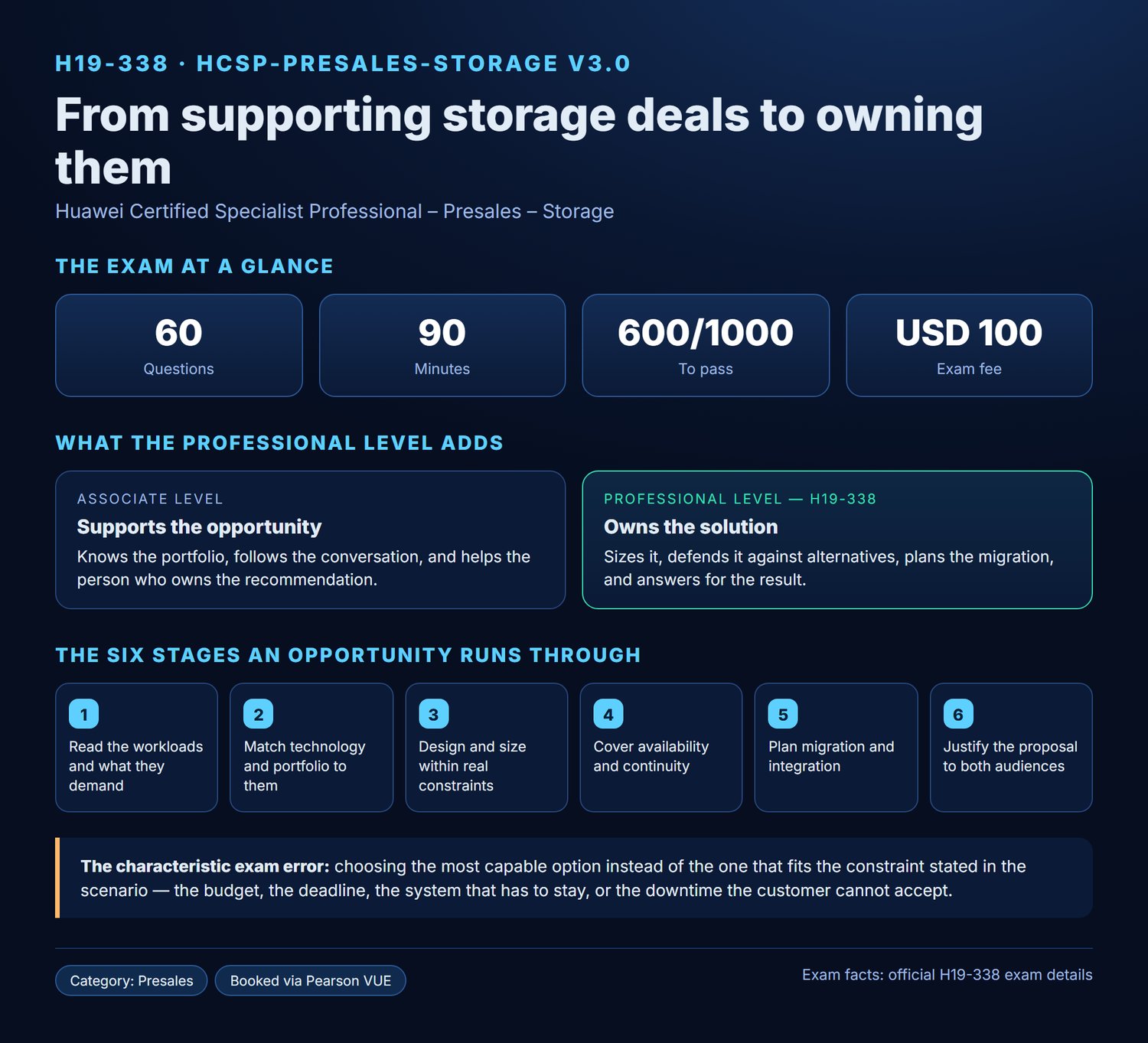
Certification tracks usually run from associate to professional to expert, and the step from the first to the second is where a career changes shape rather than simply advancing. An associate credential says you understand the portfolio and can support a conversation. A professional one says you can own the solution: size it, defend it, and be accountable when a customer asks why this rather than that.
That distinction is worth holding in mind while preparing, because it predicts the style of the questions. Expect fewer items that reward recognising a product name and more that describe a customer situation and ask what to propose. The exam is interested in judgement applied to constraints, which is what the job consists of.
Who takes it
Three groups typically sit this exam. Storage engineers and administrators moving toward customer-facing solution work take it because it certifies the design reasoning they have been absorbing informally. Presales staff already working at associate level take it as the next step, often after a year or two of supporting opportunities. Technical staff at partners, distributors, and integrators take it because a professional-level credential carries weight with customers and inside partner programmes.
Each group starts from a different place. Engineers usually have the technical depth and need the commercial framing. Associate-level presales people have the framing and need deeper solution design. Partner technical staff often have both but need the portfolio knowledge at V3.0 depth.
H19-338 Exam Overview and Details
These are the published facts for the exam:
- Exam name: Huawei Certified Specialist Professional-Presales - Storage
- Exam code: H19-338
- Version: V3.0
- Category: Presales
- Number of questions: 60
- Duration: 90 minutes
- Passing score: 600 / 1000
- Exam fee: USD 100
- Scheduling: through Pearson VUE's Huawei exam page
Those numbers describe the exam's character more precisely than they first appear.
Sixty questions in ninety minutes
Ninety seconds per question is a moderate pace, and the contrast with shorter presales exams is instructive. The extra time is there because questions at professional level tend to carry more context: a customer, an environment, a constraint, and a requirement that has to be read properly before the options make sense.
Use the time as it is intended. Read the scenario to the end before looking at the answers, because the deciding detail is often in the last line, such as a budget limit, a migration deadline, or an existing system that has to stay. Then check your pace at the halfway mark, around thirty questions at forty-five minutes. If you are behind, the cause is usually re-reading rather than deciding.
A scaled score of 600 out of 1000
The pass mark is published as a scaled 600 out of 1000, so there is no fixed number of questions you can afford to miss. For a solution-level exam the practical reading is that breadth matters: the questions will move across the whole life of an opportunity, from requirements through design to justification, and a weak stage will cost marks wherever it appears. Even coverage beats depth in one favourite area.
A USD 100 fee against the time it takes
The fee is USD 100, which is modest for a professional-level credential. That shifts the real cost to preparation time, and it makes the exam an efficient career investment if you are already working around storage opportunities. For retake rules, rescheduling, and any prerequisites, check Huawei's official certification page and Pearson VUE, since none of that is part of the exam details summarised here.
Version V3.0
The exam is at V3.0. Storage portfolios change faster than most, as media, protocols, and data services evolve, so material written for an earlier version can be subtly out of date in exactly the places a presales exam tests. Match your study to V3.0 and let the syllabus settle any disagreement between sources.
Key Topics and Syllabus for H19-338
The H19-338 syllabus on CertFun is the authority on the exam's topics and weightings; read it before planning your study. The sections below do not replace it or invent a breakdown. They describe the kinds of competence a professional presales storage exam expects, arranged in the order an opportunity unfolds, so you can see which stages your current role already covers.
Reading the customer's data and workloads
Every storage recommendation starts with what the data is doing. Transactional databases, virtual machine estates, file shares for users, media libraries, analytics platforms, and backup archives all behave differently, and each implies different demands in performance, capacity growth, access pattern, and tolerance for downtime.
A professional-level question will rarely say "this workload needs high performance." It will describe a system, a number of users, a complaint about response times, or a reporting process that runs overnight, and expect you to infer the demand. Practise that inference deliberately: for each workload you encounter at work, write down what it needs from storage in terms of throughput, latency, capacity trajectory, and availability.
Two traps are worth naming. The first is sizing for the average when the business cares about the peak: a month-end reporting run or a morning login surge decides the experience far more than the quiet hours around it. The second is treating stated capacity as the requirement. What a customer asks for is often what their current system has, not what their data needs, and a professional conversation separates the two before anything is quoted.
Storage technology and the portfolio
On the technical side, the exam expects a firm grasp of how storage is delivered and what differentiates one approach from another: block, file, and object access; the characteristics of flash and hybrid media; data protection within a system; the data services that reduce cost or improve resilience, such as efficiency features, snapshots, and replication; and how systems scale as demand grows.
Alongside that sits the portfolio itself: which products address which segments, how they differ in scale and capability, and what combinations make sense. The skill tested is positioning rather than recitation. For each offering, be able to state the customer profile it suits, the problem it solves best, and where its practical limit lies. Huawei's official certification page is the route to the current product material for V3.0.
Designing and sizing a solution
This is the core of professional-level presales and the stage that most separates it from associate work. Sizing means turning requirements into a configuration: enough capacity for today and planned growth, enough performance for the workload's pattern rather than its average, protection that matches the customer's tolerance for loss and downtime, and connectivity that suits the environment.
A worked example shows the reasoning. A customer wants to consolidate several ageing arrays supporting a virtual machine estate and a reporting database. The naive answer is a bigger array. The professional answer establishes how much usable capacity is really needed after protection and efficiency are accounted for, whether the reporting workload will disturb the virtual machines if they share a system, what the recovery expectations are for each, how growth will be handled when it arrives, and what the migration from the old arrays will involve. The configuration follows from those answers, and so does the price.
Expect questions where several options are technically workable and only one fits the stated constraint. Reading for the constraint is the discipline being tested.
Cost reasoning belongs in the same step rather than at the end. Efficiency features change how much raw capacity a given amount of data needs, the choice of media changes both price and performance, and the protection level changes the usable share of what is bought. A design that is correct technically and wrong commercially will not be approved, and the exam reflects that by putting budget limits into scenarios where the most capable answer is not the right one.
Availability, protection, and continuity
Storage decisions are risk decisions. A professional presales conversation covers what happens when a component fails, when a system fails, when a site becomes unavailable, and when data is lost or corrupted rather than merely inaccessible. Local protection, snapshots, replication between sites, and backup each cover a different part of that spectrum, and none covers all of it.
The useful habit is to connect each mechanism to the failure it addresses and to the recovery expectations it supports. Customers express those expectations as how much data they can afford to lose and how long they can afford to be without a service, and a design is credible only when it answers both.
Be precise about what each layer does not cover. Protection inside a system keeps a service running when a component fails, but it replicates a deletion as faithfully as it replicates valid data. Replication between sites protects against losing a site, and it will carry corruption across just as quickly. Snapshots give fast recovery from a mistake, but they usually live on the system they protect. Backup covers what the others miss, at the cost of slower recovery. Scenario questions often turn on which of those gaps the customer actually faces.
Migration, integration, and delivery
Few storage opportunities are greenfield. Something already exists, holds data, and has to keep working during the change. Expect attention to how data moves from an existing environment to a new one, what it costs in time and risk, how the new system fits with servers, networks, virtualisation, and backup already in place, and what the customer's own staff will have to do.
This stage is where otherwise good designs fail in practice, and candidates who have lived through a migration have a real advantage. If you have not, ask colleagues what went wrong in theirs; the answers are usually about dependencies nobody mapped and downtime nobody budgeted.
The questions worth rehearsing for a migration are practical ones. How much data has to move and over what link? Can the move happen while services run, or does it need an outage window the business will approve? Who owns the applications that must be tested afterwards? What happens if the cutover has to be reversed? A proposal that answers these reads as credible to a customer who has been through a bad migration before, and most of them have.
Justifying the proposal
Finally, a professional presales person has to make the case. That means explaining why this solution rather than an alternative, what it costs to buy and to run, what risk it removes, and what the customer gains over the life of the system. It also means presenting that case to a mixed audience, where the technical staff want the detail and the decision-maker wants the outcome.
Practise compressing a design into three sentences: what the customer gets, why this approach suits their situation, and what it will cost them to own. If you can do that without losing the substance, you are operating at the level the credential describes.
H19-338 Preparation Guide
The plan below assumes you already work around storage and are studying alongside a job.
Step 1: Map the syllabus onto the opportunities you have seen
Rather than rating topics as familiar or new in the abstract, go through the syllabus against real opportunities you have been part of. For each topic, ask whether you have seen it decided in practice, and whether you could have made the decision yourself with a reason you would defend.
That test is sharper than familiarity, and it usually reveals the same pattern: engineers are strong on technology and weak on justification; associate-level presales staff are the reverse; everyone is weaker on migration than they expect. Put your study time where the honest answer is "I have seen it done but could not have decided it."
Step 2: Study the V3.0 material in opportunity order
Huawei publishes HCSP-Presales-Storage V3.0 training through its learning portal, which opens on a Huawei sign-in page. Because it is written for this exam version, make it your primary source.
Work through it in the order an opportunity runs: workloads and requirements, then technology and portfolio, then design and sizing, then protection and continuity, then migration and delivery, then justification. Each stage supplies the inputs for the next, and studying in that order means you are never positioning a product before you understand what it is being positioned against.
Step 3: Size two or three real environments on paper
This is the exercise that moves you from associate thinking to professional thinking. Take an environment you know, whether a customer's or your own employer's, and design for it from scratch. Write down the workloads and what each demands, the capacity needed including growth and the overhead of protection, the performance profile, the recovery expectations, the connectivity, and the migration path from what exists today.
Then do the same for a very different environment, such as a small organisation with one mixed workload and a tight budget. The contrast teaches positioning better than any list of product specifications, because the right answer changes completely while the reasoning stays the same.
Step 4: Practise reading for the constraint
Move to timed practice at ninety seconds per question once the syllabus is covered. For each scenario question, underline the constraint before you look at the options: the budget, the deadline, the existing system that stays, the skills the customer has, or the downtime they cannot accept.
Review every mistake and classify it as a knowledge gap, a misread constraint, or an over-engineered answer, meaning you chose the most capable option rather than the one that fits. The third category is the characteristic professional-level error, and it usually means you are still answering as an engineer rather than as a solution owner.
Step 5: Book, then put the credential to work
Book through Pearson VUE when your timed results are consistently comfortable across every stage of an opportunity. In the final week, stop adding material, revisit your weakest stage, and do one full timed run. Rest the day before.
Afterwards, use the credential rather than filing it. Say what you can now do, not which exam you passed: size a storage solution to a workload, justify it against alternatives, and plan the migration into it. Those sentences are what move someone from supporting opportunities to owning them.
Benefits and Career Scope of HCSP-Presales-Storage
A professional-level presales credential changes what you are trusted with, which is the only career test that matters.
It marks you as someone who can own a solution
Supporting an opportunity and owning it are different jobs with different consequences. The credential signals that you can take responsibility for a storage recommendation: that you understand what the customer's data needs, what the design costs, and why the alternative was not chosen. That is the distinction hiring managers are usually testing for in interviews for senior presales roles.
It is directly useful in partner and vendor channels
Much presales work sits with partners, distributors, and integrators, where professional-level certifications often matter both for credibility with customers and inside partner programmes. Check your own programme's requirements, but in practice a professional storage credential is the kind of qualification that gets a technical person into the room for larger opportunities.
It supports the work that follows the sale
The work this certification supports includes gathering and challenging customer requirements, designing and sizing storage solutions, producing and defending proposals, planning migrations from existing environments, supporting tenders, and advising on protection and continuity. Those responsibilities tend to broaden a career rather than narrow it, because they connect technical depth to the commercial side of the business.
It builds on associate-level work and leads somewhere
For anyone already holding an associate presales credential, this is the natural next step and a visible one on a profile. For engineers, it is a bridge into solution and customer-facing roles without abandoning technical depth. For what sits beyond professional level, see Huawei's official certification pages.
Practice Test and Preparation Resources
Keep the list short and current; a professional exam punishes outdated material more than an associate one.
Official resources
- Official HCSP-Presales-Storage certification page: the authority on current details, available training, and policies including prerequisites and retake terms.
- HCSP-Presales-Storage V3.0 training: Huawei's own training for this exam version, linked in the Preparation Guide above. Your primary study source.
- Pearson VUE: where you schedule the exam and confirm testing options.
Sample questions and practice tests
Once your study is underway, work through the H19-338 sample questions on CertFun. For a solution-level exam they are most useful for learning how constraints are hidden in scenarios and how the over-engineered option is made to look attractive.
Use practice tests in timed blocks and review them properly. Every miss points at a stage of the opportunity to restudy, and every lucky guess marks reasoning that is not yet yours. Tracking which stage your errors cluster in is the fastest way to decide what to study next.
The opportunities around you
If you work for a partner or a vendor, the proposals, sizing sheets, and tender responses your organisation has already produced are the best supplementary material you will find. Read a recent one and reconstruct the requirement behind every decision in it. Where you cannot, you have found a topic to study.
Conclusion
H19-338 certifies professional-level presales competence in storage: reading what a customer's workloads demand, knowing the technology and the portfolio well enough to position them, designing and sizing a solution that fits real constraints, covering availability and continuity properly, planning the migration into it, and justifying the result to both technical and business audiences. The exam is 60 questions in 90 minutes, needs a scaled 600 out of 1000, costs USD 100, and is at version V3.0.
Read as a career step, it marks the move from supporting storage opportunities to owning them. Prepare accordingly: map the syllabus onto opportunities you have actually seen, study the V3.0 material in the order an opportunity unfolds, size two or three real environments on paper, and practise reading scenarios for the constraint rather than for the most capable product.
Do that, and the credential describes something true about you, which is the only version worth having.
FAQs
How many questions does H19-338 have, and how long is the exam?
The exam has 60 questions and a duration of 90 minutes, an average of ninety seconds per question.
What is the passing score for H19-338?
The passing score is 600 out of 1000. It is a scaled score, so it does not convert directly into a number of correct answers.
How much does the exam cost?
The exam fee is USD 100. Confirm the amount for your location when you book through Pearson VUE.
What does the "Professional" level mean here?
It is the level above associate in Huawei's certification structure. In practice it means the exam expects you to own a storage solution, including sizing and justification, rather than only support a conversation about it.
Which exam version is current?
The current version is V3.0. Match your study material to it and treat the syllabus as the authority when sources disagree.
Do I need an associate presales certification first?
The exam details summarised here do not list a prerequisite. Check Huawei's official certification page for current requirements before you book.
Where do I schedule the exam?
You book through Pearson VUE's Huawei exam page, where you can also confirm testing options.
Where can I find the official topic list?
The H19-338 syllabus on CertFun is the authority on the exam's topics and weightings. Use it to plan your study and check coverage before booking.