
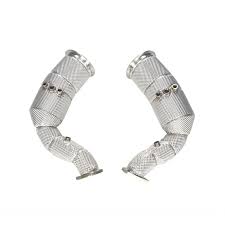
There’s something quietly thrilling about getting behind the wheel of a BMW M-series car. It’s more than the numbers on the spec sheet or the sleek bodywork—it’s the way the engine communicates, the subtle growl under light throttle, and that surge of power when the turbo finally wakes. Cars like the BMW M5 G90/G99 or the BMW M3 G80 already deliver plenty of adrenaline, but there’s a modification that enthusiasts keep coming back to: downpipes. Simple in concept but transformative in effect, they elevate both performance and the emotional connection between driver and machine.
Take the M5 G90/G99, for instance. This car is a sedan on steroids—refined enough for daily driving yet capable of astonishing speed. Upgrading with bmw m5 g90 g99 secondary downpipes changes the experience in a way that’s subtle at first but undeniable once you notice it. Turbos spool more efficiently, throttle response becomes sharper, and the exhaust develops a richer, deeper note. It’s the kind of improvement that doesn’t just hit your speedometer; it hits your senses. You start noticing nuances you never paid attention to before—the engine breathing more freely, shifts feeling crisp, and acceleration more immediate. It’s a reminder that this car was built for more than just getting from point A to B—it was built to engage the driver.
Material and design choices matter. Stainless steel remains the standard for durability, but some aftermarket options include ceramic coatings to better manage heat. Installation isn’t always trivial—the engine bay is tight and full of electronics—but the rewards are worth it. Even mundane drives, like a morning commute or a weekend errand run, feel more engaging. The M5 suddenly feels lighter, sharper, more alive. There’s this understated satisfaction that comes with knowing every rev, every gear change, and every push of the pedal is more connected than before.
Sound, of course, is part of the allure. Stock M5s already growl in a satisfying way, but high-quality secondary downpipes bring out tonal layers you didn’t realize were there. Mid-range rpm becomes more expressive, high revs more thrilling, and there’s a subtle turbo whistle that adds character without being overbearing. It’s the sort of detail that makes you smile without even trying, the kind of thing that keeps you coming back to the car for no reason other than enjoyment.
Switching to the BMW M3 G80, a car that feels more compact and impatient, the effect of downpipes is just as remarkable. Installing bmw m3 g80 downpipes immediately enhances responsiveness. The turbo spools faster, mid-range torque hits harder, and every throttle input feels precise. Even navigating traffic becomes more satisfying—the car reacts eagerly to small inputs, making you feel in control in a way stock configurations rarely offer. It’s amazing how such a relatively minor modification can dramatically alter the driving experience, turning everyday driving into something that feels alive.
Pairing these downpipes with ECU tuning amplifies the benefits. The M3’s engine responds more linearly, turbo lag diminishes, and acceleration feels almost telepathic. It’s not just about raw horsepower; it’s about refinement, control, and connection. You begin to feel the engine working with you rather than just producing numbers on a dyno. And that’s where the emotional payoff truly lies—driving becomes more about engagement than simply speed.
Heat management is another factor often overlooked. High-performance turbocharged engines run hot, and removing restrictions in the exhaust increases exhaust temperatures. Premium downpipes often feature heat-resistant coatings or materials designed to mitigate these effects. This ensures that performance improvements don’t come at the cost of engine reliability. Proper installation and high-quality components allow you to enjoy gains in performance, sound, and response without worrying about long-term durability.
The subtle psychological impact is worth mentioning, too. Driving a car that feels more connected, responsive, and alive builds confidence. Every merge, every corner, every acceleration is met with a sense of control and precision. The car doesn’t just move—it communicates. It rewards attention and skill, enhancing the feeling that you’re part of a finely tuned machine. This feedback loop is what turns driving from a task into an experience, a dance between human and machine.
Practicality matters as well. Well-designed downpipes can provide noticeable gains without making the car unbearable for daily driving. They don’t drastically alter the exterior, but the internal experience—the immediacy of throttle, the tonal richness, the turbo responsiveness—is dramatically improved. It’s a performance upgrade that’s felt more than it’s seen, subtle yet transformative.
Ultimately, downpipes are about uncovering hidden potential. On the M5 G90/G99, BMW M5 G90 G99 secondary downpipes reveal a level of responsiveness and character that the stock setup hints at but doesn’t fully deliver. On the M3 G80, BMW M3 G80 downpipes elevate precision and turbo efficiency, making the car feel eager, alive, and communicative. Both upgrades bring out a layer of connection between driver and machine that can’t be quantified, only experienced.