

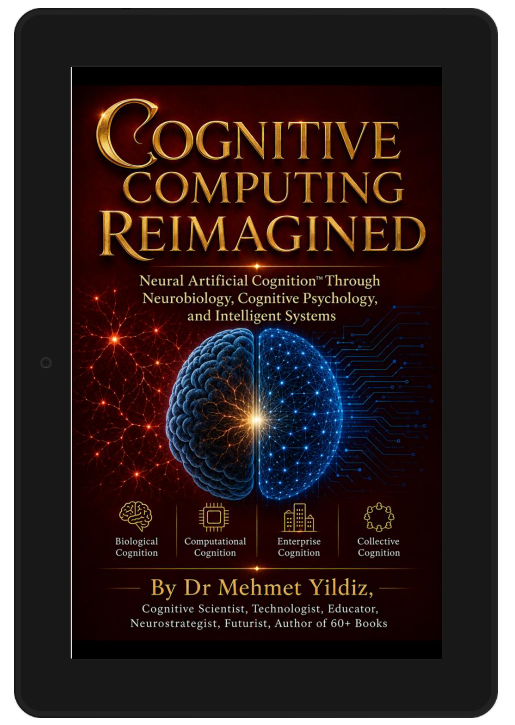
Why I Wrote This Book and How You Can Benefit from It
Check here for the details of the book
Some questions stay with us for a lifetime. One question has followed me throughout my career in cognitive science, computational linguistics, enterprise architecture, neurobiology, artificial intelligence, and technology leadership: How does cognition give rise to intelligence?
At first, this may sound like a question meant only for scientists and engineers. Over the years, I came to believe otherwise. The answer influences how we learn, make decisions, educate our children, build organizations, develop intelligent technologies, and perhaps even how we understand ourselves.
That question first came to my mind during my early studies in cognitive science and computational linguistics many decades ago. It continued through my work in enterprise architecture, systems engineering, neurobiology, artificial intelligence, and technology leadership. Although these disciplines appeared independent, I repeatedly observed that they were attempting to understand different aspects of the same phenomenon. Each provided valuable insights, yet none seemed to offer a complete explanation of cognition itself.
Writing my previous book, Neurocomputing and Neural Architectures, taught me something unexpected. It explored how biological nervous systems continue to inspire new computational architectures and demonstrated the remarkable influence neurobiology has had on the evolution of computing. During that journey, however, another question gradually became more prominent in my mind. We had become remarkably good at building more intelligent computational systems. Yet I found myself asking a more fundamental question. What exactly are these systems trying to emulate? The more I reflected on that question, the more I realized that the answer was not simply intelligence itself. It was cognition.
The answer, I believe, is not simply intelligence. It is cognition. At first glance, the distinction may appear subtle. In practice, I believe it changes the entire conversation.
Artificial intelligence has advanced at an extraordinary pace. Large language models generate coherent prose. Intelligent systems recognize images, translate languages, discover scientific patterns, and collaborate with humans in ways that would have seemed extraordinary only a few years ago. These achievements deserve recognition because they represent decades of remarkable scientific, technical, and engineering progress.
Yet while observing these developments, I found myself returning to a more fundamental question. We frequently describe machines as becoming more intelligent, but what do we actually mean by intelligence? More importantly, what processes allow intelligence to emerge in the first place?
My observations gradually led me to a realization that became the foundation of this book. Intelligence is what we observe. However, cognition is what makes those observations possible.
When people solve problems, remember experiences, anticipate future events, make decisions, learn from mistakes, or communicate ideas, they are exercising a rich collection of cognitive processes. Similarly, when intelligent systems recognize patterns, retrieve knowledge, generate language, adapt through feedback, or assist human decision-making, they also rely upon underlying computational processes that perform analogous functions. The implementations differ considerably, yet the questions they invite are remarkably similar.
This realization encouraged me to look beyond artificial intelligence as a technological discipline and toward cognition as a broader scientific phenomenon. As this perspective evolved, I gradually recognized that cognition appears in at least four remarkably different domains. We observe it in biological organisms through nervous systems that continuously perceive, learn, remember, reason, and adapt. We observe related computational processes in intelligent software and capable AI systems. We observe distributed forms of cognition inside organizations that collectively perceive change, preserve knowledge, make decisions, and learn from experience.
Finally, we observe cognition emerging through collaboration among people, enterprises, and intelligent technologies working together. These domains differ enormously in their implementation. Yet they usually reveal surprisingly similar cognitive patterns. That observation became one of the strongest motivations for writing this book.
As I explored this perspective further, I noticed that many disciplines were contributing valuable pieces of the puzzle. Neurobiology explained how living nervous systems process information. Cognitive psychology illuminated attention, memory, learning, and reasoning. Neuroscience revealed sophisticated mechanisms supporting adaptive behavior. Systems science demonstrated how complex capabilities emerge from interactions among simpler components. Enterprise architecture showed how organizations perceive, remember, decide, and learn collectively. Artificial intelligence provided practical computational implementations of many cognitive functions.
Each discipline contributed meaningful insights. Each also remained, naturally, focused on its own perspective. Rather than viewing this diversity as a limitation, I began seeing an opportunity. I thought the next meaningful advance would not arise from another isolated discipline, but from connecting them through a common conceptual framework centered on cognition itself. That idea eventually evolved into Neural Artificial Cognition™ (NAC).
To make it clear upfront, I deliberately describe it as an integrative framework rather than a new discipline. My intention is not to compete with neurobiology, cognitive psychology, artificial intelligence, systems science, enterprise architecture, or philosophy. Instead, I hope to build meaningful bridges among them by focusing on the phenomenon they share: cognition itself.
I do not present NAC™ as a finished theory or as a replacement for existing disciplines. Scientific progress does not advance through absolute conclusions. Instead, it grows through better questions, clearer concepts, careful observation, respectful debate, and continuous refinement. I therefore regard Neural Artificial Cognition™ as an evolving conceptual framework designed to encourage interdisciplinary thinking rather than disciplinary boundaries.
The word neural is used intentionally. It acknowledges that our current understanding of cognition originates largely from studying biological nervous systems. However, it does not imply that future intelligent systems must replicate biology exactly. Evolution solved many remarkable problems, but engineering remains free to discover alternative computational solutions inspired by, rather than constrained by, biological principles.
Likewise, I use the phrase artificial cognition with equal care. Artificial intelligence has become one of the defining scientific achievements of our era, yet intelligence itself may be only part of a much broader story. My interest shifted toward the cognitive capacities that enable intelligent behavior to emerge. Perception, attention, memory, learning, reasoning, prediction, communication, adaptation, decision-making, and metacognition became the organizing principles around which this book gradually unfolded.
This perspective also influenced the structure of the book. Rather than organizing chapters around specific technologies that will inevitably continue evolving, I chose to organize them around enduring cognitive capacities. Technologies change rapidly. Cognitive principles tend to evolve more gradually. By placing cognition at the center, I hope this work remains useful even as today's computational architectures give way to future innovations.
Although the chapters draw upon neurobiology, psychology, engineering, artificial intelligence, enterprise architecture, and systems thinking, I intentionally wrote this book for a broader audience than specialists alone. Whether you are a researcher, engineer, educator, executive, entrepreneur, healthcare professional, policymaker, university student, or simply someone fascinated by how people and intelligent systems think, I hope you will discover ideas that encourage you to view cognition from a different and fresh perspective, reflecting my decades of experience in the field.
During the coming decades, many of us may work alongside capable cognitive partners. These systems may help us organize knowledge, remember important ideas, learn continuously, make better decisions, and solve problems that exceed the capacity of any individual working alone. Understanding cognition may therefore become valuable not only for scientists and engineers developing intelligent systems but also for ordinary people whose everyday lives will involve collaboration with them.
Throughout the chapters that follow, you will encounter examples drawn from biological organisms, intelligent computing, enterprise systems, and collaborative human-AI environments. My intention is not to argue that these systems are identical. They clearly are not. Rather, I invite you to consider whether they may share deeper cognitive principles that deserve closer scientific attention.
One lesson I have learned over several decades of interdisciplinary work is that meaningful advances occur where established disciplines begin sharing ideas rather than protecting boundaries. Some of the most influential discoveries emerge when researchers become willing to borrow concepts, methods, and perspectives from neighboring fields. I believe cognition represents one of those remarkable intersections. It offers a common language through which neurobiology, psychology, artificial intelligence, enterprise architecture, education, systems science, philosophy, metaphysics, and many other disciplines can enrich one another rather than develop independently.
This book therefore reflects both conviction and curiosity. The conviction comes from many years spent studying cognition through multiple scientific and technological lenses. The curiosity comes from recognizing how much remains unknown.
Every significant discovery seems to reveal new questions waiting to be explored. I suspect our understanding of cognition will continue evolving for many decades, perhaps even centuries. If that proves true, then Neural Artificial Cognition™ should also evolve. I would welcome that outcome because scientific frameworks should mature through discussion, evidence, refinement, and constructive criticism rather than remaining static.
More than once while writing these chapters, I realized that building more intelligent machines may not become the most important outcome of artificial intelligence. The greater achievement may be that, through the effort of understanding and designing cognition, we gradually begin understanding ourselves more deeply. If that happens, the greatest contribution of artificial cognition will not simply be technological progress. It will be a richer appreciation of what it means to learn, to reason, to collaborate, to create, and ultimately to be human.
Ultimately, this book is an invitation. It is an invitation to researchers to build bridges across disciplines. It is an invitation to engineers to think beyond algorithms. It is an invitation to educators to nurture curiosity rather than memorization. It is an invitation to technology leaders to design organizations that continuously learn and adapt. It is an invitation to students to remain lifelong learners. Most importantly, it is an invitation to every reader to become more curious about the remarkable cognitive system they carry with them every day.
As intelligent systems become more woven into the fabric of our societies, understanding cognition itself may prove just as important as advancing computation. I hope the ideas presented throughout these pages contribute, however modestly, to that continuing journey.
If this book encourages you to ask deeper questions, connect ideas across disciplines, become a more thoughtful learner, collaborate more wisely with intelligent technologies, and view cognition through a broader scientific lens, then it will have fulfilled my purpose for writing it.
More importantly, I hope it leaves you with one important thought. We began this journey by asking how intelligent systems become intelligent. We may finish it by realizing that, in trying to build more intelligent machines, we are also learning to understand ourselves more deeply than ever before.
Thank you for reading my introduction.
You can check out my FEATURED series of 60+ books on Amazon markets:
Health, Wellness, and Cognitive Performance Series
Technology Excellence and Leadership Series
Writing Mastery, Excellence, and Eminence Series
Leadership Concepts and Case Studies Series
If you are a writer, you are welcome to join my publications by sending a request via this link. I support 43K writers who contribute to my publications on this platform. Check out the recent update for the writers of my publications.
You can contact me via my website. If you are a new writer, check out my writing list to find some helpful stories for your education. You can also join my author platform as a guest blogger.
I interviewed several new professionals and thought leaders. You can find them linked at the end of the latest one.
I invite you to subscribe to my publications on Substack, where I offer experience-based and original content on health, content strategy, book authoring, and technology topics you can’t find online to inform and inspire my readers.
Health and Wellness Network
Content Strategy, Development, & Marketing Insights
Technology Excellence and Leadership
Illumination Book Club
Illumination Writing Academy
Healthspan Mastery (NEW)
Superlearning with SMART MIND Loop™ (NEW)
Links to my most loved stories on this platform
Get an email whenever Dr. Mehmet Yildiz publishes. He is a top writer and editor on Medium.
Check out Free Blog Posts by Digitalmehmet Contributors. Here is the link to my FREE personal blogs. Now you can read our blog posts via a Flipboard Magazine for convenience.
I invite you to explore some of my books on my discount bookstore including: Train Your Brain for a Healthier and Happier Life, Cortisol Clarity, Ketosis + BDNF: The Healing Molecules That Saved My Life, The Science & Wisdom of Graceful Aging, The LIFE Matrix Keeps the Score, How I Accelerated My Learning Effortlessly for a Happier Life, Neurocomputing and Neural Architectures, Substack Mastery Version 2, The Zen of Book Authoring, Monetize Your Passion with WooCommerce, Agile Business Architecture for Digital Transformation V2, Agile Business Architecture for Digital Transformation (Audiobook), A Powerful Toolkit for Substack Newsletter Mastery, Smart and Ethical SEO, Modern Affiliate Marketing for Writers, 4 Pillars of Enterprise Architecture, and Smart Email Marketing Content Integration, The Mysterious Leadership Mind of Robert F. Kennedy Jr., Cognitive Computing Reimagined.
Reference: Chapter of Generosity™ at Digitalmehmet Content Ecosystem
Cognitive Computing Reimagined
Prefacio: Por Qué Escribí Este Libro y Cómo Puede Beneficiarle
Reclaiming Cognition from Computation: A Scholarly Appraisal of the Interdisciplinary Neural Artificial Cognition™ (NAC) Framework