

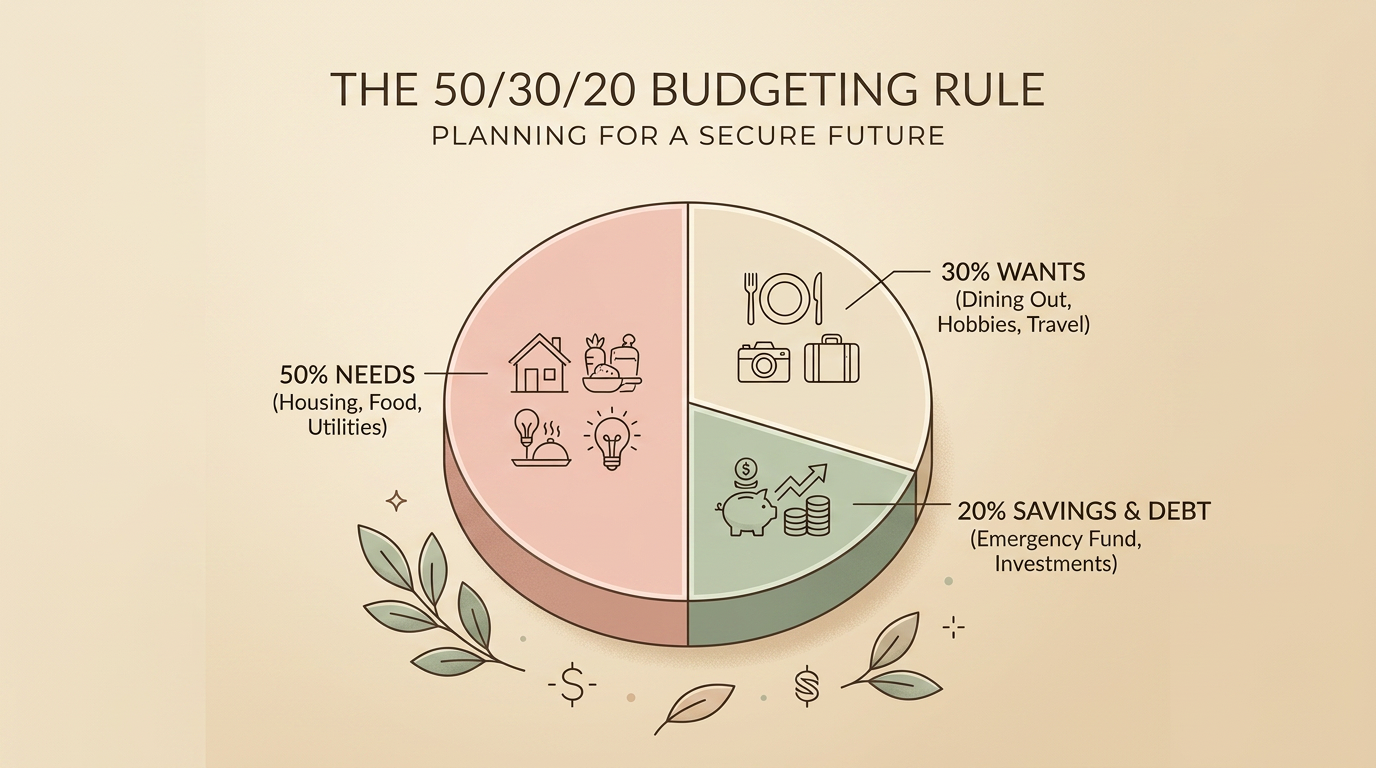
If you've spent any time on our Pinterest, you've probably seen the pin: three circles, three percentages, one simple promise — spend with purpose, save with intention, live with freedom.
That framework is the 50/30/20 rule, and it's one of the most beginner-friendly budgeting methods out there. But circles and percentages can feel abstract when you're staring at your actual paycheck. So let's make it real. Grab your take-home pay number, and let's walk through exactly what this looks like with dollars attached.
The Framework, Quickly
- 50% → Needs — the non-negotiables
- 30% → Wants — the joy spending, guilt-free
- 20% → Savings & Debt Payoff — your future self
Simple in theory. Let's make it simple in practice too.
Let's Run the Numbers
Say your monthly take-home pay is $4,000. Here's how that breaks down:
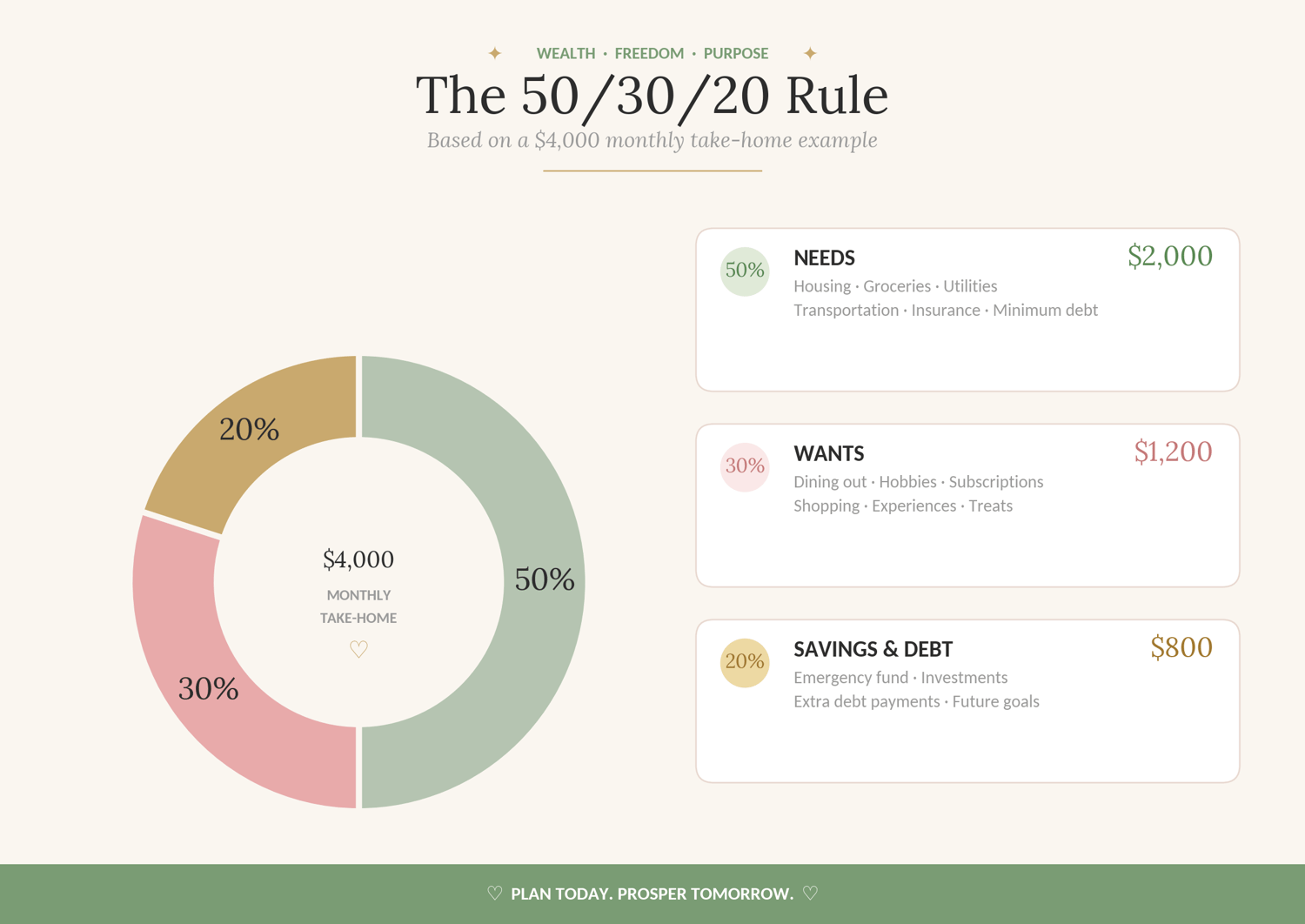
Now let's zoom into each bucket so it stops being a percentage and starts being a plan.
Needs — $2,000
This covers your essentials: housing, groceries, utilities, transportation, insurance, and minimum debt payments. If you're renting at $1,200, that leaves roughly $800 for groceries, gas, phone bill, and insurance combined. Tight, but workable — and this is exactly the kind of math that shows you where a conversation about housing costs or a side income stream might need to happen.
Wants — $1,200
This is dining out, that subscription you love, a new top, your hobbies. Notice this bucket isn't small — it's nearly a third of your income. That's intentional. A budget that starves your wants doesn't last. This rule builds joy in from the start, because joy is part of a sustainable plan, not a reward you earn after depriving yourself.
Savings & Debt — $800
This is where your future gets funded. If you're paying off debt, this is your extra payment beyond the minimum (which already lives in your Needs bucket). If you're debt-free, this becomes your emergency fund, retirement contribution, or a goal you're saving toward — a house, a trip, a cushion that lets you breathe.
What If Your Numbers Don't Fit the Mold?
Here's the part most beginner guides skip: for a lot of women, especially in high cost-of-living areas, Needs eat up way more than 50%. If your rent alone is 40% of your income, the math doesn't lie — but it also doesn't mean you've failed.
The 50/30/20 rule isn't a law. It's a compass. If your real numbers look more like 65/20/15 right now, that's simply your starting point. The goal over time is to shift the needle — trim a want here, grow your income there — so more of your money moves toward the 20% column. Progress, not perfection.
A Simple Way to Try This This Week
- Pull up your last month's take-home pay.
- Multiply it by .50, .30, and .20 to get your three target numbers.
- Sort last month's spending into the three buckets and see how close you landed.
- Don't judge the gap — just notice it. That's your starting line.
That's it. No spreadsheet required to start — just fifteen minutes and honesty.
Want This Framework Without Doing the Math Yourself?
Once you've seen your numbers on paper, a lot of women find it's easier to stick with a framework when it's already built for you — no calculator required every month. That's exactly what the Monthly Money Blueprint in the shop is designed for: your income, needs, wants, and savings goals, laid out and ready for you to fill in, month after month.
Shop the Monthly Money Blueprint
You don't need to have this memorized. You just need somewhere to put it.
Balance your money. Align with your goals. Build the life you want. ♡