
Caspar David Friedrich, a prominent figure of the German Romantic movement, is renowned for his evocative landscapes that capture the essence of nature's grandeur and the human condition. His paintings, often characterized by their solitude, mystery, and contemplation, continue to resonate with viewers today. This blog post will delve into the captivating world of Friedrich, exploring his life, artistic philosophy, and the profound impact of his work.
A Solitary Soul: Friedrich's Life and Times
Born in Greifswald, Germany, in 1774, Friedrich's early life was marked by tragedy. He lost his mother at a young age and witnessed the deaths of several siblings. These personal losses likely influenced his introspective and melancholic nature, which is reflected in many of his paintings.
Friedrich's artistic journey began with an apprenticeship in a local frame-maker's shop. He later enrolled in the Dresden Academy of Fine Arts, where he studied under renowned artists such as Christian Wilhelm Ernst Dietrich. During this time, Friedrich developed a deep appreciation for the works of the Dutch Golden Age landscape painters, such as Jacob van Ruisdael and Meindert Hobbema.
The Romantic Vision: Friedrich's Artistic Philosophy
Friedrich's paintings are deeply rooted in the Romantic movement, a cultural and artistic era characterized by a fascination with nature, emotion, and the supernatural. The Romantics sought to escape the constraints of reason and embrace the power of imagination. Friedrich's landscapes perfectly embody these ideals, inviting viewers to contemplate the mysteries of the universe and their own place within it.
One of the key themes in Friedrich's work is the concept of the sublime. The sublime refers to experiences that evoke a sense of awe, terror, and wonder. Friedrich's paintings often depict vast, desolate landscapes that are both awe-inspiring and slightly unsettling. These scenes can be seen as metaphors for the human condition, reflecting our longing for connection with something larger than ourselves.
Iconic Works: A Closer Look
Friedrich's oeuvre includes several iconic works that have become synonymous with his name. Here are a few examples:
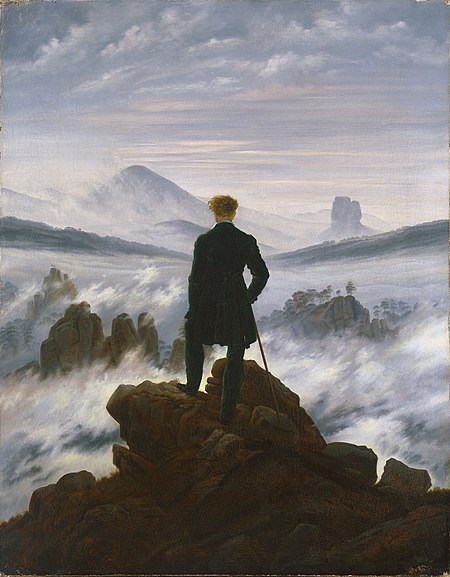
- The Wanderer Above the Sea of Fog (1817): This famous painting depicts a solitary figure gazing out over a misty landscape. The figure's small size in relation to the vast scenery emphasizes the individual's insignificance in the face of nature's power.
Wanderer Above the Sea of Fog by Caspar David Friedrich
- The Abbey in the Oak Forest (1810): This haunting scene portrays a crumbling abbey nestled deep within a forest. The painting is a meditation on the passage of time and the inevitability of decay.
Abbey in the Oak Forest by Caspar David Friedrich
- The Chalk Cliffs (1818): This dramatic landscape features towering white cliffs overlooking a turbulent sea. The painting is a powerful depiction of nature's raw beauty and its ability to inspire both awe and fear.
Chalk Cliffs by Caspar David Friedrich
The Enduring Legacy of Caspar David Friedrich
Caspar David Friedrich's art continues to captivate and inspire audiences today. His evocative landscapes offer a glimpse into the Romantic soul and invite us to contemplate the mysteries of nature and the human condition. Friedrich's enduring legacy is a testament to the power of art to transcend time and connect us with the universal themes of existence.
caspar-david-friedrich-greifswald.de
Caspar David Friedrich statue