
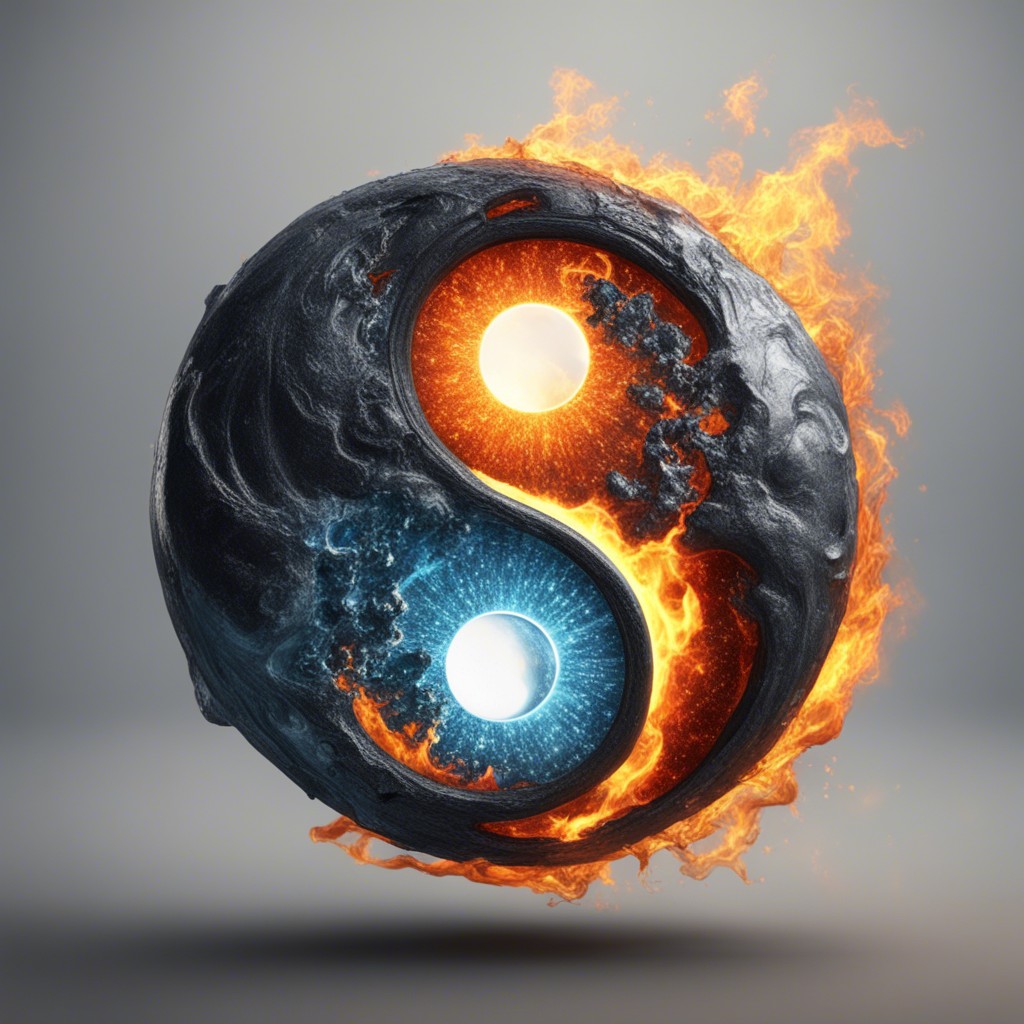
Explore how the ancient symbol of Yin-Yang has found a new life in modern art, representing balance, harmony, and duality.
![]() The Historical Significance of the Yin-Yang Symbol
The Historical Significance of the Yin-Yang Symbol
The Yin-Yang symbol, originating from ancient Chinese philosophy, represents the concept of dualism. It illustrates how seemingly opposite or contrary forces may actually be complementary, interconnected, and interdependent in the natural world. The symbol is composed of a circle divided into two halves by a curved line, with one half black (Yin) and the other white (Yang). Each half contains a small circle of the opposite color, signifying the interrelated nature of the forces.
Historically, the Yin-Yang symbol has been used to explain various phenomena, from the changing seasons to the balance of good and evil. Its roots can be traced back to texts such as the I Ching and Tao Te Ching, which explore the dynamics of harmony and balance in life. This intrinsic philosophy has transcended time and culture, finding relevance in various aspects of life, including art.

This vector image was created with Inkscape by Klem, and then manually edited by Mnmazur
Yin-Yang Motifs in Contemporary Visual Art
Contemporary visual artists have embraced the Yin-Yang symbol, integrating it into diverse forms of artwork such as paintings, sculptures, and digital media. The symbol's simplicity and profound meaning provide a versatile motif that artists can adapt to convey themes of balance and duality.
In modern visual art, the Yin-Yang symbol often appears in abstract compositions, where artists use contrasting colors, shapes, and textures to evoke the essence of duality. Some artists incorporate the symbol into more literal representations, embedding it within complex scenes that depict the interplay between light and dark, chaos and order, or masculine and feminine energies.
Balance and Duality: Themes Explored by Modern Artists
The themes of balance and duality are central to modern artistic expressions involving the Yin-Yang symbol. Artists explore how these themes manifest in everyday life, relationships, and the broader universe. Through their work, they examine the tension and harmony between opposing elements.
For instance, some artists may focus on the balance between technology and nature, highlighting the need for sustainable coexistence. Others might delve into the dualities within human nature, such as the struggle between ambition and contentment, or the interplay between individuality and community. By using the Yin-Yang symbol, artists can visually articulate these complex themes, offering viewers a deeper understanding of the interconnectedness of opposites.
Cultural Relevance of Yin-Yang in Today's Artistic Expressions
The cultural relevance of the Yin-Yang symbol in today's artistic expressions cannot be overstated. In a world increasingly characterized by polarization and division, the symbol offers a reminder of the necessity of balance and harmony. Its presence in modern art serves as a call for unity and understanding amidst diversity.
Moreover, the Yin-Yang symbol's integration into global art forms reflects the blending of Eastern and Western philosophies. As artists from different cultural backgrounds adopt the symbol, they contribute to a richer, more inclusive dialogue about balance and duality. This cross-cultural exchange not only enhances the aesthetic value of the artworks but also promotes a deeper appreciation of the universal principles that the Yin-Yang represents.
Famous Modern Art Pieces Featuring the Yin-Yang Symbol
Several renowned modern art pieces prominently feature the Yin-Yang symbol, showcasing its enduring appeal and versatility. One notable example is the work of Japanese artist Yayoi Kusama, whose installations often incorporate the symbol within her signature polka dot patterns, creating mesmerizing visual experiences that explore infinity and duality.
Another example is the 'Yin-Yang' mural by American street artist Shepard Fairey, which uses the symbol to comment on social and political issues. Fairey's interpretation blends contemporary iconography with traditional elements, making a powerful statement about the need for balance in society.
These famous pieces highlight how the Yin-Yang symbol continues to inspire and resonate with modern artists, enabling them to convey profound messages through their creative endeavors.