

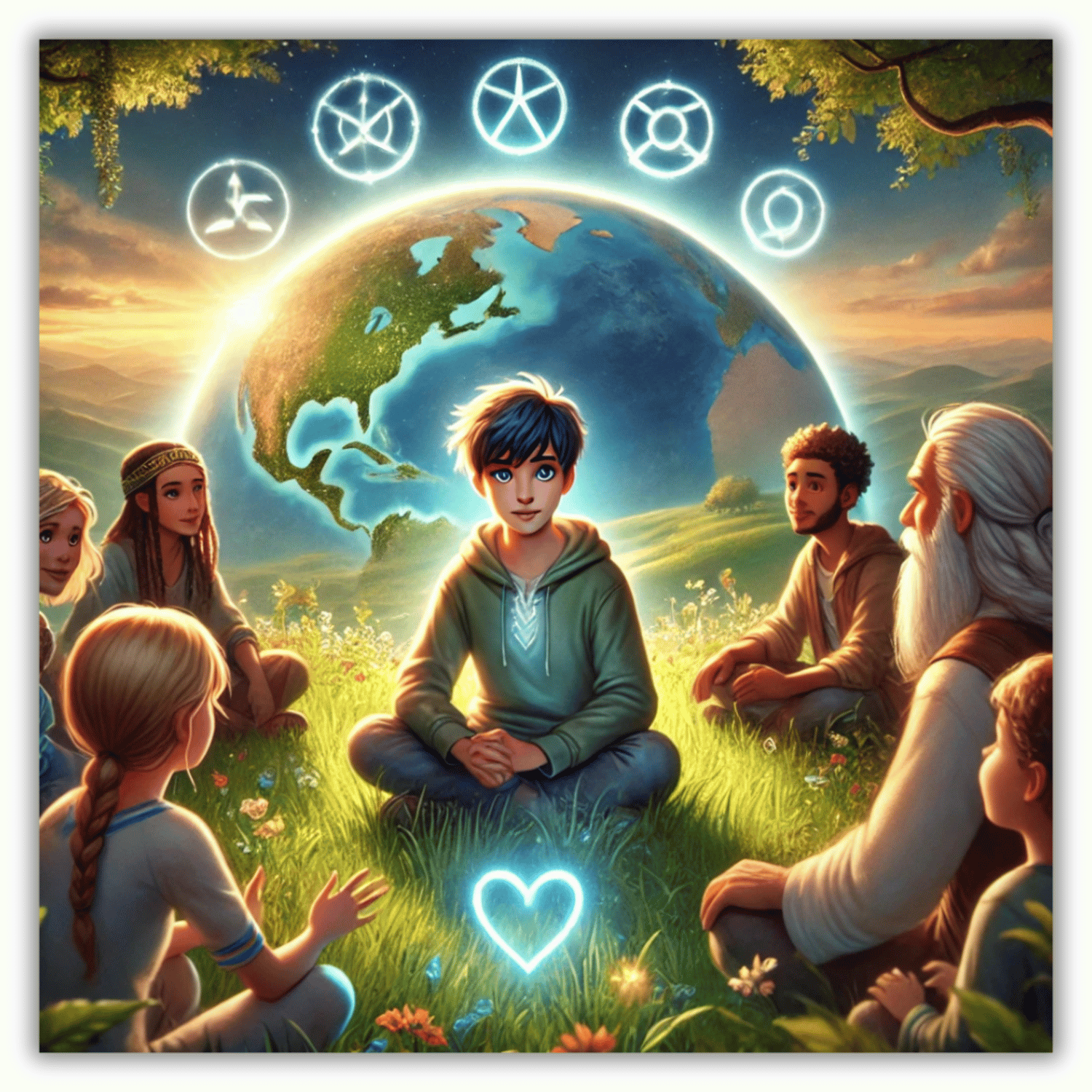
Creating a universal message that combines the core teachings of major world religions and belief systems into a codex for a new, love-centered movement requires a thoughtful, inclusive approach. Here’s a starting framework for Kai’s religion, LOVE, and the Universal Codex of the Creator.
, The Vision of LOVE
Purpose: To unite humanity under a shared understanding of love, ethics, and connection to the Creator.
Core Message: All beings are interconnected, and love is the highest principle guiding us toward truth, harmony, and self-realization.
, Universal Codex of the Creator
A synthesis of essential teachings from major religions, presented as guiding principles:
1. From Hinduism: Unity in Diversity
Embrace the idea that the Creator exists in all forms and all beings (Brahman). Love others as manifestations of the divine.
Codex Principle:
"All paths, when walked with love, lead to the Creator."
2. From Judaism: Covenant and Justice
Commit to living with integrity and justice, fulfilling your sacred covenant to care for the world.
Codex Principle:
"Through love and fairness, we honor our bond with the Creator and one another."
3. From Buddhism: Compassion and Mindfulness
Practice non-attachment, compassion, and mindfulness to transcend suffering and cultivate inner peace.
Codex Principle:
"Love is freedom from fear; it flourishes in the stillness of a mindful heart."
4. From Christianity: Grace and Sacrifice
Love selflessly, offering grace and forgiveness to others as a reflection of divine love.
Codex Principle:
"Love transforms and redeems, lighting the path to eternal truth."
5. From Islam: Surrender to Love
Submit to the Creator’s will, trusting in divine love and striving for peace through service and humility.
Codex Principle:
"True love is in surrendering ego and serving the greater good."
6. From Paganism: Harmony with Nature
Honor the cycles of nature and recognize the Creator in the interconnectedness of the Earth and cosmos.
Codex Principle:
"The Creator’s love is found in the rhythms of the Earth and the stars."
, Principles of the Religion "LOVE"
1. Love Above All: Let love be your guide in thoughts, words, and actions.
2. Unity in Diversity: Respect all paths, beliefs, and cultures as expressions of the Creator’s love.
3. Serve with Compassion: Help others selflessly to spread love and alleviate suffering.
4. Embrace the Sacred Present: Live mindfully, cherishing each moment as a gift of creation.
5. Guard the Earth: Treat the natural world with reverence, as it is the Creator’s dwelling place.
, Kai’s Leadership and Growth
1. Initial Steps:
Kai begins by gathering small, diverse groups to share messages of love and universal truths.
Community rituals, emphasize reflection, gratitude, and acts of kindness.
2. Spreading the Message:
A simple, symbolic practice (e.g., lighting a candle for love) is introduced to unite people worldwide.
Stories from all traditions are shared as parables to illustrate the principles of love.
3. Building Momentum:
Kai uses storytelling to explain the Universal Codex, showing how love connects all faiths.
The movement grows through word of mouth, social media, and a foundational text: The Universal Codex of Love.
, Potential Obstacles and Resolutions
Skepticism or Resistance: Address concerns by emphasizing inclusion and respect for all traditions.
Dilution of Teachings: Ensure the core message remains love and authenticity, avoiding dogma.
, Kai and the Rise of LOVE:
A Story of how people can totally change their way of thinking.
, The Beginning
Kai was just a boy when he first realized the power of love. With piercing blue eyes that seemed to reflect the depth of human suffering and hope, he had always been different. In a world divided by greed, fear, and dogma, Kai believed that love was the one universal truth that could heal humanity.
He began by speaking softly to small groups, like farmers, merchants, and children. His message was simple:
“Love is the Creator’s voice within us. Let it guide your actions, and you will find peace.”
At first, many dismissed him as an idealist. But when Kai spoke, people felt seen, understood, and valued. He didn’t preach from a pedestal; he listened, worked, and wept with those in pain. Slowly, his gatherings grew. People from different faiths, classes, and backgrounds began to sit together, united by his vision of universal love.
, The Struggle of Truth
As Kai’s influence grew, so did opposition. Religious leaders, fearing he would undermine their authority, accused him of heresy. Politicians, threatened by his ability to unite people across divides, labeled him a disruptor.
Kai faced his greatest challenge when a powerful warlord named Malrek arrived at one of his gatherings. Malrek, known for his cruelty and iron rule, scoffed at Kai’s words. “Love is weakness,” he growled. “Power comes from fear and control, not tenderness.”
Kai, calm and unwavering, replied, “Love is the only power that grows when shared.
Fear crumbles under its light.”
Intrigued by Kai’s fearlessness, Malrek stayed to listen. Over weeks, Kai shared stories from the Universal Codex of the Creator, drawing wisdom from all traditions. He recounted how a compassionate act could disarm hatred and how forgiveness could rebuild trust. Slowly, Malrek’s hardened heart began to soften. He started to question his ways, haunted by the faces of those he had harmed.
, The Turning Point
One night, Malrek approached Kai in private. “If I let go of fear, what remains of me? My power, my identity, it is all built on control.”
Kai placed a hand on his shoulder and said, “What remains is your true self, freed from the chains of fear. With love, your power will not destroy but create.”
Malrek wept for the first time in decades. The next day, he disbanded his army, using his wealth and influence to build schools, farms, and sanctuaries. His transformation became a symbol of what was possible when love replaced fear.
, The Movement Spreads
Stories of Malrek’s conversion spread like wildfire. People trapped in cycles of greed, anger, and despair began seeking Kai’s gatherings.
A corrupt merchant returned stolen wealth and became a philanthropist.
A divided family reconciled, breaking years of silence with a single embrace.
An isolated artist, inspired by Kai’s words, began painting murals that depicted unity and hope, igniting movements in distant cities.
Kai’s followers, called Builders of LOVE, carried his message to prisons, slums, and war zones. They didn’t preach; they listened, healed, and worked alongside those in need. The Universal Codex of the Creator became a guidebook for practical action, teaching people how to turn love into tangible change.
, The Struggle Persists
But the path was not easy. The forces of greed and fear fought back. Propaganda painted Kai as a deceiver, claiming his vision of love was naive. Violence broke out in regions where leaders clung to power.
Kai never retaliated. Instead, he reminded his followers: “The struggle of truth is eternal. Every act of love plants a seed that will grow in time. Do not despair.”
Even when Kai was imprisoned by those who sought to silence him, his influence only grew. People from all walks of life took up his cause, proving that the message of love could not be contained.
, The Transformation of Earth
Decades later, the world began to shift. While conflict still existed, communities united under the principles of love became beacons of hope. Cities were rebuilt with kindness at their core, prioritizing education, equality, and sustainability.
Kai’s legacy was not a religion in the traditional sense. It was a way of life, a movement that turned fear into courage, hatred into creativity, and despair into purpose. His followers didn’t worship him; they embodied his teachings, ensuring that the struggle of truth continued with love as its weapon.
, Epilogue
In his final days, Kai sat beneath a tree, watching the sunrise. A child approached him and asked, “Will love ever conquer everything?”
Kai smiled. “Love doesn’t need to conquer. It simply grows, one heart at a time.”
The child ran off, carrying Kai’s words into a world still learning to heal. And as the sun rose higher, Kai closed his eyes, knowing that the seeds he had planted would bloom for generations to come.
LOVE
Love is a profound and multifaceted experience that transcends simple definitions. It can be understood on different levels, emotional, spiritual, philosophical, and even biological, but at its core, love is a force that connects, uplifts, and transforms.
, Love as Connection
Love is the deep bond that unites individuals, communities, and even humanity as a whole. It is the feeling of being seen, valued, and accepted without conditions.
It bridges gaps between differences, reminding us of our shared humanity and universal worth.
, Love as Action
Love is not just a feeling; it’s a choice and an act. It’s seen in kindness, forgiveness, and selflessness.
It’s the willingness to prioritize others’ well-being without expecting anything in return, whether through small gestures or profound sacrifices.
, Love as Growth
Love inspires personal and collective growth. It challenges us to overcome fear, ego, and selfishness, leading us toward compassion and wisdom.
It encourages vulnerability and authenticity, helping us become our truest selves while fostering the same in others.
, Love in Philosophy and Spirituality
1. Hinduism: Love is seen as a divine force (prema), guiding individuals toward unity with the divine and others.
2. Christianity: Love (agape) is selfless and unconditional, often described as the essence of God.
3. Buddhism: Love (metta) is compassion and loving-kindness, focused on reducing suffering for all beings.
4. Islam: Love for God (Ishq-e-Haqiqi) is the highest form of devotion, inspiring humility and service.
5. Secular Views: Philosophers like Plato and Rumi describe love as the force that connects souls and transcends the physical world.
, Love in Practice
In Relationships: Love builds trust, respect, and intimacy. It’s about supporting each other’s growth while cherishing shared moments.
In Society: Love inspires acts of charity, justice, and peace, addressing the needs of the vulnerable.
In Self: Love includes self-acceptance, care, and forgiveness, allowing us to radiate love outward.
, Biological Perspective
From a scientific standpoint, love involves neurochemicals like oxytocin and dopamine, creating feelings of bonding and joy. But these are only mechanisms, the experience of love goes far beyond biology.
, A Timeless Truth
Ultimately, love is the force that makes life meaningful. It’s infinite in expression yet universal in essence. It breaks barriers, heals wounds, and reminds us that we are all connected.
Kai’s answer might be:
“Love is the Creator within us, the truth that connects all hearts and all things.”
TRUTH
Truth is the alignment with reality, authenticity, and universal principles. It can be understood in different ways depending on the context, philosophical, spiritual, scientific, or personal, but at its core, truth is what is real, consistent, and unchanging.
, Truth as Reality
Truth represents the way things are, free from illusions or distortions.
In science, truth is tied to facts that can be observed, tested, and verified.
, Truth as Authenticity
Truth is living in harmony with your authentic self, your values, beliefs, and actions are aligned.
It’s the courage to express yourself honestly and recognize the truths of others without fear or judgment.
, Truth in Philosophy
1. Absolute Truth: Philosophers like Plato suggested that there is a higher, unchanging reality or truth beyond our perceptions.
2. Relative Truth: Others argue truth is shaped by perspectives, cultures, and experiences, making it subjective.
3. Existential Truth: Existentialists like Kierkegaard emphasize personal truth, what resonates deeply with an individual’s lived experience.
, Truth in Spirituality
Hinduism: Truth (Satya) is eternal and unchanging, often associated with the divine essence of the universe.
Buddhism: Truth is the realization of the Four Noble Truths, acknowledging suffering and the path to liberation.
Christianity: Jesus is described as “the way, the truth, and the life” (John 14:6), linking truth to divine love and salvation.
Islam: Truth (Al-Haqq) is one of the names of God, representing ultimate reality.
, Truth in Human Experience
Truth can be found in the shared human experience, love, suffering, growth, and connection.
It is often uncovered through introspection, dialogue, and the courage to face uncomfortable realities.
, Truth as a Journey
Truth is not always immediate or easy. It requires questioning, seeking, and often letting go of assumptions or biases.
The journey toward truth often involves self-discovery, understanding others, and uncovering universal principles.
, Truth in Practice
In Thought: Truth involves intellectual honesty, seeking evidence, questioning biases, and being open to change.
In Action: Truth is integrity, living in alignment with one’s words and values.
In Relationships: Truth fosters trust and understanding through transparency and honesty.
, A Timeless Principle
Truth may be subjective in certain contexts but always points toward clarity, wisdom, and authenticity. It is not just about facts but about meaning, connection, and what aligns with the greater good.
Kai’s answer might be:
“Truth is the Creator’s light, guiding us to see clearly, act justly, and live authentically.”