

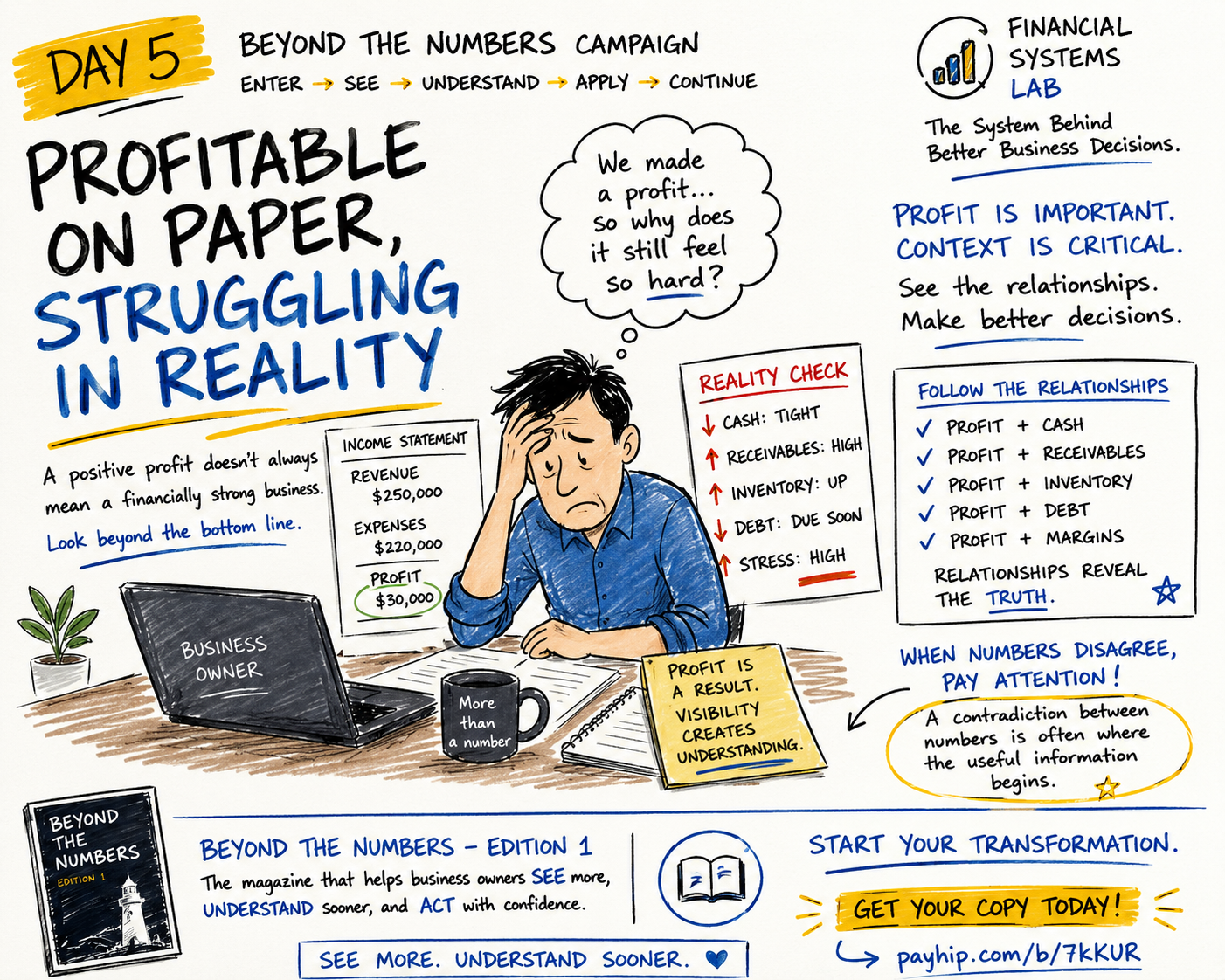
Your business made a profit.
So why does it still feel like something isn't right?
You may have a positive bottom line and still be asking:
Why is cash so tight?
Why do I keep putting out fires?
Why doesn't the business feel financially stronger?
Because profit tells you something important.
It just doesn't tell you everything.
Profit is a result, not the whole picture
Imagine your business reports a $30,000 profit this quarter.
That sounds healthy.
But at the same time:
- several large invoices haven't been collected
- inventory has absorbed cash
- loan repayments are due
- operating costs are rising
The $30,000 profit is real.
So is the pressure.
Profit and cash are answering different questions.
Profit tells you the financial result over a period.
Cash tells you what is available to meet obligations.
Understanding the difference matters.
Look at what sits behind the profit
Consider a business that makes a $50,000 sale.
The sale may contribute to revenue and profit, but fulfilling it requires inventory, labour and delivery costs.
The customer has 60-day payment terms.
Suppliers need payment now.
The business is profitable on the transaction.
But the cash hasn't arrived.
The result looks healthy. The timing creates pressure.
Now consider two customers who each generate $20,000.
One pays quickly, produces a healthy margin and requires little support.
The other takes 90 days to pay, negotiates heavily, produces a thin margin and consumes significant team time.
Same revenue. Different business impact.
This is why the bottom line needs context.
Follow the relationships
Instead of reading profit in isolation, place it alongside the numbers that influence the business.
Profit + cash
Is the profit translating into usable cash?
Profit + receivables
How much of the result is still waiting to be collected?
Profit + inventory
How much cash is tied up in stock?
Profit + debt
What obligations will consume future cash?
Profit + margin
Which sales are actually contributing to profitability?
These relationships turn separate numbers into signals.
And signals give you something more valuable than a headline figure:
a reason to investigate.
When numbers disagree, pay attention
You might see:
Profit ↑
Cash ↓
Or:
Revenue ↑
Margin ↓
Or:
Sales ↑
Receivables ↑
Those aren't necessarily problems.
They're signals.
The mistake is dismissing them because one number looks positive.
Instead, ask:
What's causing the difference?
Is it temporary or recurring?
Where is the cash tied up?
What is changing underneath the result?
A contradiction between numbers is often where the useful information begins.
From reporting to understanding
This is where Financial Visibility matters.
It isn't about collecting more numbers.
It's about understanding the relationships between them.
Instead of stopping at:
“Did we make money?”
you begin asking:
“Why does the business still feel financially tight?”
Then:
“What's happening around the profit?”
And finally:
“What decision does this require?”
That's the movement from reporting to understanding.
You are no longer simply reading the result.
You are investigating the business behind it.
Ask better questions when profit increases
The next time your business reports a profit, don't stop at the bottom line.
Ask:
How much cash did we generate?
How much is still tied up in receivables?
How much is sitting in inventory?
What obligations will consume cash next?
Which customers, products or services are driving the margin?
Then ask:
“Does the financial strength of the business match what the profit number suggests?”
That is a much better question than simply asking whether the business made money.
The journey continues
Day 1 began with a simple idea:
Your business is talking. Are you seeing the signals?
Day 2 challenged the belief that working harder is always the answer.
Day 3 took us beneath individual numbers.
Day 4 showed why more sales don't automatically mean a stronger business.
Today, we take the next step:
More profit doesn't automatically mean the business is financially strong.
Profit matters.
But understanding what sits behind it matters too.
See the relationships.
Understand the signals.
Then decide what they require you to do.
That's Financial Visibility.
ENTER → SEE → UNDERSTAND → APPLY → CONTINUE
The magazine is the vehicle.
The transformation is the destination.
Start your transformation.
Beyond The Numbers — Edition 1
See more. Understand sooner.