

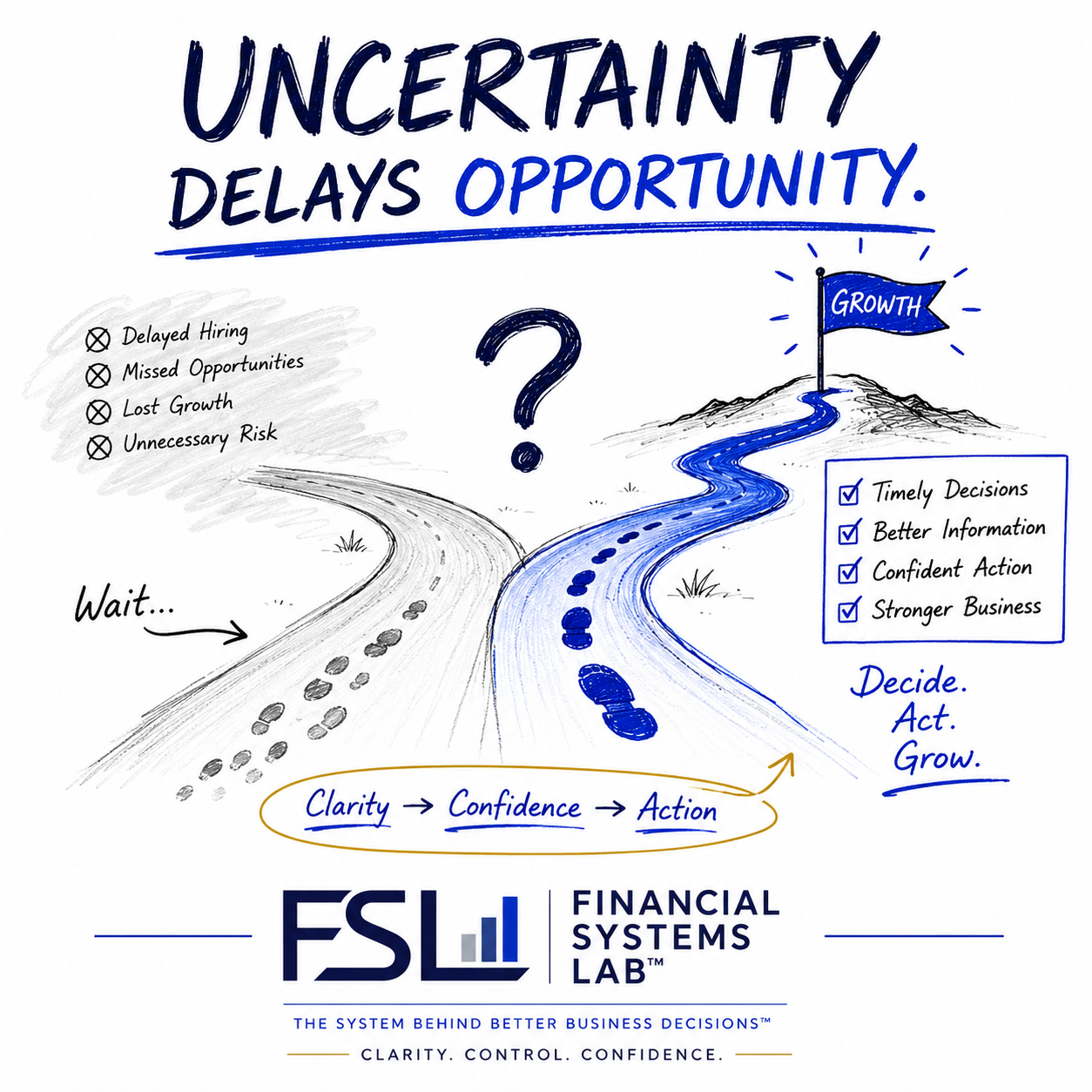
Why uncertainty quietly slows growth and increases risk.
"The biggest risk in business isn't always making the wrong decision. More often, it's delaying the right decision because you don't have enough confidence in the information before you."
Every business owner has faced moments of uncertainty.
Should I hire another employee now or wait?
Can I afford to invest in new equipment?
Is it the right time to increase prices?
Should I take on a large customer order?
Can I safely withdraw money from the business?
These are not accounting questions.
They are business decisions.
Yet many business owners answer them using incomplete information, assumptions, or instinct because they simply don't have timely financial insight.
That uncertainty has a cost.
Unfortunately, it is one of the few business costs that never appears in your financial statements.
The Cost You Never Record
Most business owners can identify expenses such as rent, wages, inventory, and marketing.
They appear clearly in the accounts.
Financial uncertainty does not.
It quietly influences decisions every day.
A delayed investment.
A postponed recruitment.
A missed opportunity.
An unnecessary loan.
A customer order declined because the business owner isn't sure whether there is enough cash to fulfil it.
None of these costs appear on an income statement.
Yet they affect the future of the business just as much as any recorded expense.
The true cost of uncertainty is often measured in opportunities that were never pursued.
When Uncertainty Becomes the Default
Imagine you own a growing manufacturing business.
A long-standing customer asks whether you can increase production by 30% over the next six months.
It is exactly the kind of opportunity every business hopes for.
But before saying yes, several questions immediately come to mind.
Can the business finance the additional raw materials?
Will cash flow remain healthy while waiting for customer payments?
Can existing operations support the increased workload?
Would hiring additional employees create unnecessary financial pressure?
If reliable answers are unavailable, hesitation replaces confidence.
Eventually, the customer awards the contract to another supplier.
The lost opportunity will never appear in your financial reports.
Yet the financial impact could be significant.
This is how uncertainty quietly slows business growth.
Confidence Comes From Clarity
People often believe experienced business owners simply make faster decisions.
In reality, many successful business owners make faster decisions because they have better information.
They know their current cash position.
They understand future cash requirements.
They monitor key performance indicators regularly.
They recognize emerging problems before they become urgent.
Confidence is not built on optimism.
Confidence is built on clarity.
And clarity comes from well-designed financial systems.
The Financial Systems Lab Perspective
One of the biggest misconceptions about finance is that its primary purpose is to report what happened last month.
Historical reporting is important.
But growing businesses need much more than history.
They need information that helps them make today's decisions and prepare for tomorrow's opportunities.
At Financial Systems Lab, we believe financial systems should reduce uncertainty—not simply produce reports.
A well-designed financial system should help answer questions such as:
- Can we comfortably finance our planned growth?
- What will our cash position look like over the next ninety days?
- Which products, services, or customers generate the greatest value?
- Where are we creating unnecessary financial risk?
- What information do we need before making our next major decision?
When business owners can answer these questions with confidence, uncertainty begins to lose its influence.
Not because business becomes predictable.
But because decisions become informed.
That is the purpose of Financial Systems Design.
It is not about creating more reports.
It is about creating better decisions.
Financial Systems Insight
Financial uncertainty rarely announces itself.
It quietly influences the decisions you postpone, the opportunities you decline, and the risks you fail to recognize.
Reducing uncertainty is not about eliminating risk.
It is about improving the quality of the information that supports your decisions.
Decision Moment
Imagine your largest customer asks you today to double their monthly order.
Before answering, what financial information would you want to see?
Would you rely on facts—or hope?
Your answer says a great deal about the strength of your financial system.
From the Lab
One pattern appears repeatedly when working with growing businesses.
Owners rarely struggle because they lack ambition.
They struggle because critical financial information arrives too late, is incomplete, or is scattered across different reports and spreadsheets.
When information improves, decisions improve.
When decisions improve, businesses become stronger.
Key Takeaways
- Financial uncertainty creates hidden costs that traditional financial statements never record.
- Delayed decisions can be just as expensive as poor decisions.
- Confidence comes from timely, reliable financial information.
- Financial systems should support decision-making, not just compliance.
- Better decisions begin with reducing uncertainty.
Financial Systems Reflection
Take a few moments to reflect honestly.
- Do you know your current cash position without asking someone else?
- Can you estimate your cash position 90 days from now?
- Have you delayed an important business decision because you didn't have enough financial information?
- What opportunities might your business have missed because uncertainty made you hesitate?
Sometimes the greatest opportunity for improvement is not working harder.
It is reducing uncertainty.
Tomorrow's Lesson
Profit Isn't the Whole Story
Many business owners believe that if a business is profitable, it must also be financially healthy.
Tomorrow, we'll challenge that assumption and explore why profitable businesses still run out of cash.
A Practical Next Step
If today's article made you think differently about the role of financial information in your business, I invite you to take one practical step.
Complete the 15-Minute Business Financial Health Check: Discover the Five Financial Systems Every Business Needs for Greater Clarity, Control, and Confidence.
Rather than measuring accounting knowledge, it helps you evaluate the systems that support your business decisions and highlights areas where greater clarity could strengthen your business.
Comment “Financial Systems Lab”, I will personally share the link
Follow Financial Systems Lab
If you found this article valuable, follow Financial Systems Lab on Medium and connect with us on LinkedIn, Facebook, Instagram, and X.
If this insight challenged the way you think about business, please clap, leave a comment, and share it with another business owner. Every conversation helps build a community of leaders committed to making better business decisions.
About Financial Systems Lab
Financial Systems Lab helps small and growing business owners design intelligent financial systems that improve Visibility, Liquidity, Performance, Control, and Decision.
Our mission is simple:
Better business decisions begin with better financial systems.
About the Author
This article is written by:
NM Duncan, CPA, BBA - Accounting, MBA Finance
Founder & Chief Financial Systems Architect
Financial Systems Lab LLC