

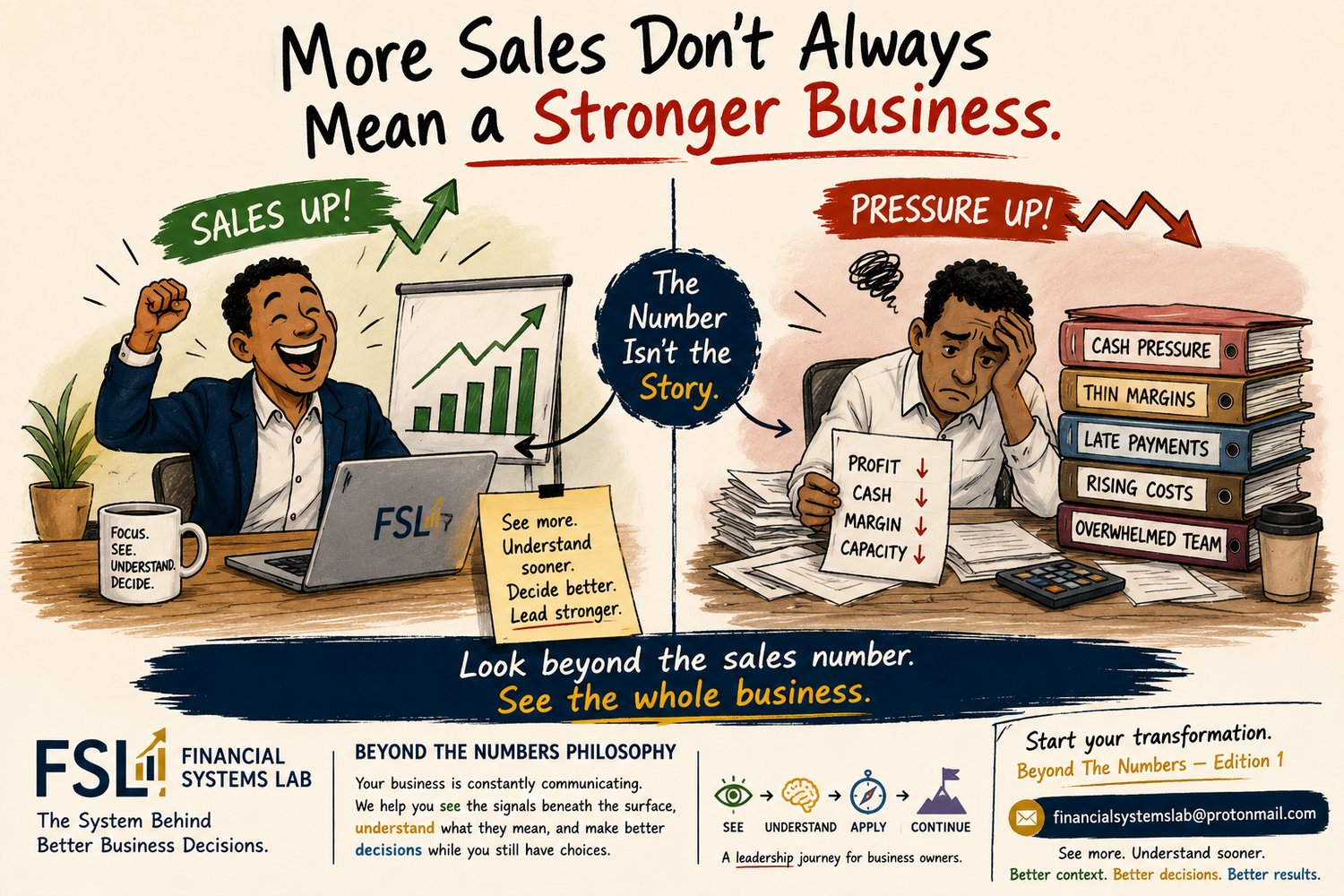
More sales should mean a stronger business. Right?
Not necessarily.
Revenue can rise while cash gets tighter. Margins can shrink. Receivables can grow. Costs can accelerate.
The sales number may look better while the business underneath it becomes harder to manage.
The question isn't simply, “Did we grow?”
It's:
“What did that growth do to the business?”
The sale is not the whole story
Imagine your business generates $100,000 in sales one month.
The following month, sales rise to $125,000.
25% growth.
It sounds like a win.
But what happened to:
- profit?
- cash?
- receivables?
- inventory?
- operating costs?
- team capacity?
If those changed significantly, the additional $25,000 tells only part of the story.
That's the problem with treating revenue as the final measure of business performance.
What happens around the sale?
Consider a business that wins a $50,000 order.
The owner celebrates.
But fulfilling it requires additional inventory, labour and delivery costs. Suppliers need payment now, while the customer has 60-day terms.
The $50,000 sale is real.
But the cash hasn't arrived.
Revenue increased. Cash pressure increased too.
Now consider two customers who each generate $20,000.
One pays quickly, produces a healthy margin and requires little support.
The other takes 90 days to pay, negotiates heavily, produces a thin margin and consumes significant team time.
Same revenue. Different business impact.
The lesson isn't that sales are bad.
It's that revenue needs context.
Follow the relationships
When revenue increases, look at what moves with it.
Revenue + margin
Are you keeping enough of what you sell?
Revenue + cash
Are sales actually becoming cash?
Revenue + receivables
Are customers paying at the same speed?
Revenue + costs
Are costs rising faster than sales?
Revenue + capacity
Can the business handle the demand sustainably?
These relationships turn isolated numbers into signals.
And signals give you something much more useful than a headline figure:
something to investigate.
The number isn't lying
A rising revenue number isn't bad news.
Neither is growth.
The danger is assuming that one positive number explains the condition of the business.
You may see:
Sales ↑
Margins ↓
Receivables ↑
Cash ↓
That's not necessarily a reason to panic.
It's a reason to ask better questions.
The number isn't the answer.
It's the beginning of the question.
From reporting to understanding
This is where Financial Visibility matters.
It isn't about collecting more numbers.
It's about understanding the relationships between them.
Instead of stopping at:
“What happened?”
you begin asking:
“Why did it happen?”
Then:
“What else is connected to it?”
And finally:
“What decision does this require?”
That's the movement from reporting to understanding.
And understanding gives you a stronger basis for action.
Ask better questions about growth
The next time sales increase, don't stop at the revenue report.
Ask:
What happened to margin?
What happened to cash?
What happened to receivables?
What happened to costs?
What happened to capacity?
Then ask the question that brings them together:
“What did this growth do to the business?”
That question can change what you decide to do next.
The journey continues
On Day 1, we began by asking you to SEE the signals your business is constantly producing.
Day 2 challenged the belief that working harder can solve every growing-business problem.
Day 3 took us beneath individual numbers and into the story behind them.
Today, we apply that thinking to revenue.
A bigger sales number is not enough. You need to understand what is happening around it.
That is Financial Visibility.
ENTER → SEE → UNDERSTAND → APPLY → CONTINUE
The magazine is the vehicle.
The transformation is the destination.
Start your transformation.
Beyond The Numbers — Edition 1
See more. Understand sooner.