

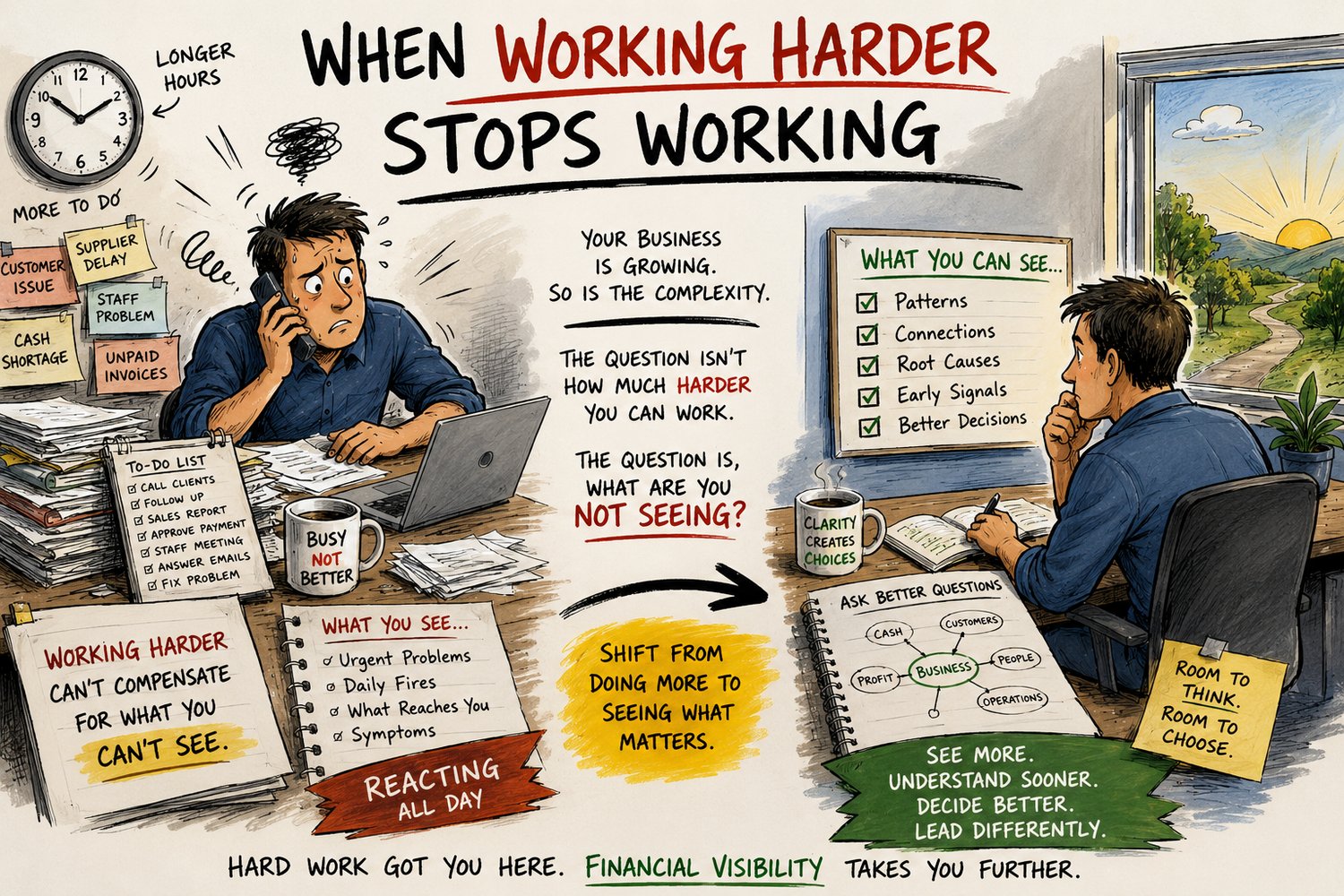
There is a point in almost every growing business when the owner starts wondering:
“Why am I working harder than ever, but it doesn’t feel like we’re getting ahead?”
But here is the uncomfortable part:
The more your business grows, the less useful working harder can become as a way of managing it.
That sounds almost wrong.
Hard work is what got you here.
So why would working harder become the problem?
Because the business you are trying to manage today may no longer be the business you started.
Hard work can get you started
Hard work matters.
It can help you get your first customers.
It can keep the business alive when resources are limited.
It can help you overcome setbacks.
It can get things done when there aren’t enough people to do them.
In the early stages, the owner often has to be everywhere.
You sell.
You deliver.
You negotiate.
You collect.
You manage.
You solve.
You do whatever needs to be done.
And because you are close to everything, your effort has a visible impact.
Work harder.
Get more done.
Move forward.
For a while, that equation works.
Then the business grows.
And the equation starts to change.
The business gets bigger, but your day doesn’t get longer
More customers arrive.
More orders need attention.
More employees join.
More suppliers become involved.
More money moves through the business.
More decisions need to be made.
More things happen at the same time.
But there are still only twenty-four hours in your day.
So you compensate.
You work earlier.
You finish later.
You check your phone more often.
You become involved in more decisions.
You ask for more updates.
You try to stay on top of everything.
And sometimes you succeed.
But eventually you reach a point where:
More effort no longer creates proportionately more control.
You are still working harder.
But you are no longer seeing everything.
This is where things become dangerous
The danger isn’t simply that you are tired.
The bigger danger is that you may start managing what reaches you instead of managing what actually matters.
The loudest customer gets your attention.
The urgent supplier gets your attention.
The employee with a problem gets your attention.
The unpaid invoice gets your attention.
The cash shortage gets your attention.
The declining sales number gets your attention.
You spend the day responding to whatever is in front of you.
And at the end of the day, you have been incredibly productive.
But you may still not know:
Why did cash become tighter?
Why are margins falling?
Why are the same operational problems returning?
Why are customers taking longer to pay?
Why does the team keep coming back to you with the same issues?
Why does growth feel harder than it should?
Those are different questions.
They require something more than effort.
They require visibility.
Your business may have outgrown your way of seeing it
This is one of the hardest transitions for a business owner.
In the beginning, you can often see almost everything yourself.
You know who owes you money.
You know which customer is unhappy.
You know which product is moving.
You know which supplier is causing problems.
You know where the cash is going.
You know what your people are dealing with.
The business is small enough for your personal awareness to cover much of what matters.
Then it grows.
And suddenly:
The business becomes bigger than what one person can personally see.
This doesn’t mean you have failed.
It means the business has reached a new stage.
But if your way of managing the business doesn’t evolve with it, something begins to happen.
You work harder to compensate for what you can no longer see.
More effort can become a trap
Imagine a business owner who notices that cash is constantly tight.
The owner works harder to generate more sales.
Sales increase.
But cash is still tight.
So the owner pushes even harder.
More sales.
More activity.
More customers.
More pressure.
Yet the underlying problem remains.
Perhaps customers are taking too long to pay.
Perhaps margins are too thin.
Perhaps inventory is absorbing cash.
Perhaps the business is growing faster than its cash can support.
The owner has responded to the visible problem:
“We need more sales.”
But the deeper question was:
“Why isn’t the current level of sales producing the cash we need?”
That’s the difference between reacting to a problem and understanding it.
Being busy can hide what matters
There is a dangerous satisfaction that comes with a full day.
You answered twenty emails.
Made ten calls.
Attended three meetings.
Approved payments.
Spoke to customers.
Solved staff issues.
Reviewed reports.
Followed up on sales.
You can go home knowing you accomplished a lot.
But ask yourself:
Did you make the business easier to understand?
Did you identify a recurring problem?
Did you discover why something changed?
Did you connect two issues that appeared unrelated?
Did you make an important decision earlier than you normally would?
Did you prevent tomorrow’s problem?
Because there is a difference between doing more and understanding more.
And as a business grows, that difference becomes increasingly important.
The problem isn’t that you need to work less
This isn’t an argument for simply working fewer hours.
A growing business will demand effort.
There will always be difficult days.
There will always be unexpected problems.
There will always be things that need your attention.
The real question is:
Are you using your effort to move the business forward — or using your effort to compensate for what you cannot see?
That is a very different question.
Because if the owner has to personally chase every problem, explain every number, solve every recurring issue and make every important decision, the business has a visibility problem as much as it has an operational problem.
What changes when you can see earlier?
Imagine noticing that customers are beginning to pay more slowly before cash becomes critical.
Imagine seeing a margin problem before it seriously damages profitability.
Imagine recognising that a recurring staff issue is connected to a process problem.
Imagine noticing that rising sales are consuming more cash than expected.
Imagine seeing a pattern while it is still small enough to address.
Now the conversation changes.
You are no longer asking:
“What do I do about this crisis?”
You can ask:
“What is this signal telling me?”
That gives you room to think.
And room to think changes decisions.
From reacting to seeing
This is the shift that growing business owners eventually need to make.
Reacting means waiting for a problem to demand attention.
Seeing means recognising the signals before they become impossible to ignore.
Understanding means asking what those signals mean and how they connect.
Deciding means choosing what needs to happen.
Acting means putting that decision into motion.
The objective isn’t to eliminate uncertainty.
Business will always contain uncertainty.
The objective is to:
Reduce the amount of the business you are managing blindly.
Your numbers can help — but only if you look beneath them
Financial information is particularly important here.
Not because every business owner needs to become a financial expert.
But because financial numbers often provide signals about what is happening elsewhere in the business.
A change in gross margin may point toward pricing, costs, product mix or operational issues.
A change in receivables may point toward customers, credit terms or collection processes.
A change in cash may reflect decisions being made across sales, purchasing, inventory and spending.
The number is important.
But the number alone isn’t enough.
You need to understand the story behind it.
That’s where Financial Visibility begins to matter.
The next stage of business growth requires a different kind of capacity
At some point, the owner cannot simply become more involved.
There is a limit.
The answer isn’t to personally carry more of the business.
It is to become better at seeing what matters.
To recognise signals.
To understand connections.
To identify patterns.
To ask better questions.
To make decisions sooner.
And to build a business where important information doesn’t depend entirely on the owner being everywhere at once.
That is a different kind of capacity.
It isn’t simply the capacity to work harder.
It is the capacity to see better.
Your business does not need more of you everywhere
It needs you where your judgment matters most.
And good judgment requires something that constant reaction makes difficult:
clarity.
Clarity comes from seeing.
Seeing creates understanding.
Understanding creates better decisions.
Better decisions create stronger action.
And stronger action is what moves a business forward.
The next level of growth may not require you to work harder.
It may require you to see more.
The question to take into tomorrow
Before you finish your business day, ask:
What problem consumed most of my time today?
Then ask:
Was I solving the problem — or only responding to its latest symptom?
Then go one step further:
What might my business be telling me through that problem?
That question could reveal more than another hour of work.
Because sometimes the next breakthrough in your business doesn’t come from doing more.
It comes from seeing differently.
When hard work reaches its limit
Hard work is not the enemy.
It got you here.
But it cannot be the entire system for running a growing business.
Eventually, the business becomes too complex for personal effort alone to provide the visibility you need.
That’s the point at which the owner must begin making a shift:
from doing everything → to seeing what matters
from reacting → to understanding
from solving symptoms → to identifying connections
from waiting for problems → to recognising signals
from working harder → to leading better
This is not about becoming less committed to your business.
It is about making your commitment more effective.
Your business does not need you to carry everything
It needs you to see what matters.
And that requires a different kind of leadership capacity.
The capacity to recognise signals.
The capacity to understand connections.
The capacity to identify patterns.
The capacity to make decisions before problems become urgent.
Because the owner who sees sooner has something the constantly reacting owner often doesn’t:
Room to choose.
And that room can change the quality of the decision.
The journey continues
Day 1 began with a simple question:
Your business is talking. Are you seeing the signals?
Today, we take that question further.
Because if you are working harder and harder just to keep up, there may be something worth examining beneath the workload.
Has your business outgrown the way you currently see it?
If the answer might be yes, don’t stop at recognition.
The next step is learning how to see the connections between what is happening across your business — and what those connections are telling you.
That is the journey behind Beyond The Numbers — Season I: Building Financial Visibility.
Edition 1 is designed to take you beyond isolated numbers, isolated problems and isolated decisions — and into a different way of seeing and leading your business.
The journey is deliberate:
ENTER → SEE → UNDERSTAND → APPLY → CONTINUE
You begin by recognising what may be happening.
Then you learn to see it differently.
Then you understand what the signals and connections may mean.
Then you apply that thinking to your own business.
And you continue the journey.
The magazine is the vehicle. The transformation is the point.
The goal is not simply to give you more information.
It is to build your capacity to see, understand and decide sooner.
Because stronger businesses are not built only by owners who work hard.
They are built by owners who can see what matters, understand what it means, and act while they still have choices.
If you know an owner who is carrying more and more of the business on their own shoulders…
Send this article to them.
They may not need another reminder to work harder.
They may need a different way to see the business.
And if that owner is you:
Start your transformation.
Beyond The Numbers — Edition 1
See more. Understand sooner.