

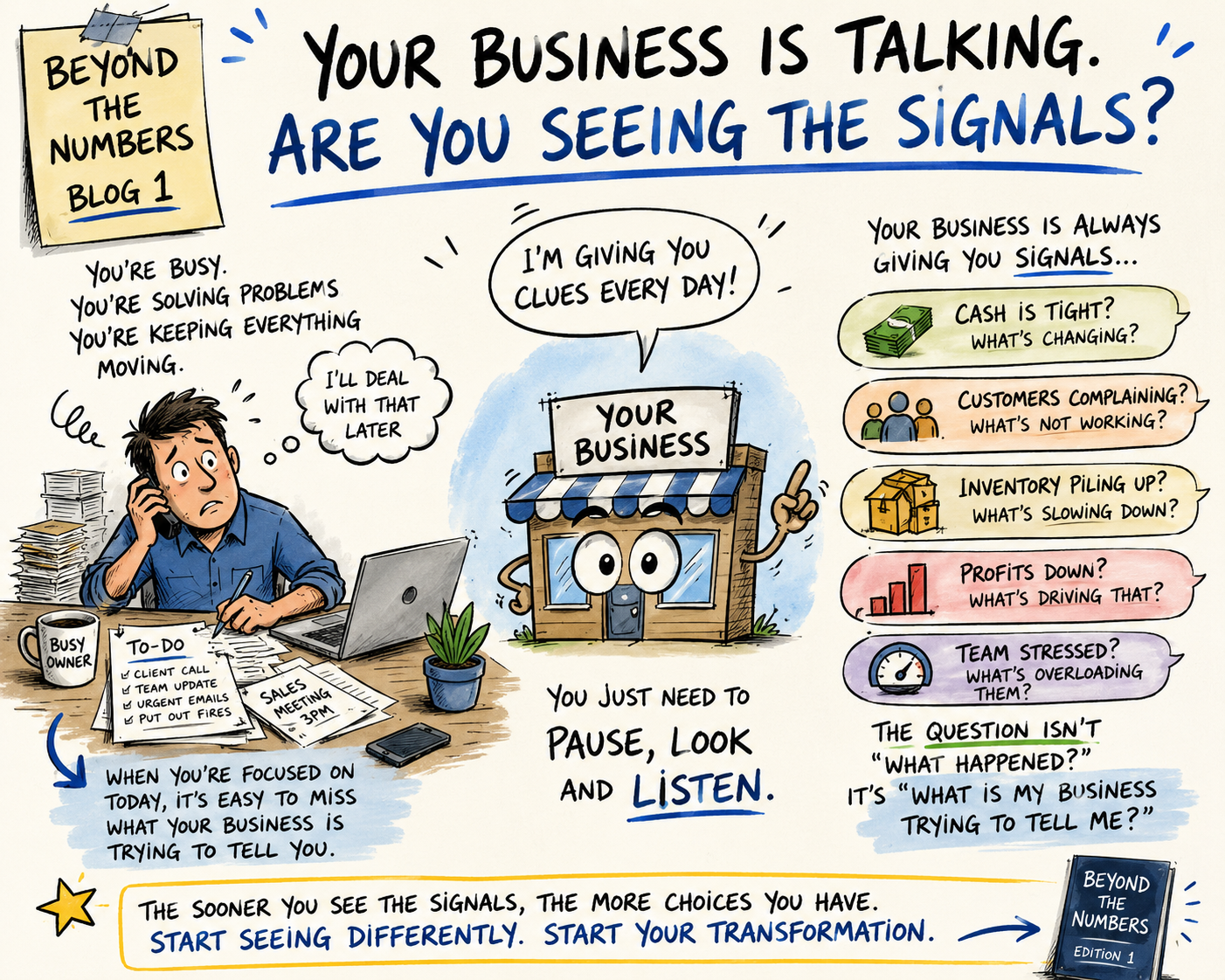
You can spend the entire day working on your business and still miss what your business is trying to tell you.
You answer customers.
You follow up on payments.
You deal with suppliers.
You check on your team.
You solve problems.
You make decisions.
You put out fires.
You work late.
And at the end of the day, you are exhausted because you have been busy all day.
But then comes the uncomfortable question:
Did all that activity actually help you understand what is happening inside the business?
Because there comes a point in the life of almost every growing business when working harder stops producing the same return it once did.
That doesn't necessarily mean you are doing something wrong.
It may mean the business has changed.
And your way of seeing it needs to change with it.
Your business is giving you signals every day
Your business is constantly producing information.
A customer who takes longer to pay.
A product that is selling well but leaving less money behind.
A supplier whose prices keep increasing.
A team member dealing with the same problem repeatedly.
A customer complaint that keeps coming back.
Revenue increasing while cash remains tight.
Expenses that look manageable individually but are putting pressure on the business collectively.
A decision that keeps getting postponed.
These things may look like separate events.
They aren't always separate.
A late-paying customer can affect cash.
Cash pressure can affect supplier payments.
Supplier problems can affect operations.
Operational problems can affect customers.
Customer problems can affect revenue.
And suddenly what looked like a cash problem was connected to something that happened much earlier.
The business was giving you signals.
The challenge was seeing the connection.
The dangerous part about being busy
Being busy can feel like progress.
After all, you are doing things.
But activity and progress are not the same thing.
You can spend an entire day responding to problems without addressing what keeps creating them.
You can have five meetings and still not understand why cash is getting tighter.
You can receive another financial report and still not know what decision needs to be made.
You can increase sales and still find yourself with less money available.
You can work twelve hours and finish the day with the uncomfortable feeling that:
You dealt with everything except what really mattered.
That's not necessarily a failure of effort.
It may be a failure of visibility.
When working harder stops solving the problem
In the early days of a business, hard work often works.
You are close to everything.
You know the customers.
You know the sales.
You know the cash.
You know your people.
You know the suppliers.
You know what is happening because much of what happens passes directly through you.
In a sense:
You are the system.
Then the business grows.
More customers.
More transactions.
More employees.
More suppliers.
More expenses.
More decisions.
More things happening at the same time.
You simply cannot be everywhere anymore.
But many owners respond to this change by trying to compensate with more effort.
They check more.
They ask for more reports.
They hold more meetings.
They personally approve more decisions.
They work longer.
They become more involved.
And this can work for a while.
Until it doesn't.
Because there is a limit to how much one person can personally see.
The business can eventually become bigger than the owner's personal visibility.
That is one of the most important transitions in business growth.
Your business doesn't need more information
This may sound strange.
Especially if you already receive financial reports.
But more information does not automatically create more clarity.
You can have:
- more spreadsheets
- more reports
- more dashboards
- more numbers
- more meetings
and still be asking:
“What's actually going on?”
Why?
Because information and visibility are not the same thing.
Information can tell you:
what happened.
Visibility helps you explore:
What changed?
Why did it change?
What else is connected to it?
Is this a pattern or a one-off event?
Does it matter?
What happens if nothing changes?
What decision needs to be made now?
That is a different way of looking at a business.
And it leads to a different quality of decision-making.
The signals usually appear before the crisis
This matters because business problems rarely become serious in one instant.
The warning signs often appear first.
Cash becomes tighter gradually.
Margins begin slipping.
Costs increase little by little.
Customers change their behaviour.
A recurring operational problem becomes normal.
A team problem keeps resurfacing.
A decision gets delayed again and again.
Nothing seems serious enough to demand immediate attention.
So the business owner keeps moving.
Until eventually the combined effect becomes impossible to ignore.
Now the owner has a problem.
But the real cost isn't simply that the problem exists.
The cost is that by the time you see it clearly, your options may already be smaller.
Earlier visibility gives you something extremely valuable:
time to understand.
Time to question.
Time to consider alternatives.
Time to act while the situation is still manageable.
That is why seeing the signals matters.
Financial visibility is not about staring at numbers
Financial visibility is not about turning a business owner into an accountant.
It is not about producing more reports for the sake of producing reports.
It is about helping the owner see the business more clearly.
To recognise what is changing.
To understand what is connected.
To distinguish a symptom from a deeper problem.
To identify what deserves attention.
And ultimately:
to make better decisions while there are still meaningful choices available.
That is the difference between simply knowing what happened and understanding what the business may be telling you.
A different way to lead
Better visibility changes the owner's role.
Instead of constantly moving from problem to problem:
Reacting → Recognising
Instead of simply recognising something is wrong:
Recognising → Understanding
Instead of understanding after the damage is done:
Understanding → Deciding
Instead of endlessly postponing decisions:
Deciding → Acting
And ultimately:
Acting → Leading
That is the transformation.
The goal isn't to eliminate every problem.
It isn't to predict everything.
It isn't to make the business perfectly controllable.
And it isn't to give an already busy owner another pile of work.
The goal is simpler:
See more. Understand sooner. Decide better.
Ask yourself a different question tonight
At the end of a difficult business day, you may normally ask:
“What did I get done today?”
That is a useful question.
But ask another one:
“What did my business tell me today?”
Did your customers tell you something?
Did your cash position tell you something?
Did your costs tell you something?
Did your people tell you something?
Did your operations tell you something?
Did your financial numbers tell you something?
Did the same problem appearing again tell you something?
Did something change that deserves your attention?
Your business is constantly communicating.
The question isn't whether it is talking.
It is.
The question is whether you are seeing the signals.
Don't stop at recognition
If this made you look differently at your own business, don't stop at recognising the problem.
There is a deeper question:
What would change if you could see the business more clearly before problems became urgent?
What would you notice earlier?
What decisions might you make differently?
What recurring problems might finally make sense?
What could you stop reacting to and start understanding?
That is where the journey goes next.
Beyond The Numbers — Season I: Building Financial Visibility was created around that journey.
Edition 1 takes the conversation beyond the obvious problem and begins helping the business owner understand the connections between customers, cash, people, operations, decisions and performance.
Not as another collection of business articles.
But as a progression:
ENTER → SEE → UNDERSTAND → APPLY → CONTINUE
You begin by recognising what may be happening.
Then you learn to see it differently.
Then you understand what the signals and connections may mean.
Then you apply that thinking to your own business.
And finally, you continue the journey.
Your business is talking.
It is telling you about customers.
Cash.
People.
Costs.
Operations.
Performance.
Decisions.
Patterns.
Changes.
The signals are there.
The opportunity is not simply to know more.
It is to see more.
Because when you see sooner, you have more time to understand.
And when you understand sooner, you can make better decisions while you still have choices.
That is how better visibility becomes better leadership.
If you know a business owner who is working harder but feels that something important is still being missed, send them this article.
And if the business owner is you:
Start the journey.
Beyond The Numbers — Edition 1
Building Financial Visibility
Start Your Transformation — Beyond The Numbers Edition 1
See more. Understand sooner.