
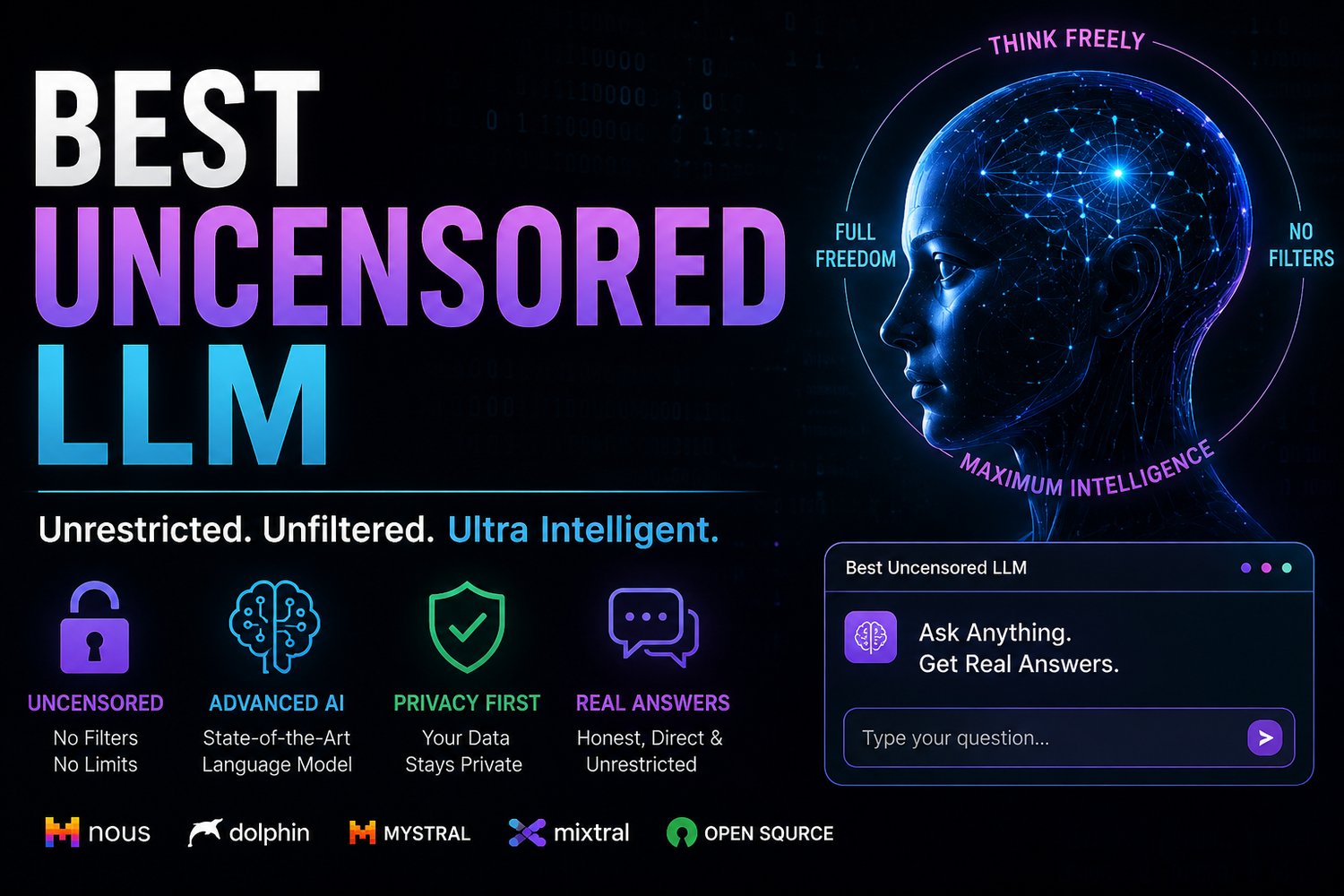
Artificial Intelligence has transformed how we write code, generate content, and solve complex problems. However, most mainstream, commercial AI models—such as ChatGPT, Claude, and Gemini—come with strict guardrails, safety filters, and alignment boundaries. While these restrictions exist to prevent harm, they often lead to false positives, best uncensored llm refusal to answer benign creative writing queries, or overly cautious responses during deep academic research.
For researchers, creative writers, cybersecurity professionals, and open-source enthusiasts, uncensored Large Language Models (LLMs) offer a refreshing alternative. Free from corporate alignment filters, these models respond to prompts neutrally and without preaching.
In this guide, we will explore what uncensored LLMs are, how they work, and the absolute best uncensored LLMs you can run or access today.
What Is an Uncensored LLM and How Does It Work?
An uncensored LLM is a language model that has been modified or fine-tuned to remove or minimize built-in safety filters, preachy refusals, and moralizing alignment layer restrictions.
When mainstream AI models are trained, they undergo two main stages:
- Pre-training: Learning patterns, facts, and language structure from massive text datasets.
- Alignment / Reinforcement Learning from Human Feedback (RLHF): Training the model to decline answering sensitive, dangerous, or controversial queries.
Uncensored models are typically created by applying fine-tuning techniques—such as Abliterated fine-tuning or Direct Preference Optimization (DPO)—on open-weights base models like Llama, Mistral, or Qwen. The goal is to strip away the refusal bias while retaining the base model's core intelligence, reasoning ability, and general knowledge.
The Top Uncensored LLMs Available Today
Here are the standout open-weights uncensored and low-restriction models that offer unmatched freedom, intelligence, and versatility:
1. Llama-3-8B / 70B Instruct (Abliterated Versions)
Meta’s Llama 3 models are widely considered some of the most capable open-weights models in the world. However, Meta’s official releases come with noticeable refusal guardrails.
To solve this, open-source developers created Abliterated variants (e.g., Llama-3-8B-Instruct-Abliterated). Instead of re-training the model, abliteration mathematically neutralizes the specific directional vectors in the neural network responsible for refusal responses.
- Key Strengths: Exceptional reasoning, top-tier coding capabilities, natural conversational tone, and zero preachiness.
- Best For: General tasks, complex logic, coding, and open storytelling.
2. Dolphin Series (Dolphin 2.9 / Dolphin-Mixtral)
Created by Eric Hartford, the Dolphin dataset family is legendary in the open-source AI community. Dolphin models are specifically trained on unfiltered datasets to be compliant, helpful, and completely uncensored.
- Dolphin 2.9 (based on Llama 3 or Mistral): Highly responsive, direct, and excellent at taking strict formatting instructions.
- Dolphin 2.7 Mixtral (8x7B): A Mixture-of-Experts (MoE) model that offers near-GPT-3.5 speed and intelligence with total freedom from guardrails.
- Key Strengths: High instruction-following precision, absolute compliance with prompts, and strong creative performance.
- Best For: Roleplay, unfiltered research, creative writing, and prompt automation.
3. Mistral 7B & Mixtral 8x22B (Instruct / Uncensored Fine-tunes)
Developed by Paris-based Mistral AI, the base Mistral models are renowned for their lightweight efficiency and impressive speed-to-performance ratio. While Mistral AI keeps its models relatively open by default, community fine-tunes take it a step further to eliminate edge-case refusals.
- Key Strengths: Low hardware resource requirements (runs smoothly on consumer GPUs/MacBooks), blazingly fast token generation, and deep multilingual capabilities.
- Best For: Running locally on personal hardware, rapid prototyping, and privacy-first local setups.
4. Qwen 2.5 (Abliterated / Unfiltered Fine-tunes)
Alibaba’s Qwen 2.5 architecture has taken the open-source community by storm, outperforming many proprietary models in math, coding, and technical knowledge. Open-source developers have quickly released unfiltered variants of Qwen 2.5 (ranging from 7B up to 72B parameters).
- Key Strengths: Industry-leading coding proficiency, long context window support, and deep math capabilities without safety interruptions.
- Best For: Penetration testing scripts, advanced software development, and technical problem-solving.
Key Benefits of Using Uncensored AI Models
Choosing an uncensored AI over a standard commercial service brings several distinct advantages:
- No Preachiness or Moralizing: Uncensored models answer the prompt directly without judging the user, giving unsolicited advice, or issuing lectures.
- Higher Precision in Fiction & Roleplay: Standard models often refuse benign fiction involving conflicts, dark themes, or historical violence. Uncensored models write authentic narratives without artificial interruptions.
- Enhanced Cybersecurity Research: Security engineers and white-hat hackers can test code vulnerabilities, analyze malware samples, and execute penetration testing prompts without triggering false-positive safety flags.
- Complete Data Privacy: Because most uncensored models are open-weights, you can run them entirely offline on your local computer using tools like Ollama, LM Studio, or KoboldCPP. Your data never leaves your device.
How to Run Uncensored LLMs Locally
Setting up your own private, uncensored AI takes only a few minutes:
- Download a Local AI Runner: Install a free tool like LM Studio or Ollama.
- Search for Models: Look for models tagged with Abliterated, Dolphin, or Uncensored (popular GGUF formats from quantized model creators like GGUF or Bartowski).
- Load and Chat: Select the model based on your system RAM/VRAM capacity:
- 8GB VRAM / RAM: Run 7B or 8B parameter models (4-bit quantization).
- 16GB–24GB VRAM: Run 14B–32B parameter models.
- 32GB+ RAM/VRAM: Run 70B parameter models for expert-level output.
Final Thoughts: The Future of Open & Uncensored AI
Uncensored LLMs represent the true spirit of open-source technology: giving users full control over their software. While commercial AI models serve a broad consumer audience, uncensored fine-tunes remain the tool of choice for creators, researchers, and tech enthusiasts who demand uncompromised freedom, maximum privacy, and unbiased intelligence.
Whether you choose Dolphin Llama 3 for creative storytelling or an Abliterated Qwen 2.5 for coding, running these models locally ensures your creative and technical pursuits are limited only by your imagination—not by guardrails.