
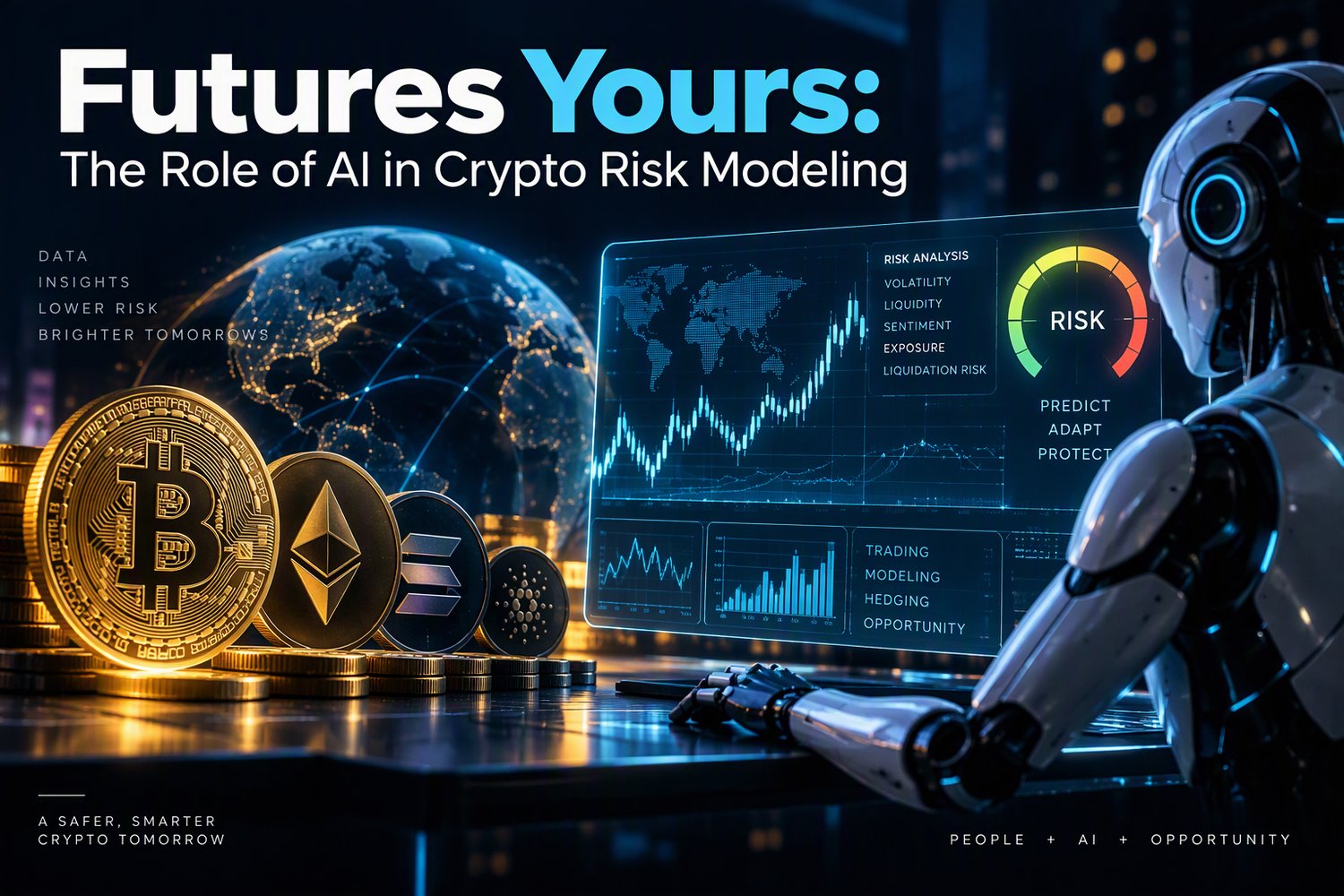
Futures Yours: The Role of AI in Crypto Risk Modeling
How artificial intelligence is transforming the way traders, investors, and institutions navigate volatility in digital asset markets.
Introduction
The cryptocurrency market has always been defined by uncertainty. Prices can swing double digits in a matter of hours, regulatory announcements can reshape entire sectors overnight, and market sentiment often spreads faster than traditional financial indicators can react. In this environment, risk management is not just a competitive advantage, it is a necessity.
As crypto markets mature and derivatives trading continues to expand, artificial intelligence (AI) is becoming one of the most powerful tools for forecasting market behavior and assessing risk. What was once the domain of human analysts and static financial models is rapidly evolving into a data-driven ecosystem powered by machine learning, predictive analytics, and real-time decision engines.
For traders participating in cryptocurrency futures markets, AI is not replacing expertise. It is enhancing it.
Why Traditional Risk Models Fall Short
Traditional financial risk models were designed for markets with relatively stable behavior patterns and extensive historical records. Crypto markets are different.
Several factors challenge conventional approaches:
- Extreme volatility and rapid price movements
- Limited historical data compared to traditional asset classes
- Influences from social media sentiment and online communities
- Regulatory uncertainty across multiple jurisdictions
- Continuous 24/7 global trading activity
Models based solely on historical price action often struggle to capture the complexity of these variables. As a result, institutions and sophisticated traders increasingly rely on AI systems capable of processing massive volumes of structured and unstructured data simultaneously.
How AI Improves Crypto Risk Modeling
1. Real-Time Market Analysis
AI algorithms can analyze thousands of data points every second, including:
- Order book activity
- Trading volume
- Volatility indicators
- Blockchain transaction data
- Macroeconomic events
By identifying patterns that would be difficult for humans to detect, AI systems can provide earlier warnings of potential market stress or emerging opportunities.
For futures traders, this means faster reactions to changing market conditions and more accurate assessments of potential downside risk.
2. Predictive Volatility Forecasting
Volatility remains one of the most significant drivers of futures risk.
Machine learning models can identify relationships between variables that traditional statistical approaches may overlook. These systems continuously retrain themselves using new data, improving their forecasting accuracy over time.
Instead of relying solely on past volatility measurements, AI can incorporate:
- News sentiment
- Social media activity
- Network growth metrics
- Liquidity changes
- Cross-market correlations
The result is a more dynamic and adaptive view of market risk.
3. Sentiment Analysis at Scale
Market sentiment often moves crypto markets as much as technical fundamentals.
Natural Language Processing (NLP) models can scan:
- Financial news
- X (formerly Twitter)
- Reddit discussions
- Community forums
- Regulatory announcements
AI can quantify sentiment and detect shifting narratives before they appear in price movements. This provides traders with another layer of insight when evaluating futures positions and exposure levels.
AI and Futures Trading: A Powerful Combination
Futures markets amplify both opportunities and risks through leverage. A small market movement can create significant gains or losses.
AI-driven risk models help traders by:
- Estimating liquidation probabilities
- Monitoring portfolio exposure
- Identifying concentration risks
- Optimizing position sizing
- Recommending hedge strategies
Rather than making decisions based on intuition alone, traders can leverage probabilistic forecasts supported by millions of data points.
This creates a more disciplined and informed trading environment.
Institutional Adoption Is Accelerating
Large financial institutions and crypto-native firms are increasingly integrating AI into their risk infrastructure.
These organizations use AI for:
- Portfolio stress testing
- Counterparty risk assessment
- Fraud detection
- Market surveillance
- Automated compliance monitoring
As institutional participation in crypto grows, AI-powered risk systems are becoming standard components of professional trading operations.
This trend is likely to continue as digital assets become more deeply integrated into global financial markets.
Challenges and Limitations
Despite its advantages, AI is not a crystal ball.
Several limitations remain:
- Models are only as good as the data they receive.
- Unexpected events can disrupt established patterns.
- Algorithmic bias can produce misleading signals.
- Overreliance on automation can create new forms of systemic risk.
The most effective approach combines AI-driven insights with human judgment, market expertise, and sound risk management principles.
Technology should support decision-making, not replace accountability.
The Future of Crypto Risk Management
As computing power increases and machine learning techniques become more sophisticated, AI will continue reshaping the future of crypto risk modeling.
Emerging developments include:
- Autonomous trading agents
- Deep-learning market simulators
- On-chain behavioral forecasting
- Real-time macroeconomic integration
- AI-powered decentralized finance (DeFi) risk analytics
The firms and traders that successfully integrate these technologies will be better positioned to navigate an increasingly complex market landscape.
Conclusion
The future of crypto risk management lies at the intersection of data, technology, and human expertise. AI offers a powerful framework for understanding market dynamics, forecasting volatility, and managing exposure in ways that traditional models simply cannot match.
As cryptocurrency futures markets continue to evolve, those who embrace AI-driven risk modeling will gain more than just a technological edge. They will gain the confidence to make smarter decisions in one of the world's most dynamic and unpredictable financial ecosystems.
In a market defined by uncertainty, intelligence may become the ultimate asset.
Continue Learning
👉 Use the “Back” button below to return to all my blog content and explore more topics.
Go Deeper
👉 Use the upper‑right button to visit my shop and access my full crypto guides.