

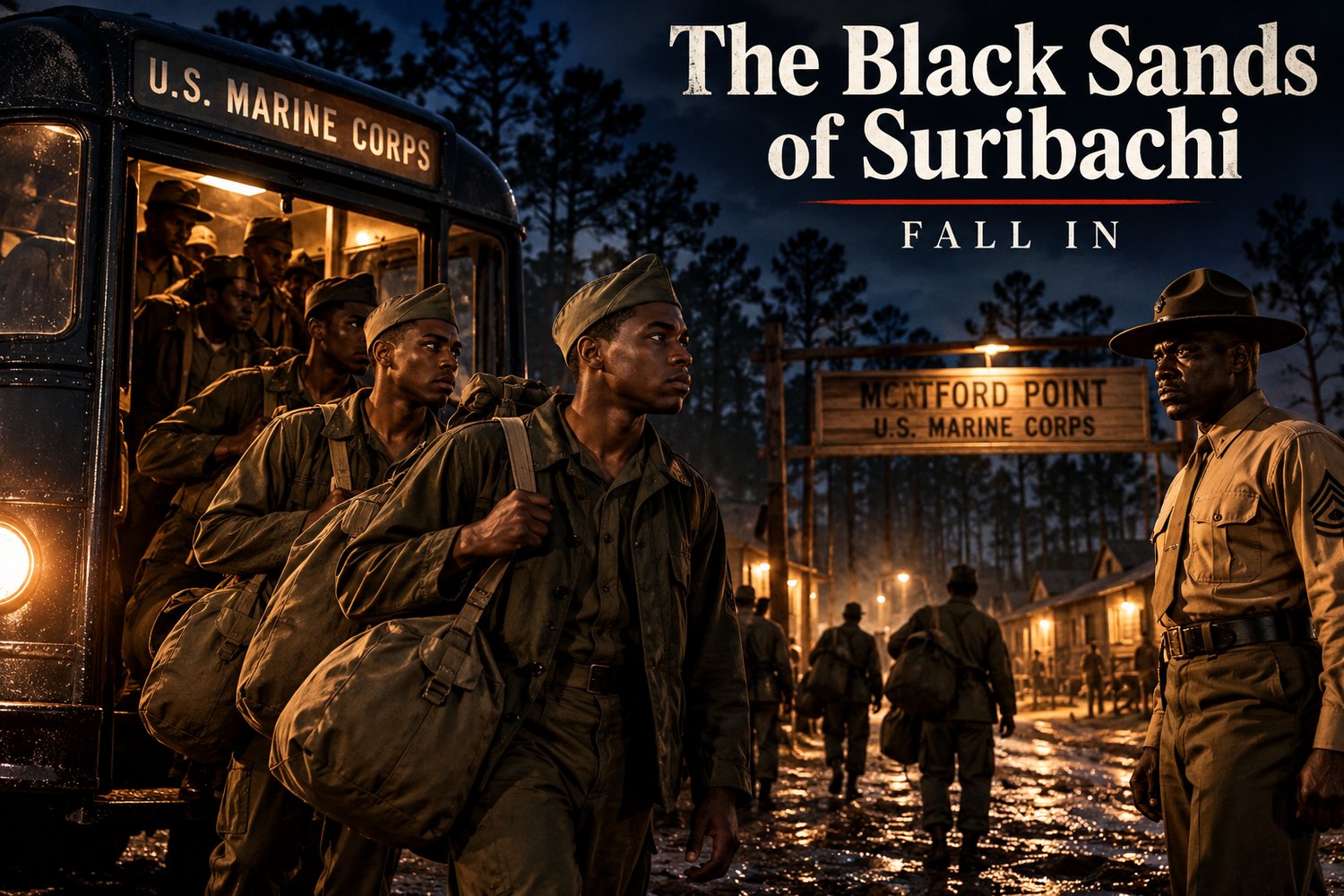
On August 26, 1942, the first Black recruits the United States Marine Corps had ever accepted arrived at a camp in North Carolina that did not fully exist yet. The place was called Montford Point, a stretch of pine woods and swamp beside Camp Lejeune. There were tar paper huts, mosquitoes, and a Corps whose own Commandant had testified against letting these men in at all.
That is where my new series begins. The Black Sands of Suribachi is a prequel and four novels about the Montford Point Marines at Iwo Jima, and the prequel, Fall In, is the book I want to tell you about this month.
Why start before the island
When people hear “Iwo Jima,” they picture the flag on Mount Suribachi. They don’t picture the Black Marines who were there. Men from the 8th Ammunition Company and the 36th Marine Depot Company landed on D-Day, February 19, 1945. The 33rd and 34th Marine Depot Companies came ashore in the days that followed. They hauled ammunition across volcanic sand, carried the wounded, buried the dead, and fought when the fighting came to them. Most of the photographs looked somewhere else.
I could have opened the series on the beach. I decided I couldn’t, because the beach makes no sense unless you know what these men had already survived just to be standing on it. A Black man in 1942 did not simply enlist in the Marine Corps. He walked through a gate the Corps had kept shut for generations, into a training camp built apart from everyone else, under officers who in many cases expected him to fail. The courage on Iwo Jima was real. So was the courage it took to step off that bus.
Fall In is the record of that first step.
The men on the bus
The novel opens on a bus with taped headlights, rolling out of Jacksonville, North Carolina, into the dark. Three men carry the story.
Ezell Grant is a freight clerk’s son from Wilmington who counts everything. His mother taught him that the man who keeps the record cannot be erased, and he believes her, so he keeps a record of all he sees. Odell Rush lost a brother in 1918, a man who served in a labor battalion and never came home, and he has carried more than twenty years of silence about it. He boards the bus ready to finally spend that silence on something.
The third man is real. Gilbert Johnson was a former Army soldier in his thirties, with two services behind him when he arrived at Montford Point. He became one of the most feared drill instructors the Corps ever produced. The recruits cursed him. Then they became Marines because of him. In 1974, the Marine Corps renamed the camp in his honor. It is Camp Gilbert H. Johnson today.
Ezell and Odell are my inventions. Johnson, the camp, the dates, and the units are drawn from the documented record, and the book tells you plainly, in a note at the front, where the record ends and my imagination begins. I think readers deserve to know which part is evidence and which part is me.
What the book is about
On the surface, Fall In is a training story. The men build their own camp with their own hands. They learn to march, to shoot, and to qualify, one score at a time, against people who were waiting for them to fall short. They watch the first Black sergeants take charge of platoons under the campaign hat. There is a sergeant’s first order, given deadpan in the swamp: don’t slap the mosquitoes; they are government property. There is plenty of humor in this book, because there was plenty of humor in those huts. People survive hard places by laughing in them.
Underneath, it is a book about what a country asks of men it does not fully trust. When the orders finally come, these Marines learn exactly what kind of war they have been given. Most Montford Point Marines were assigned to depot and ammunition companies, hauling and loading and supplying. Those jobs were essential and dangerous, and they were also a message about who the Corps believed could be trusted with a rifle. Fall In follows the men through that discovery, onto the trains west, and to the moment they load their own ship for an island nobody has named for them yet.
I wrote it for readers who love military fiction and have never heard these names. I also wrote it for my own people. About twenty thousand Black men trained at Montford Point between 1942 and 1949. In 2012, the survivors received the Congressional Gold Medal, seventy years after the first bus. Many of the men had already died by then. Their children and grandchildren deserve to know what was done, in detail, by people who looked like them.
The rest of the series
Fall In is the prequel to four novels that follow the Montford Point Marines from the first wave onto the beach at Iwo Jima, through the fight in the island’s north, to the last Japanese attack of the battle and the promise kept in the years after:
D-Day and the Volcanic Dust
The Graves of Iwo
Inferno at Turkey Knob
The Last Dawn
Each volume carries a map of Iwo Jima traced from a public-domain 1944 U.S. Army map, with that book’s ground marked, so you always know where the men are standing. Each one is anchored to the documented history of units that were too often left out of the pictures. You can read Fall In first, as the gate, or begin with Book One and come back to it later. Either way, it is where the making happens.
You can read it soon. Fall In releases on November 14, 2026, with the four novels following one week apart through December 12. The books will be available in paperback and as Kindle eBooks.
While you wait, you can browse the store for my other series about people the record tried to forget: Major Taylor, the fastest man on a bicycle; Matthew Henson at the North Pole; Jimmy Winkfield, the jockey who won the Kentucky Derby twice and then became a champion in Russia. Several series prequels are free to download.
Visit the store: payhip.com/inkylinespress (https://payhip.com/inkylinespress)
The Corps swore these men could not be made. This book is the record of the making.
Comments ()