

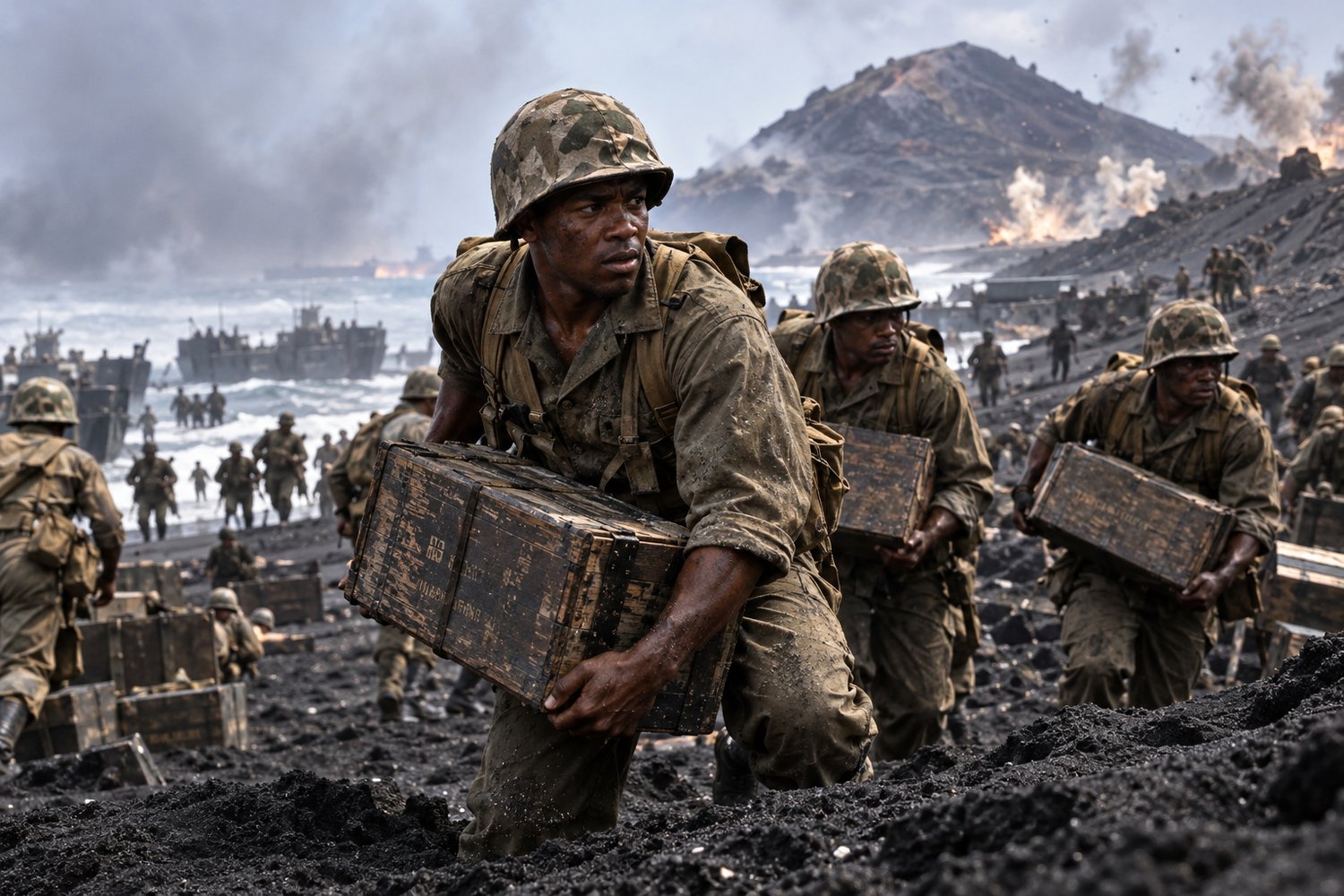
On the morning of February 19, 1945, the first waves of Marines went ashore on Iwo Jima, a small volcanic island about 750 miles south of Tokyo. Among them were Black Marines from Montford Point, the segregated camp in North Carolina where the Corps had trained its first Black recruits only two and a half years before. By the time the battle ended, more than five hundred Montford Point Marines had served there, among nearly nine hundred African American servicemen on the island.
Most Americans have still never heard that. They know the photograph of the flag on Mount Suribachi. They don’t know that the men who carried ashore the ammunition that made the flag possible included Black Marines, or that the newsreels and most of the white press of the day rarely pointed a camera at them.
Last month I wrote here about Fall In, the prequel to my series The Black Sands of Suribachi, which follows these men through training at Montford Point. This month I want to tell you about Book One, D-Day and the Volcanic Dust, where they finally reach the island.
What the record says
Four Black units served at Iwo Jima: the 8th Ammunition Company and the 33rd, 34th, and 36th Marine Depot Companies. The 8th Ammunition Company and the 36th Depot Company landed on D-Day itself. The 33rd and 34th came ashore in the days that followed.
The Corps assigned most Montford Point Marines to ammunition and depot companies, meaning hauling, loading, and supplying. On Iwo Jima that distinction meant very little. The beaches were under fire for days. The black volcanic sand rose in steep terraces that swallowed boots, trucks, and crates. Ammunition dumps were hit and burned. Every round the assault troops fired had to be carried forward by somebody, and much of it was carried by these men, under the same guns as everyone else. They also helped bring the wounded down to the beach.
Commanders praised the ammunition and depot companies in the official record, and men of those units earned Bronze Stars and Purple Hearts. The Black press noticed them too. Papers like the Pittsburgh Courier, whose Double V campaign called for victory over fascism abroad and racism at home, followed Black servicemen in the Pacific while most newsreels looked elsewhere.
Two Marines of the 34th Depot Company, Corporal Hubert E. Daverney and Private James M. Wilkins, were killed on the beach. Their names appear in the book, among the names its narrator carries, in their honor. In 2012, the surviving Montford Point Marines received the Congressional Gold Medal. For many, it was the first time their country formally thanked them.
The men at the center of the book
D-Day and the Volcanic Dust is historical fiction, and I want to be clear about what's real.
The story is told by Thomas McPhatter, a real sergeant of the 8th Ammunition Company who landed on D-Day. After the war, he became a minister and served as a chaplain in the United States Navy until he retired as a captain. For the rest of his life, he told one story above all about that island, about the length of pipe that held up the first flag raised on Suribachi, and the book handles that story with care. In the novel, McPhatter returns to Iwo Jima for a fiftieth anniversary reunion in 1995. He watches a television crew walk past him to interview someone else, and he decides that he is finished waiting for anyone to ask. Then he tells the whole story, starting from the water.
Two other real men stand beside him. Eugene Doughty of the 36th Depot Company was a student at City College of New York, turned twenty-one on the island, and later led the Montford Point Marine Association. Archibald Mosley, from Carbondale, Illinois, served on Iwo Jima as a Montford Point Marine and became a minister after the war.
Their recorded memories are the frame of the book. I reconstructed their inner lives, their conversations, and most of the men around them, and a note at the back of the book lists exactly who is real, who is a composite, and who is invented. I believe readers should never have to guess where the evidence ends and the novelist begins.
What it was like to write
The hardest chapters to write were the quiet ones. Battle scenes have their own momentum. The scenes that cost me were the small moments of indignity the men carried onto that beach, the remarks and assumptions the record documents down to the vocabulary, sitting right beside flashes of respect earned under fire. I chose to render both as they were. One promise governed every page of the series: brutal honesty without one ounce of disrespect.
This book also has a thread about the camera itself. The newsreels that went home in 1945 chose what the country would see. McPhatter watched them choose. Fifty years later, standing on the same black sand, he watches it happen again, and this time he answers back. The book is about the work, and it is also about who finally gets remembered.
The series and where to find it
D-Day and the Volcanic Dust is the first of four novels in The Black Sands of Suribachi, with Fall In as the prequel:
Fall In
D-Day and the Volcanic Dust
The Graves of Iwo
Inferno at Turkey Knob
The Last Dawn
Book Two, The Graves of Iwo, follows the depot companies into the hardest detail of the campaign, the cemeteries. The series carries the men all the way to March 26, 1945, when men of the depot companies helped break one of the last Japanese assaults on the island.
Each novel includes a map of Iwo Jima traced from a public-domain 1944 U.S. Army map, with that volume’s ground marked, so you always know where the men are standing.
D-Day and the Volcanic Dust will be released in paperback and as a Kindle ebook on November 21, 2026, one week after Fall In. The ebook edition is already available in my store, and Fall In is free with your email address if you would like to start at the gate.
Get the ebook: D-Day and the Volcanic Dust
Visit the store: payhip.com/inkylinespress
They landed on D-Day. The cameras turned away. These pages do not.
Comments ()