

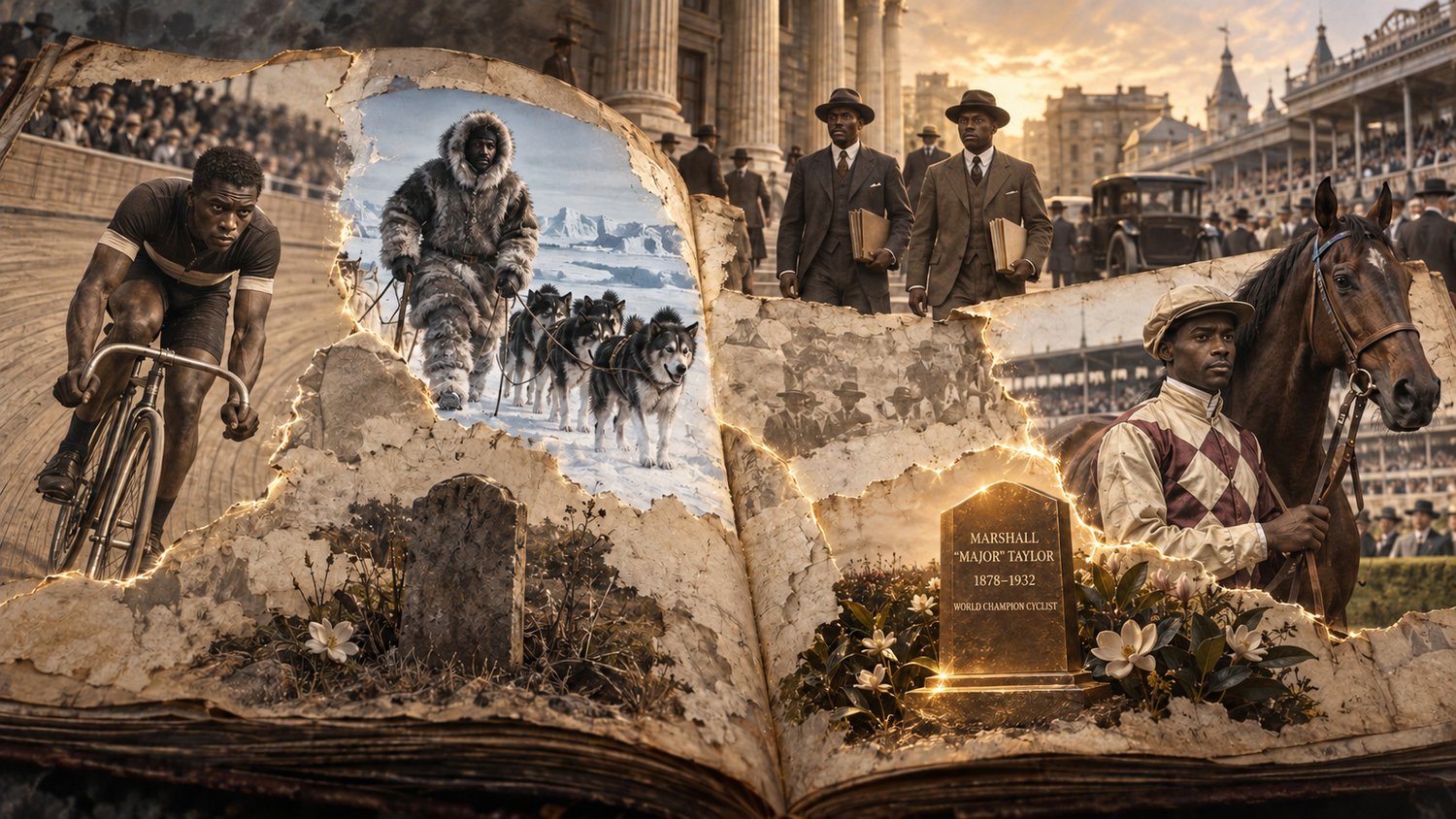
In 1948, a group of Black cyclists in Chicago paid to move a body.
The man in the grave had been the fastest human being on earth. In 1899, he was world sprint champion. He held seven world records before he turned twenty-two. He raced in Paris, Melbourne, and Sydney, and crowds who had never seen a Black American in their lives turned out to watch him run. His name was Marshall Taylor, and everyone called him Major.
He died in 1932 in the charity ward of a Chicago hospital and was buried in an unmarked pauper's grave. Sixteen years later, some men who remembered raised the money, moved him to a proper plot, and set a bronze marker over him.
I have been writing about people like Major Taylor for a long time now, and I have come to think of that sixteen-year gap as the real subject. Not the winning. The gap between what a person did and what the record agreed to keep.
What the record keeps
History is not a camera. It is a set of decisions, made by people, about what is worth writing down and who is worth writing down about. Those decisions have a pattern, and the pattern is not subtle once you start looking for it.
Matthew Henson stood at the North Pole in April 1909. By most accounts, he got there first — he was ahead of the sleds, breaking trail, and Peary was being hauled. He had spent twenty-two years on the ice. He spoke Inuktitut. He could build a sled, drive a dog team, and read the sea ice in a way that no white member of any of those expeditions could.
When they came home, Peary got the medals, the lecture tours, and the argument with Cook over who deserved the credit. Henson got a job as a messenger in a New York customs house. He held it for almost thirty years. He was seventy-one before the Explorers Club admitted him, eighty-one before a president shook his hand.
I wrote five novels about him, and I titled them by latitude, because the latitudes tell the story without my help. The Runaway and the Sea is 38°27′ North, a Maryland field. Brother to the Ice is 77°41′. Eighty-Seven North is 87°06′, the closest anyone had come and not close enough. Ninety North is 90°00′, the top of the world. And then True North is 40°49′ North — Harlem — which is lower than the one before it.
He went as far north as the earth allows and came home two degrees above where he began.
The ones who are not in the textbook at all
Jimmy Winkfield won the Kentucky Derby in 1901 and again in 1902. More than a century later, nobody has matched that back-to-back run. Within two years, American racing had closed its saddles to Black jockeys, and he left the country at twenty-three and never rode in America again.
What happened next is the part that sounds invented. He became champion of Russia. They called him the Black Maestro in Moscow and Warsaw. When the revolution came, he drove two hundred thoroughbreds eleven hundred miles across the steppe to get them out. He built a training yard outside Paris. The Germans occupied it in 1940.
In 1961, Sports Illustrated invited him to a banquet in Louisville, sixty years after his first Derby. He was eighty years old. He flew in from France.
What happened at the door of that banquet is the reason I wrote three books instead of one.
Durham, 1933
The story I keep coming back to, though, has no victory in it.
In 1933, a young Black man named Thomas Hocutt applied to the University of North Carolina's School of Pharmacy. They refused him because of his race. Two Black lawyers in Durham — Conrad Pearson and Cecil McCoy — took the case. Hocutt v. Wilson was the first direct legal challenge to segregation in higher education anywhere in the American South.
They lost. They lost on a technicality that still makes me put the book down: the president of the Black college Hocutt had attended would not certify his transcript. A Black man closed that door, under pressure from white men who controlled his funding, and the case died there.
Twenty-one years later, the argument Pearson and McCoy built helped win Brown v. Board of Education. Thurgood Marshall knew their names. Charles Hamilton Houston knew their names.
Almost nobody else does.
That is the thing I want to sit with. Not the injustice — that is obvious, and it is not interesting to simply point at it. What interests me is the arithmetic. Every famous victory in civil rights law sits on top of a stack of lost cases, and the people who lost them did the same work, took the same risks, and lost their practices, their health, and sometimes their lives. The record keeps the top of the stack.
Why fiction
People ask why I write novels about this instead of history, and the answer is that history is very good at the outside of a life and almost useless on the inside.
The record can tell you that Major Taylor refused to race on Sundays and that it cost him titles. It cannot tell you what it was like to be the best in the world at something and to spend every week deciding again that the Sabbath mattered more than the win. The record can tell you Henson worked in a customs house for thirty years. It cannot tell you what a man thinks about, sorting mail, having stood on the top of the world.
So I stay close to the documented record for everything it can hold — the dates, the places, the outcomes, who was in the room — and then I go inside, where the record cannot follow. Every one of my novels has a note at the front telling you exactly where that line falls. I think readers deserve to know which part is evidence and which part is me.
Where to start
If you want a sense of what I do before you spend anything, three of my books are free. The Wrong Direction is a prequel story about the Bonus Army in Washington in 1932, and the eviction of twenty thousand veterans who came to ask for pay they had been promised. Kintsugi: The Eight Months is set in Tokyo, eight months before everything breaks. And there is a thirty-question sampler of One Question Deeper, which is the other half of what I write — short practical books about having better conversations with people you actually know.
Take one. They cost nothing, and they'll quickly tell you whether the rest is for you.
The men in this post are not obscure because they were minor. They are obscure because obscurity was arranged. The least I can do is write them down. Please read the article and use DALL.E to create an image to publish with it.
Comments ()