
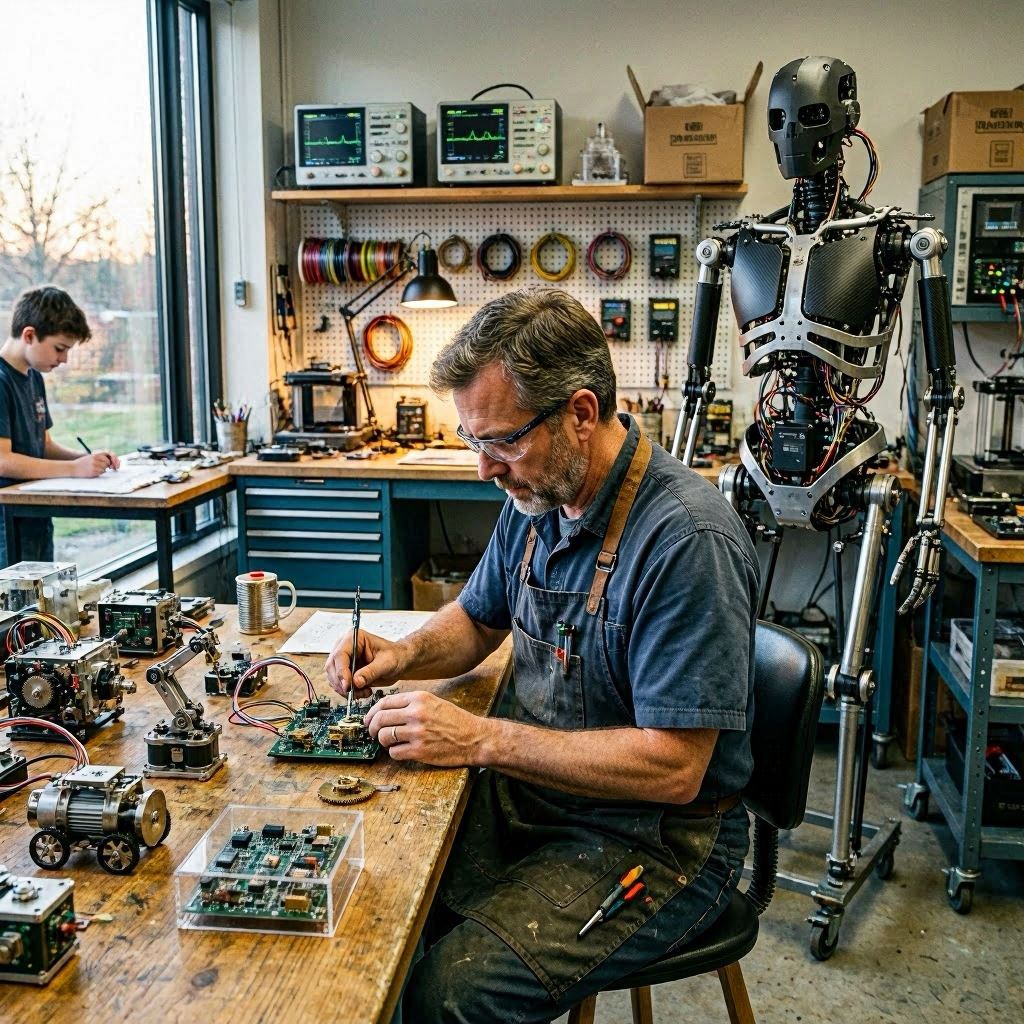
They usually start with a random question.
A child asks why a sensor reacts to movement. Someone wonders how automatic systems know when a person enters a room. Another person gets curious after seeing a movie scene with beams of light protecting a secret vault. It sounds funny, maybe even a little dramatic, but curiosity works in strange ways. Tiny questions often open surprisingly large doors.
And honestly, that’s how learning has always worked.
People rarely wake up excited to laser security alarm memorize theories or definitions. They become interested when something captures their attention first. A moving machine. A blinking light. A project that feels almost like magic. Once curiosity gets involved, learning tends to follow naturally.
That’s probably why hands-on projects continue to hold such a strong place in education and creative learning spaces. People remember experiences much longer than instructions.
Maybe because experience asks us to participate.
Technology feels less intimidating when people can touch it.
For many students, electronics and science can seem complicated at first glance. Wires everywhere. Small parts. Technical terms that sound far more difficult than they actually are.
It creates distance.
The subject starts feeling like something meant for experts rather than beginners.
But once students physically interact with projects, something changes. The mystery starts fading. Concepts become visible. Learning stops feeling locked behind complicated language.
You see it happen all the time.
Someone begins building a simple circuit. They connect components, experiment a little, make mistakes, and gradually understand what’s happening. The process isn’t perfectly smooth, but maybe that's the point.
Learning rarely arrives neatly packaged.
Sometimes understanding shows up through trial and error.
Sometimes through confusion.
Sometimes after asking, “Wait...why didn’t that work?”
Oddly enough, those moments often teach the most.
Hands-on experiments create stronger memories than passive learning.
Most adults don’t remember every lesson from school. The details tend to blur over time.
Yet people somehow remember the projects.
The cardboard models.
The experiments that nearly failed.
The moments when something finally worked after multiple attempts.
There’s a reason for that.
Hands-on activities activate curiosity differently. Instead of simply receiving information, students become part of the process. They create, test, adjust, and observe.
That involvement matters.
Educational projects involving a laser security alarm often capture attention because they combine technology with problem-solving in a way that feels interactive and exciting. There’s a certain thrill in watching a project respond when a beam gets interrupted. Suddenly science isn’t sitting quietly inside a textbook anymore.
Now it reacts.
Now it surprises people.
And surprise has a funny way of making lessons stick.
Mistakes quietly become part of the education.
Nobody likes getting things wrong. At least not at first.
Projects can be frustrating sometimes. Components don’t align. Connections fail. Instructions somehow make perfect sense until the moment assembly actually begins.
Then chaos enters the room.
A project that looked simple suddenly feels confusing.
People sigh.
Start over.
Try again.
Yet hidden inside those frustrating moments is something important.
Problem-solving.
Real-world learning rarely involves perfect first attempts. Engineers redesign ideas constantly. Creators revise their work. Inventors test failures long before discovering success.
Hands-on learning introduces that reality early.
Not through lectures.
Through experience.
Students learn patience without realizing they’re learning patience.
And honestly, that’s a useful skill almost everywhere.
The excitement of discovery still matters.
Technology today moves fast. Maybe too fast sometimes.
Children grow up surrounded by smart devices, screens, and automated systems. Information appears instantly. Answers arrive in seconds.
But there’s a difference between accessing information and discovering something firsthand.
Discovery feels personal.
There’s excitement involved.
Students exploring projects built around a laser light security system often become interested not only because the concept feels futuristic, but because it creates a visible connection between science principles and real-world applications. Instead of abstract explanations, they see cause and effect happening right in front of them.
That experience creates understanding in a completely different way.
You’re not simply reading.
You’re participating.
That changes things.
Quite a bit, actually.
Curiosity tends to grow once people realize they can build things themselves.
One project often leads to another.
That’s the interesting part.
A student builds a simple experiment and suddenly starts asking new questions. How do sensors work? Can movement trigger other reactions? What if more features get added?
Questions multiply quickly.
And that’s a good sign.
Because curiosity creates momentum.
People become less focused on completing assignments and more interested in exploration itself. Learning becomes something they choose rather than something they’re told to do.
There’s a big difference there.
One feels like obligation.
The other feels like adventure.
Sometimes small projects quietly shape bigger futures.
Not every student building science projects becomes an engineer.
Not every child experimenting with electronics enters the world of technology later in life.
And that’s perfectly fine.
The value goes beyond careers.
Hands-on experiences teach laser light security system creativity, patience, resilience, and critical thinking. They encourage experimentation. They create confidence through action rather than memorization.
Years later, people often remember the moments when curiosity first showed up.
A project on a desk.
A blinking light.
An experiment finally working after several failed attempts.
Nothing extraordinary at the time.
Just learning.
Just curiosity doing its thing.
Yet sometimes those small moments quietly become the beginning of something much larger than anyone expected.