
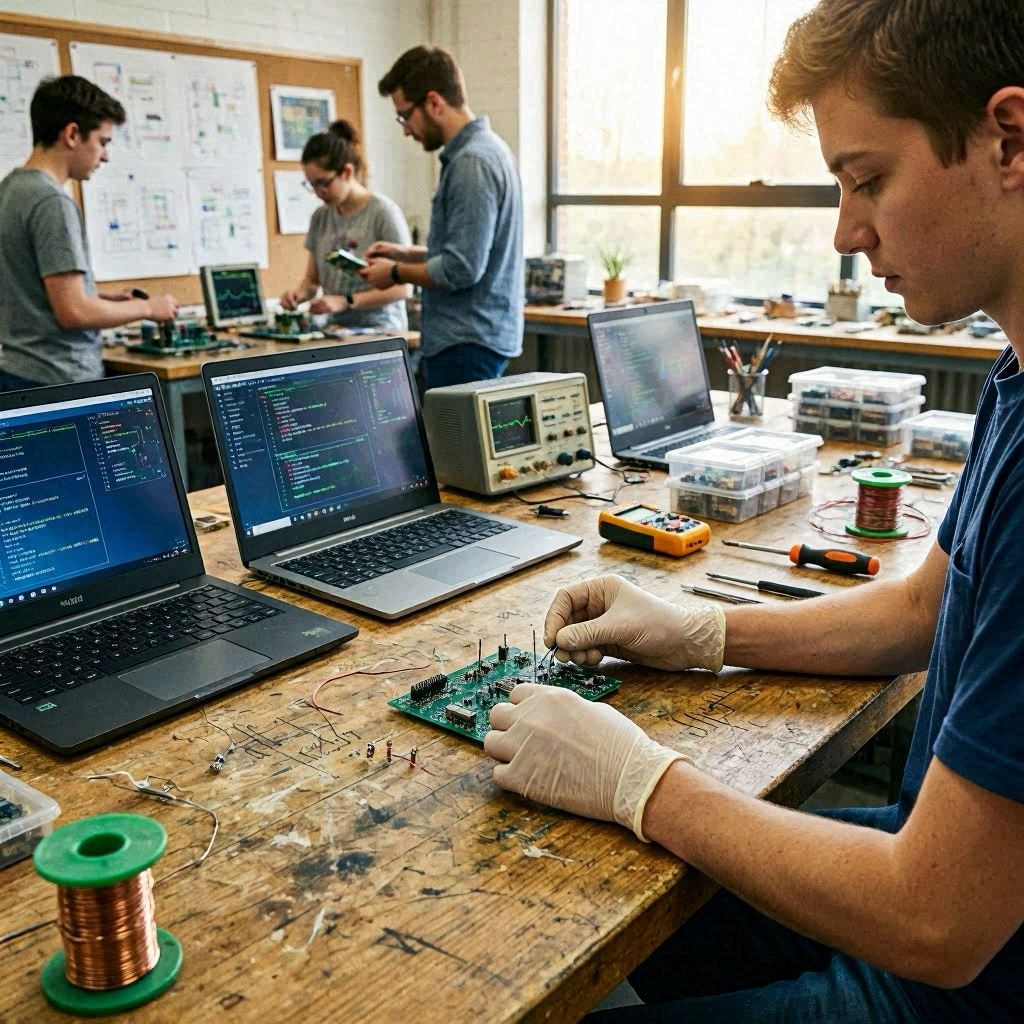
There’s a moment that happens during almost every hands-on project. At first, everything feels organized. Components are arranged neatly, instructions seem clear, and confidence is surprisingly high. You look at all the pieces spread across a table and think, "This should be easy."
Then reality shows up.
Something doesn’t fit. A connection goes wrong. The project that looked simple five minutes ago suddenly feels like a puzzle written in another language.
And yet, people keep going.
That’s probably because curiosity has a strange science kit electric way of pulling us forward. Once we become interested in figuring something out, stopping becomes difficult. We want answers. We want movement. We want to see whether the thing in our heads can become real.
Funny enough, that's where learning often begins.
Not with perfection.
With curiosity.
Hands-on experiences create a different relationship with knowledge.
Reading about science can absolutely teach valuable things. Watching educational videos helps too. There’s more information available now than ever before, and that’s a good thing.
Still, there’s a noticeable difference between watching and doing.
Imagine reading twenty pages about riding a bicycle. You could memorize every step perfectly. Balance, movement, coordination—all explained clearly.
But eventually, someone has to sit on the bicycle.
That first attempt usually gets a little wobbly.
Learning through projects works the same way.
People understand concepts differently once they physically build something. They stop observing from a distance and become part of the process itself.
That shift changes everything.
Because participation creates ownership.
And ownership creates stronger learning.
Small components often open surprisingly big doors.
Robotics and beginner electronics projects might look simple at first glance. Tiny wheels. Wires. Small motors. Plastic parts spread across tables.
Nothing dramatic.
Yet hidden inside those projects are lessons much larger than the pieces themselves.
Students exploring mechanical movement often encounter a dc gear motor because it creates practical opportunities to understand how speed, torque, and motion work together. At first it seems like just another component, but eventually students realize it's helping them understand broader ideas about engineering and design.
That’s the interesting part.
One small object quietly becomes a teacher.
Not through explanation.
Through interaction.
People remember experiences they participate in.
That pattern shows up again and again.
Projects rarely work perfectly, and honestly, that's probably helpful.
Nobody enjoys project failures in the moment.
Connections get mixed up. Batteries die unexpectedly. Instructions somehow stop making sense halfway through.
For a while, frustration takes over.
Then people begin experimenting.
Troubleshooting.
Testing ideas.
Trying again.
Without realizing it, something important starts happening.
Problem-solving develops naturally.
Patience grows quietly.
Confidence slowly begins showing up too.
Not confidence based on immediate success.
The stronger kind.
The kind built around figuring things out after things go wrong.
Life outside classrooms works a lot like that too.
Very few important things come together perfectly the first time.
Projects simply introduce that lesson early.
Technology becomes more interesting once people understand what happens underneath.
Modern devices feel effortless because most systems operate quietly in the background. Doors open automatically. Sensors react instantly. Machines respond without explanation.
Most people accept technology and move on.
Curious learners tend to ask different questions.
How does it know?
What triggered that?
Why did it react?
That curiosity often creates the best learning opportunities.
Projects involving a laser alarm system frequently capture attention because they create visible reactions that students can immediately understand. Interrupt the beam and something happens. The relationship between action and response becomes clear in real time.
And there’s excitement hidden in that moment.
Because suddenly science stops feeling distant.
Now it’s happening right in front of you.
That experience matters.
People remember moments that surprise them.
The process often becomes more valuable than the result itself.
People naturally focus on outcomes.
Finished projects.
Completed experiments.
Successful builds.
But real learning usually happens somewhere in the middle.
During uncertainty.
During mistakes.
During those moments where people quietly stare at scattered parts wondering what exactly went wrong.
Growth rarely announces itself while it’s happening.
It usually feels ordinary.
One adjustment.
One attempt.
One tiny improvement at a time.
Then eventually, looking back, people realize how much changed.
Funny how that works.
Curiosity creates momentum once people realize they can build things themselves.
One successful project rarely stays alone.
Questions start multiplying.
Could movement improve?
Could different parts create better results?
What happens if something changes?
Learning becomes laser light security system less about finishing assignments and more about exploration.
That shift changes the entire experience.
Because curiosity asks people to keep going.
To experiment.
To discover.
And discovery has a habit of sticking around.
Years later, people often remember these moments.
Not because projects were perfect.
Not because every attempt succeeded.
They remember the excitement.
The frustration.
The satisfaction of finally making something work.
Because sometimes learning doesn’t arrive through carefully planned lessons.
Sometimes it starts with scattered components, a little uncertainty, and the simple decision to try one more time.