

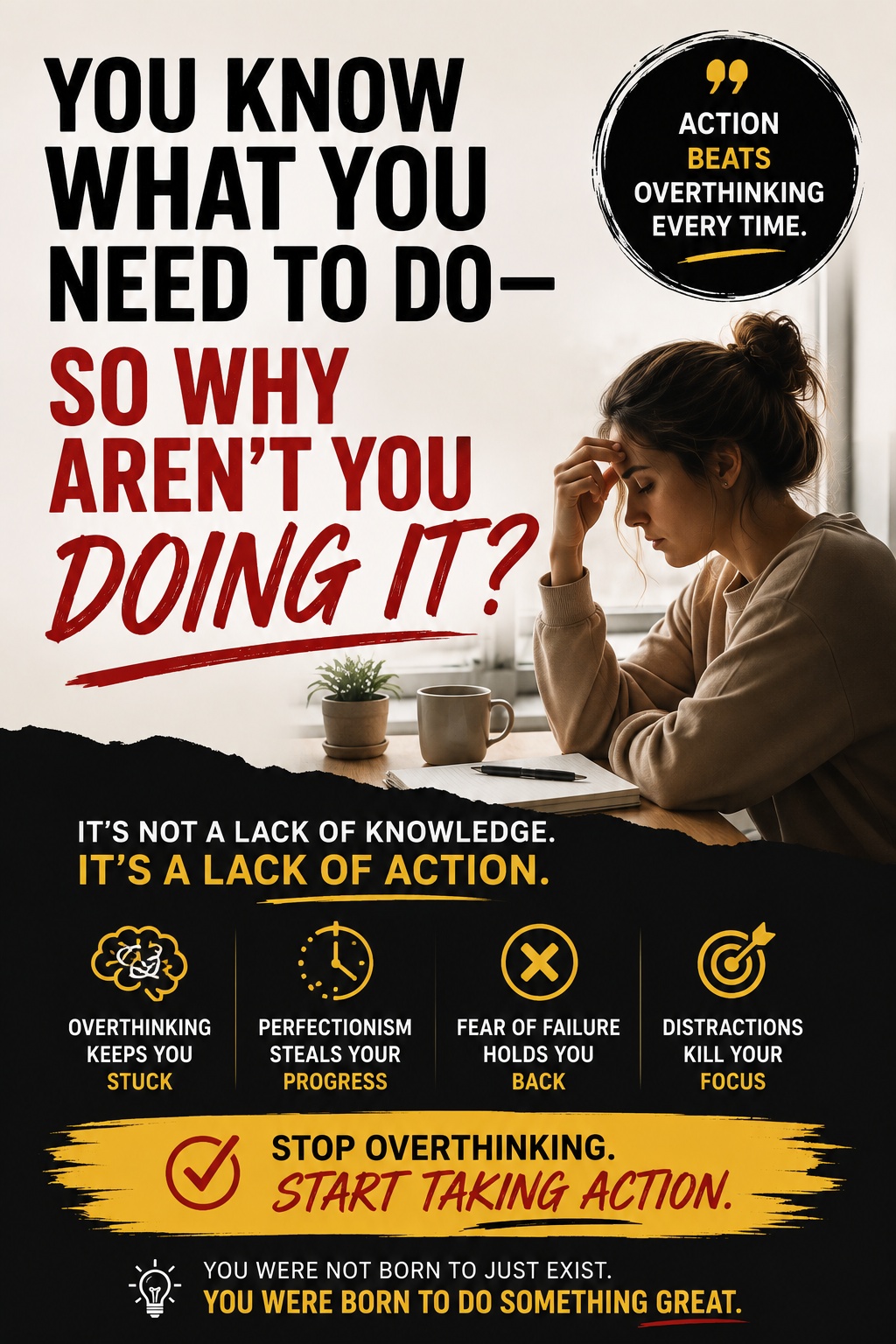
You know you need to stop procrastinating. You know you should be more consistent. You know there are goals you keep putting off, habits you need to change, and things you promised yourself you would finally finish.
But somehow, another day passes.
Then another week.
And sometimes another year.
The frustrating part isn't that you don't know what to do.
It's that you can't seem to make yourself do it consistently.
If that sounds familiar, the problem may not be a lack of motivation.
It may be a lack of self-discipline.
Knowing What to Do Isn't the Same as Doing It
We have more information available to us than ever before.
Want to start a business? There are thousands of videos showing you how.
Want to get organized? There are apps, planners, books, and productivity systems everywhere.
Want to exercise? You can find a workout in seconds.
Want to stop procrastinating? You can probably name five things you should change right now.
So information isn't always the problem.
Execution is.
There's a huge gap between knowing what could improve your life and actually doing those things consistently.
That gap is where many goals disappear.
You keep learning.
You keep planning.
You keep promising yourself that you'll start soon.
But eventually, you have to stop preparing to change and start changing.
Stop Waiting for Motivation
If you keep starting strong and falling off when the excitement disappears, The Silent Power of Self-Discipline: Motivation Is for Amateurs, Discipline Is for Pros can help you understand why discipline not motivation is what keeps you moving toward your goals.
Start building the discipline to follow through, even on the days you don't feel like it.
You're Waiting Until You Feel Motivated
This is one of the biggest traps.
You tell yourself:
"I'll start Monday."
"I'll do it when I have more energy."
"I'll start when things calm down."
"Tomorrow I'll be more motivated."
But tomorrow comes and you still don't feel like doing it.
That's because motivation is an emotion.
And emotions change.
You might wake up Monday feeling unstoppable and wake up Tuesday wanting nothing to do with the goal you were excited about 24 hours earlier.
If your progress depends on being motivated, your progress will always be vulnerable to how you feel.
Discipline changes the question.
Instead of asking:
"Do I feel like doing this today?"
You begin asking:
"What did I commit to doing today?"
That's a completely different mindset.
Procrastination Isn't Always Laziness
Sometimes procrastination looks surprisingly productive.
You research.
You watch another video.
You create another plan.
You buy another planner.
You reorganize your workspace.
You make another list.
You tell yourself you're preparing.
But preparation can become procrastination when you're constantly getting ready to do something instead of actually doing it.
At some point, you have to stop preparing to start.
You have to start.
Your Goal Might Be Too Big
Sometimes you're not avoiding the work because you're lazy.
You're avoiding it because the goal feels overwhelming.
Think about statements like:
"I need to build my business."
"I need to write my book."
"I need to completely change my life."
Those aren't really tasks.
They're enormous outcomes.
Your brain sees everything that needs to happen and doesn't know where to begin.
So make the goal smaller.
Instead of:
"I need to write my book."
Try:
"I'm going to write for 20 minutes today."
Instead of:
"I need to build my business."
Try:
"I'm going to complete one task today that could bring me closer to a customer."
Instead of:
"I need to get my life together."
Ask:
"What's one thing I can finish today that will make tomorrow better?"
Small actions reduce resistance.
And small actions repeated consistently create something extremely powerful:
Momentum.
Stop Negotiating With Yourself
You decide you're going to do something.
Then the negotiations begin.
"I'm tired."
"I'll do it tomorrow."
"Skipping today won't hurt."
"I'll start next week."
"I deserve a break."
Sometimes you really do need rest.
But there's a difference between intentionally resting and repeatedly talking yourself out of doing what you already decided was important.
Every time you make a commitment to yourself and immediately negotiate your way out of it, following through becomes harder.
Try something different.
Make the decision once.
If you've decided you're going to spend 30 minutes working on your goal tonight, don't reopen the debate when the time arrives.
The decision has already been made.
Now execute.
Build the Habit of Following Through
Knowing what to do isn't enough. The real transformation happens when you become someone who can consistently do what needs to be done—even when it's inconvenient, boring, or difficult.
The Silent Power of Self-Discipline explores how to move beyond temporary motivation and develop the consistency, focus, and follow-through needed to make real progress.
If you're tired of making promises to yourself that you don't keep, this is where you start changing the pattern.
Make the First Step Almost Too Easy
One mistake people make when trying to become more disciplined is attempting to change everything overnight.
New morning routine.
New diet.
New workout.
New business schedule.
No social media.
Wake up at 5:00 a.m.
Read every day.
Journal every night.
By Wednesday, they're exhausted.
Instead, lower the barrier.
Want to exercise consistently? Start with 10 minutes.
Want to write? Write one page.
Want to grow your business? Complete one meaningful business-building task every day.
Want to wake up earlier? Start 15 minutes earlier instead of trying to completely redesign your morning overnight.
Your first objective isn't perfection.
It's consistency.
Try the 10-Minute Rule
The next time you're procrastinating on something you know you need to do, try this:
Give yourself 10 minutes.
Tell yourself you don't have to finish the entire task.
You only have to work on it for 10 minutes.
Open the document.
Make the phone call.
Work on the business.
Clean the room.
Start the assignment.
Take the walk.
Do the first 10 minutes.
Why?
Because sometimes the biggest obstacle isn't doing the work.
It's starting the work.
Once you've started, continuing often becomes much easier.
Keep Small Promises to Yourself
Self-discipline doesn't have to begin with some dramatic transformation.
It can begin with one promise.
And then keeping it.
You said you'd walk for 15 minutes? Do it.
You said you'd work on your business tonight? Do it.
You said you'd stop scrolling and work on your goal at 7:00? Put the phone down.
Every time you follow through, you're creating evidence.
Evidence that says:
"I can trust myself."
"I finish what I start."
"I don't need to feel motivated before I take action."
That's when discipline starts becoming part of your identity rather than something you're constantly trying to force.
Motivation Gets You Excited. Discipline Gets You Results.
Motivation isn't useless.
It can help you begin.
It can remind you what's possible.
It can give you the energy to take that first step.
But eventually the excitement fades.
The goal becomes work.
Progress slows down.
Nobody is applauding.
Results don't happen as quickly as you expected.
And that's where the difference is made.
Because successful people aren't necessarily motivated every day.
They've simply learned how to keep moving when motivation isn't there.
Motivation says: "I'll do it when I feel ready."
Discipline says: "I'm doing it because I said I would."
Ask Yourself This Question Today
Forget about everything you're supposed to accomplish this month.
Forget about the giant list of things you want to change.
Ask yourself one question:
What do I already know I need to do but keep avoiding?
Don't overthink it.
You probably already know the answer.
Now ask:
What's the smallest action I can take today?
Then do it.
Not Monday.
Not next month.
Not when life becomes less busy.
Today.
Your next breakthrough may not require another strategy, motivational video, productivity hack, or complicated plan.
You might already know enough.
The question is whether you're willing to act on what you know.
Motivation Is for Amateurs. Discipline Is for Pros.
If you're tired of starting over, procrastinating on goals that matter, or waiting until you "feel motivated," it's time to build something stronger than motivation.
The Silent Power of Self-Discipline: Motivation Is for Amateurs, Discipline Is for Pros
is designed for people who are ready to develop greater focus, consistency, mental toughness, and follow-through.
Don't just learn what you should be doing.
Become disciplined enough to actually do it.
Your goals don't need another promise.
They need action.
Start reading The Silent Power of Self-Discipline and begin building the discipline to get it done.