
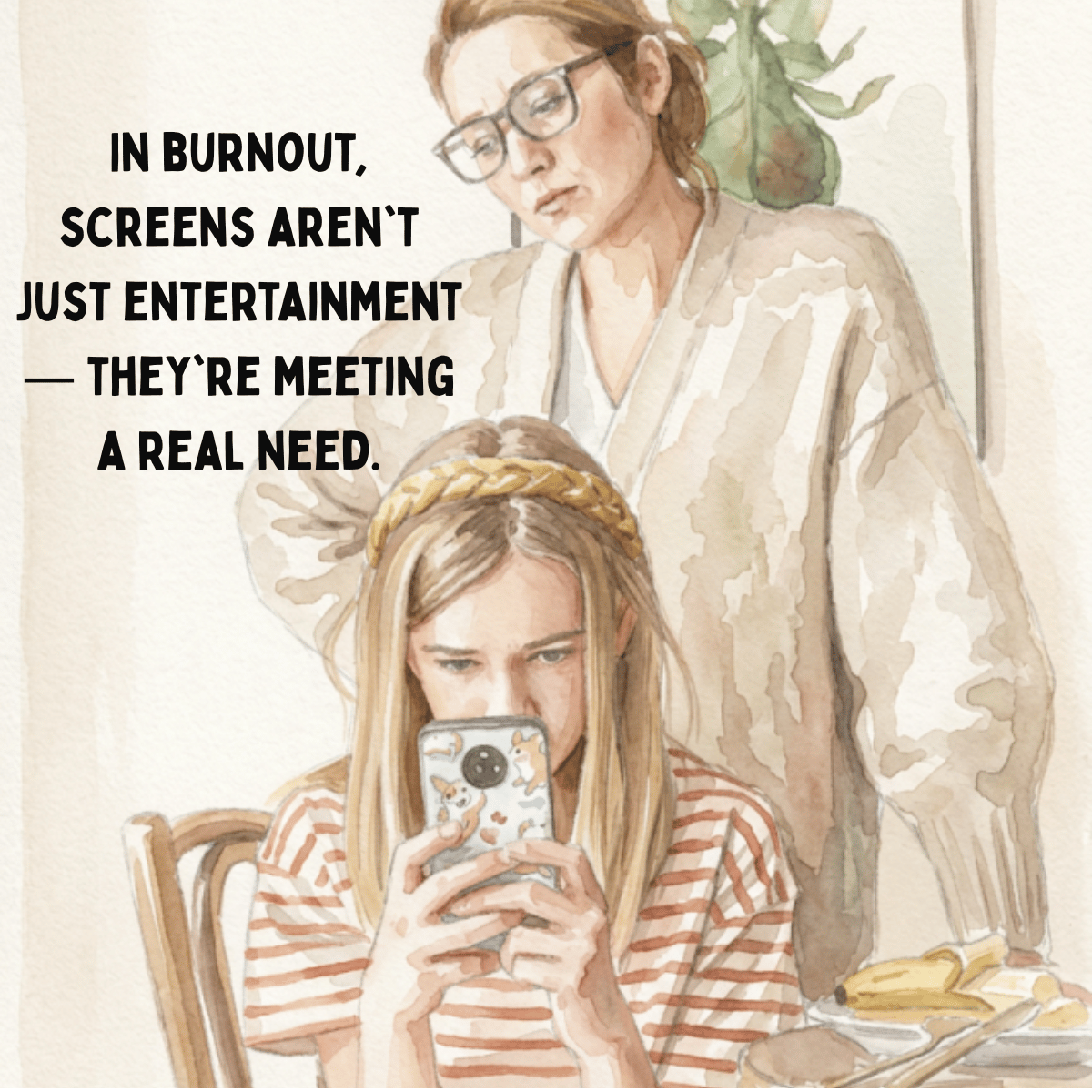
If you're the parent of an autistic, ADHD, or PDA child who is deep in burnout, there's a good chance screens have taken over. Hours of gaming. Endless scrolling. A bedroom door that barely opens. And somewhere underneath the worry, a quiet voice telling you this is your fault for "letting it get this bad."
It isn't. And more screen rules almost never fix it.
This post looks at what's actually happening in neurodivergent burnout, why screens so often become the default during it, and what genuinely helps — without turning your home into a battleground over minutes and hours.
What Neurodivergent Burnout Actually Looks Like
Neurodivergent burnout is a state of physical and emotional depletion that builds up after sustained masking, sensory overload, or unmet needs — often after weeks or months of a child holding it together somewhere else, usually school.
It commonly shows up as:
- Withdrawal from activities they used to enjoy
- Increased meltdowns or shutdowns, especially after school
- Difficulty with basic tasks that used to feel manageable
- Sleep disruption
- A sharp drop in tolerance for demands of any kind
- Retreat into one narrow, predictable activity — very often a screen
For children experiencing Emotionally Based School Avoidance (EBSA), burnout and screen retreat frequently arrive together. School has become too demanding to sustain, and the screen becomes one of the only places left that doesn't ask anything of them.
Why Screens Become the Default During Burnout
It's tempting to see heavy screen use as the problem itself. In behaviour-analytic terms, though, screen use is a behaviour maintained by reinforcement — which means the real question isn't "how do we stop this," it's "what is this actually doing for my child right now?"
During burnout, screens are rarely just entertainment. They're usually meeting one or more genuine needs:
- Escape from demands that currently feel impossible
- Connection, through multiplayer games, chat, or shared online spaces
- A sense of control, in a life that otherwise feels unpredictable
- Competence, in a space where they're not failing or being corrected
- Calm, through low-effort, highly predictable input
None of these are trivial. All of them are things a burnt-out nervous system is actively trying to get. When we remove the screen without replacing what it was providing, we don't get more resilience — we usually get more distress, because the one reliable coping tool has just been taken away.
Why "Just Cut the Screen Time" Backfires
Most standard advice on screen time assumes a child has a full toolkit of other ways to relax, connect, and feel competent — and is simply choosing screens over those options.
In burnout, that toolkit is often empty. The screen isn't competing with other options; it's the only option left. Removing access at that point tends to produce one of two outcomes:
- Escalation. The demand to stop becomes just another demand, on top of a nervous system that's already over capacity.
- A narrower, more rigid retreat. The child holds onto the screen even harder, because losing it now feels like losing their only source of regulation.
This is why so many parents describe screen time battles that get worse, not better, the more rules are added. The rules aren't the problem — but they're solving for the wrong thing.
5 Strategies for Managing Screen Time During Burnout
These strategies won't get you to zero screen time overnight, and that's the point. The goal in burnout isn't less screen time — it's understanding what it's doing, and gently widening what else is available.
1. Ask what it's giving them, not how long they've had it
Before changing anything, get curious. Is it calm? Connection? A sense of achievement in a game where the rules are fair and consistent? Escape from a hard afternoon? The answer changes what actually helps — and it usually isn't a stopwatch.
2. Protect it as recovery, not as a problem to solve
If your child is genuinely in burnout, screen time right now may be doing real recovery work. Reducing access at this stage can remove their only low-demand space. The more useful move is often to protect it — and add small, no-pressure moments of connection alongside it, rather than instead of it.
3. Change the language, not just the limit
How a boundary is communicated matters as much as the boundary itself. Compare:
"You've been on that too long. Turn it off now."
with:
"Shall we pause at the next checkpoint, or in five minutes?"
The second version keeps the same underlying limit, but offers a small amount of control back — which is often what reduces the fight, not the length of the conversation.
4. Build one small alternative, rather than removing the main one
Instead of trying to replace the screen, aim to sit alongside it. A five-minute walk with no talking required. A shared snack with no expectation of conversation. Ten minutes of a genuinely funny show together. The aim isn't competition with the screen — it's slowly building a second option, so the screen isn't the only place your child can feel calm, connected, or capable.
5. Watch for patterns, not the clock
Hours logged tell you very little. What tends to tell you more: what happens before screen time, what happens when it's time to stop, and whether things are trending toward more connection or more isolation over several weeks. Noticing patterns — without immediately acting on them — is often the most useful thing a parent can do in the early stages of recovery.
How Do You Know If It's Recovery, or Something Else?
This is usually the hardest part for parents to judge from the inside of a hard week. Is the screen sheltering your child through something they genuinely need to recover from? Is it doing double duty — some recovery, some avoidance? Or has it become the only doorway left to feeling okay at all?
Each of those situations calls for a different response — and getting it right matters, because moving too fast in the wrong direction can trigger the very escalation you're trying to avoid.
This is exactly the gap The Screen Recovery Compass was built to close. It's a short, guided reflection tool — not a lecture — that asks a few honest questions about what you're seeing, and gives you a personalised reading of what's likely happening for your child right now, along with one language shift and one small, doable step to try this week. No hour-counting, no guilt, no one-size-fits-all rule.
You're Not Failing — You're Missing Information
If screen time has taken over your house right now, it doesn't mean you've done something wrong. It usually means your child found the one thing that still works, in a period where very little else does. The goal isn't perfect screen use. It's understanding what your child needs today, while gently making room for tomorrow.
Comments ()