

When a behaviour plan isn't enough
DNA-V gives behaviour analysts a structured, function-compatible way to teach psychological flexibility: the skills a young person needs to notice difficult thoughts and feelings and still act on what matters.
You've probably met this young person. The functional assessment is solid. Escape from demands maintains the avoidance, the plan is in place, and attendance is creeping up. But every morning their inner voice still says you'll get it wrong, everyone will stare, you can't cope. When that voice gets loud, the plan wobbles.
Traditional behaviour reduction targets what we can see. Many of the young people we support, particularly those with anxiety, trauma histories or PDA profiles, also need help with what happens inside. That is where contemporary ABA and DNA-V meet.
Traditional and contemporary ABA: what has changed?
Contemporary ABA keeps the science of traditional ABA and changes how, and with whom, it is applied. The term is widely used alongside related labels such as compassionate care, assent-based practice and progressive ABA.
Traditional ABA gave us the foundations we still rely on: functional assessment, reinforcement-based teaching, measurement and single-case evaluation. Its founding dimensions, set out by Baer, Wolf and Risley in 1968, have not changed.
What has shifted is the emphasis. Breaux and Smith (2023) describe contemporary applications of ABA as individualised, empowering, focused on maximising choice, and minimising aversive procedures. Recent work has pushed the field further:
- Assent. Morris and colleagues (2024) argue that client involvement in decisions is central to behaviour analytic practice, with roots going back to Skinner and Wolf.
- Compassion. Abdel-Jalil and colleagues (2023) link compassion directly to consistently obtaining assent, including from learners with little or no spoken language.
- Trauma-informed care. Rajaraman and colleagues (2022) show how the core commitments of trauma-informed care can be built into ABA assessment and treatment.
- Private events. Behaviour analysts have long been encouraged to study emotion rather than leave it to other disciplines (Friman, Hayes & Wilson, 1998).
Traditional emphasis -> Contemporary emphasis
Goals: Reducing behaviour of concern -> Building skills and quality of life alongside reduction
Client role: Recipient of intervention -> Active participant whose assent is sought throughout
Private events: Largely set aside -> Analysed as behaviour, and taught through verbal and relational skills
Relationship: Instructional control -> Connection, safety and regulation first
Success: Compliance and reduced frequency -> Flexible, values-consistent behaviour that generalises
This is a shift in emphasis, not a rejection of traditional ABA. The science is the same. What has grown is our willingness to treat thoughts, feelings and values as behaviour worth teaching.
What is psychological flexibility, in behavioural terms?
Psychological flexibility is the ability to stay in contact with difficult thoughts and feelings while continuing to act in line with what matters. In behavioural terms, it is behaviour that stays sensitive to the current contingencies instead of being dominated by rigid verbal rules or by avoidance of private events.
It grows out of contextual behavioural science, which includes Acceptance and Commitment Therapy (ACT) and Relational Frame Theory (RFT). That makes it a close relative of our own discipline rather than a departure from it.
Consider a young person whose rule is "If I go into class, everyone will laugh at me." That rule, not the classroom itself, may be doing much of the work. Avoidance is negatively reinforced (the frightening feeling goes away when they avoid), so the rule is never tested against what actually happens. Psychological flexibility loosens that pattern. The young person learns to notice the rule as a thought, feel the fear, and still take a small step towards something they care about.
What is DNA-V?
DNA-V is a youth-focused model of psychological flexibility developed by Dr Louise Hayes and Dr Joseph Ciarrochi. It breaks flexibility into four skills that young people can learn, practise and name. For behaviour analysts, each skill maps onto processes we already know how to teach and measure.
DNA-V skill in behavioural terms
Discoverer: Behaviour shaped by direct contingencies; trial-and-error learning
Noticer: Discriminating and tacting private events, including interoceptive cues
Adviser: Verbal, rule-governed behaviour arising from derived relational responding
Values: Verbally constructed motivating operations that strengthen approach behaviour
The model also includes self-view and social view: how young people see themselves and relate to others.
The shared language is one of its biggest practical strengths. "Which part showed up?" gives young people, parents and school staff a simple, non-judgemental way to talk about difficult moments. It reframes behaviour as skills being learned, not flaws to fix.
Five principles for using DNA-V in behaviour analytic practice
DNA-V works best inside a behaviour analytic framework, not as a stand-alone activity. These five principles keep it grounded.
- Start from function. Choose DNA-V targets based on your functional assessment. If avoidance is maintained by negative reinforcement, Noticer and grounding skills build the pause, and Values work helps establish reinforcers for approach. DNA-V sits alongside function-based intervention, never instead of it.
- Check prerequisite repertoires. Many DNA-V activities rely on tacting emotions and body sensations, if–then relations, perspective-taking and understanding metaphor. For young people with complex language needs, probe these first and teach any missing skills before introducing abstract sessions.
- Lower the verbal load. Teach one part at a time, use visuals throughout, and accept any response mode: drawing, pointing, voice notes or AAC. For literal thinkers, explain any metaphor or twist before you start.
- Write measurable goals. Turn each skill into an observable target. For example: "When asked what they notice in their body, the young person will describe one sensation and one feeling in 4 of 5 opportunities across 2 adults."
- Protect assent and regulation. Deliver sessions only when the young person is regulated, offer choices about activity and response mode, and treat withdrawal of assent as meaningful information rather than non-compliance. In a crisis, keep it to grounding only. Teaching happens later.
Bringing it into practice: DNA-V in Practice
If you'd like a ready-made starting point, DNA-V in Practice is a 162-page session-based resource pack written for BCBAs, UKBA(cert)s, BCaBAs and UKiBAs.
It includes:
- 24 ready-to-deliver sessions across Discoverer, Noticer, Adviser and Values, each with a script, activities, worksheets and home practice
- an introduction that explains DNA-V in behavioural terms, with plain-language explanations for multidisciplinary colleagues
- guidance on prerequisite repertoires and adapting for complex language needs
- a goal bank linked to every session
- a Quick Guide of in-the-moment prompts for parents and school staff
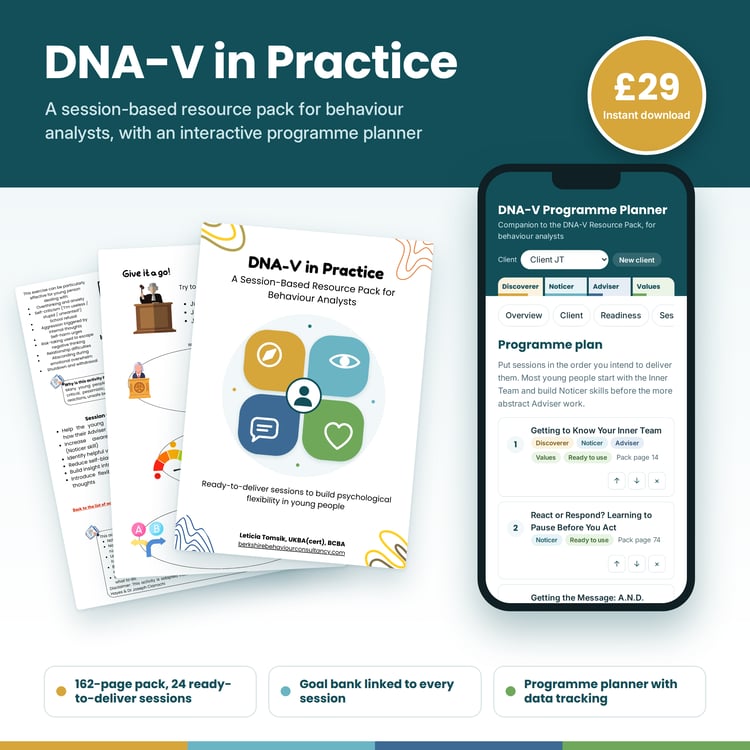
It also comes with the DNA-V Programme Planner, a browser-based companion tool. You can check a client's language readiness, build an ordered session plan, set mastery criteria and log session data. Assent withdrawals are recorded separately rather than counted as missed trials, and client data stays on your own device.
Explore DNA-V in Practice on Payhip
Frequently asked questions
Is DNA-V compatible with applied behaviour analysis? Yes. DNA-V comes from contextual behavioural science, which shares ABA's roots in behaviour analysis. Each DNA-V skill can be described in behavioural terms, taught systematically and measured.
What is the difference between traditional and contemporary ABA? Contemporary ABA uses the same science as traditional ABA but places more emphasis on assent, compassion, trauma-informed care, choice and skill-building alongside behaviour reduction.
Can DNA-V be used with young people who have complex language needs? Yes, with adaptation. Check prerequisite skills such as tacting emotions and perspective-taking first, then reduce the verbal load with visuals, concrete examples and flexible response modes.
Does DNA-V replace function-based intervention? No. DNA-V teaches skills that sit alongside a function-based plan. Your functional assessment should guide which DNA-V skills you target.
How do I measure progress with DNA-V? Write observable goals for each skill, such as independent tacts of body sensations or values-linked approach steps, and record them session by session like any other target.
References
Abdel-Jalil, A., Linnehan, A. M., Yeich, R., Hetzel, K., Amey, J., & Klick, S. (2023). Can there be compassion without assent? A nonlinear constructional approach. Behavior Analysis in Practice. https://doi.org/10.1007/s40617-023-00850-9
Baer, D. M., Wolf, M. M., & Risley, T. R. (1968). Some current dimensions of applied behavior analysis. Journal of Applied Behavior Analysis, 1(1), 91–97.
Breaux, C. A., & Smith, K. (2023). Assent in applied behaviour analysis and positive behaviour support: Ethical considerations and practical recommendations. International Journal of Developmental Disabilities, 69(1).
Ciarrochi, J. V., & Hayes, L. L. (2020). Your life, your way: Acceptance and commitment therapy skills to help teens manage emotions and build resilience. Instant Help Books/New Harbinger.
Friman, P. C., Hayes, S. C., & Wilson, K. G. (1998). Why behavior analysts should study emotion: The example of anxiety. Journal of Applied Behavior Analysis, 31(1), 137–156.
Hayes, L. L., & Ciarrochi, J. (2015). The thriving adolescent: Using acceptance and commitment therapy and positive psychology to help teens manage emotions, achieve goals, and build connection. Context Press/New Harbinger.
Morris, C., Oliveira, J. P., Perrin, J., Federico, C. A., & Martasian, P. J. (2024). Toward a further understanding of assent. Journal of Applied Behavior Analysis.
Rajaraman, A., Austin, J. L., Gover, H. C., Cammilleri, A. P., Donnelly, D. R., & Hanley, G. P. (2022). Toward trauma-informed applications of behavior analysis. Journal of Applied Behavior Analysis, 55(1), 40–61. https://doi.org/10.1002/jaba.881
DNA-V in Practice is an independent resource and is not affiliated with or endorsed by DNA-V International.
Comments ()